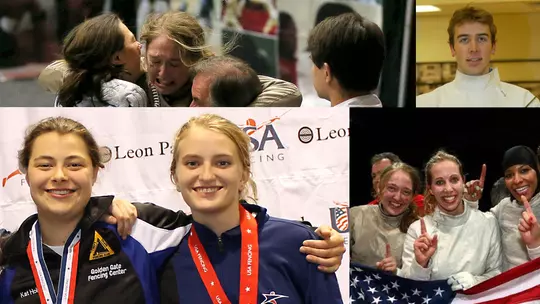
Hurry Home and Wait: Pandemic Puts Tiger Fencers' Olympic Dreams on Pause
6/17/2020
By the time one aims to become and remain an elite fencer, the need to globetrot to reach those aims has long been clear. So has the goal of competing in the Olympic Games.
Both of those, as the world knows, are on the shelf now, cast aside as so much has in a time of global pandemic.
As the summer of 2020 begins, the fencers’ pandemic stories have a beginning, and a for-now end goal of being in Tokyo in the summer of 2021, but between here and there is uncertainty, a regular companion on their journeys since mid-March.
Princeton has had a current or former fencer at each of the last two Games and three of the last four. Susannah Scanlan ’14 won bronze eight years ago in London with the U.S. women’s épée team.
The prospects for 2020 seemed bright to add more medals for those with Princeton ties, and certainly more Olympic appearances. At the time international competition ceased for the pandemic, Princeton had five current or former fencers ranked among the top 10 Americans in their weapon according to USA Fencing, plus Mohamed Hamza, who is ranked 30th in the world and second among Egyptians in foil according to the International Fencing Federation.
The path to Tokyo was almost complete when the pandemic began to grip Europe and the U.S. For those aiming for spots on the U.S. women’s épée team, a competition in Hungary had recently finished, and a trip to Uzbekistan for the final qualifier was next. That competition had already been moved from China due to the virus.
What followed was a fast-developing scramble to get back across the Atlantic ahead of travel restrictions and with next steps unknown.
Of the top six in the USA Fencing rankings in women’s épée, three are Princetonians, in third-ranked Katharine Holmes ’17, fourth-ranked Anna Van Brummen '17, and sixth-ranked Kasia Nixon, who completed her junior season 2019 before taking last year off from Princeton. All were NCAA finalists during their time with the program, with Van Brummen defeating Holmes for the NCAA title in 2017 and Nixon winning hers a year later.
Holmes and Van Brummen were both in Budapest, both balancing their plans outside of fencing with their aims for a spot in Tokyo.
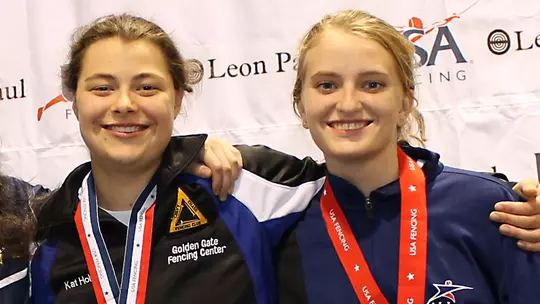
Van Brummen, a geosciences major at Princeton, had six months earlier completed her master’s degree at ETH Zurich, the Swiss Federal Institute of Technology, in geosciences and seismology. She had planned to stay in Switzerland until, hopefully, heading to Tokyo.
Holmes, a psychology major during her time at Princeton, was nearing the end of the process of applying to medical school, aiming to head back to the U.S. for an interview before going to Uzbekistan to compete.
The second week of March, however, had other plans.
Stateside, the dominoes fell quickly and fell hard that week. At the start, sports were full go. Before the end, the world of sports had all but stopped. Being overseas, for Holmes and Van Brummen, the announcement on Wednesday night of that week that travel to the U.S. from Europe was soon to be restricted was a source of confusion and of urgency to get home.
For Van Brummen, it meant a quick getaway from an apartment in Switzerland, and many of her belongings staying behind. For Holmes, who maintained a life in Princeton while working at the university’s neuroscience department, it meant a longer than expected stay in the Frankfurt airport after a flight delay on the other end due to passengers concerned about not being able to get back home once they landed in Europe.
Both, of course, made it home, and Holmes got her medical school acceptance to Mt. Sinai in New York.
As we all found out later in March, the Olympics have been pushed back a year, which, for Holmes, Van Brummen and all their fellow hopefuls, means a dream deferred, for now.
The preparation, while now over an elongated span of time, continues amid all the adjustments we’ve all had to make to life as we aim to protect ourselves and others from COVID-19.
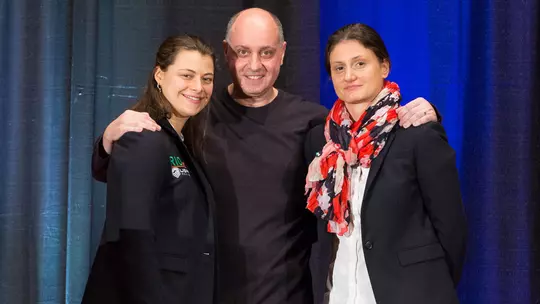
Home gyms have had to replace fencing clubs. Significant others are stand-ins for live coaches, who contribute as they can through video calls. Overall fitness training replaces some of the fencing-specific work.
“In terms of peak and training, it really changed everything,” Van Brummen, who has returned to her Houston-area family home, said. “(Other area fencers and I) just met on a track every morning and did a variety of workouts. We ran, we sprinted, we did footwork, we did general fitness. Actually, I would say we got in really good shape. I’m in some of the best shape that I’ve been in, so I’ve used this opportunity to work on my strength, work on my agility and just get fit.”
While it’s never a bad idea to get in shape, the Tokyo Olympic hopefuls are having to do so without a plan of when competitions prior to Tokyo will be, including the final step in ensuring spots on Team USA.
Holmes, who has worked as a volunteer assistant coach with Princeton fencers who have followed her, knows as much as anyone the demands of aiming to qualify for the Olympics while matriculating at Princeton. She began her Princeton career with the 2011-12 season and competed straight through to her junior year before taking two years off to prep for the Rio Games. That prep worked out, and Holmes competed in Rio in both the individual and team competitions. She was part of an American épée team that finished fifth after coming up one touch short in the quarterfinals to the eventual gold medalists from Romania.
Hamza and Nixon, as well as Maia Chamberlain and Chloe Fox-Gitomer, who were among the top 15 Americans in saber according to the USA Fencing rankings, all paused their Princeton careers ahead of 2020 qualification.
Now, 2020 becomes 2021.
“It’s very hard right now because we don’t even have a competition schedule to make a completely informed choice (on whether to try and balance school and Olympic prep in 2020-21),” Holmes said. “One thing that student-athletes do have going for them if they want to return is that we only will have one World Cup – sabres have two World Cups left, the way the schedule ended – and then one national tournament. I think it would still be very possible to qualify for the Games while in school, but preparing for the Games, all of that takes a very specific level of focus that, I think, would be very difficult to do while in school. I think particularly for people who are juniors who took time off who have a thesis to really focus on, that would be exceptionally difficult, but I think it can be done.”
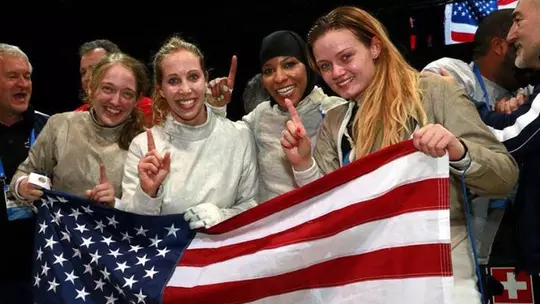
Eliza Stone ’13, an NCAA saber champion as a senior, was another Princetonian who was very close to sealing a Tokyo bid when competition stopped and a trip to Belgium to aim for more qualification points was called off.
While Stone is among the few who has put herself in position to be so close to an Olympic bid, she joins the many who are watching and waiting to see when life as we used to know it can resume. For most of us, the last stage of that will be being able to be concert attendees or sports fans in the stands. For her, it’s hoping those kinds of activities will be able to resume in time for Tokyo 2020 to realize its new schedule in 2021.
The delay, however, is not without its benefits.
“(We have the chance to) recover from injuries, and that’s a huge silver lining for most of us,” Stone said. “In the meantime, we have to keep up with our cardio and cross-training. We’re kind of adjusting it as we go.”
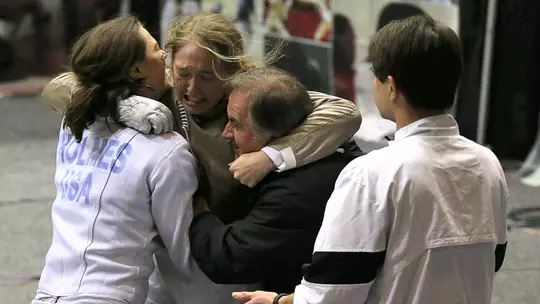
There may be no better Princetonian to speak to the whole of what the Tiger-tied Olympic hopefuls face than Soren Thompson ’05. A 2004 and 2012 Olympian, Thompson works for Daxor Corporation, a biotech company in New York.
“(COVID-19 is) something that we think about a lot, and I’ve been working for COVID-related projects, understanding the disease, understanding how our diagnostic tests can help to improve care in that disease very heavily since the pandemic started,” Thompson said.
With the calendar empty of competitions for now, routine isn’t what it used to be for those who are aiming to achieve what Thompson was able to twice over and make it to the Games.
“It’s a real challenge for planning,” Thompson said. “There’s mostly just a lot of uncertainty, and I think that athletes aren’t used to that. We’re used to having our schedules available to us before a season starts, so you’ve got an entire year to plan, and when you’re looking at something like the full quad of qualification between the Olympics, you usually have a pretty good idea of what the whole four-year period is going to look like.”
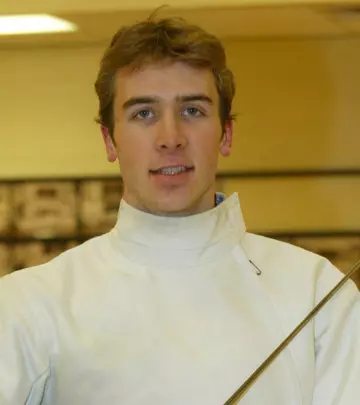
Now, at the beginning of the summer of 2020, one where Americans’ usual summer traditions push up against the need for vigilance in keeping COVID-19 at bay, Olympic dreams, and the preparation to realize them, have had to adapt, both in timing and method. With his professional insight on what it’ll take to defeat COVID-19 and return to life as most Americans knew it as recently as early March, Thompson is cautious on what 2021 might look like.
“Even in a year’s time or 15 months’ time, will there be a desire to gather millions of people from all over the world in one place for an event like the Olympics? I’m not sure if we’ll turn the corner quickly enough to have a competition like we’re used to seeing,” Thompson said. “Once you achieve success at the national level and you look to the international level, it’s really all about getting to the Olympics and then hopefully having success once you get there. So, I think for a sport that doesn’t have a big professional component, it would be very difficult to maintain interest by athletes and also maintain participation after NCAA or other national events. Sports like basketball and baseball and golf, they all have large professional events and a lot of incentive to both start and continue in the sport, but amateur events like fencing are mostly driven by the Olympics, so it really is massively impactful not to have an event like that happen. Hopefully, we can get back on track quickly and we can keep all the athletes involved and the next generation working toward the upcoming Olympics as well.”