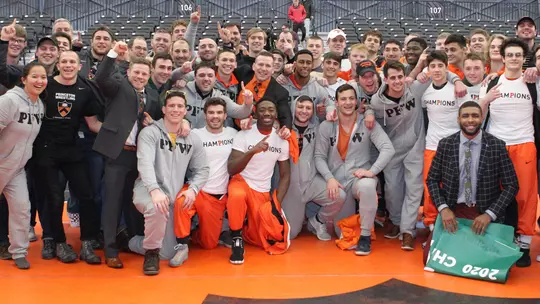
Champions Across Generations: '86 Tigers Get Company as Title, Award Droughts End
6/20/2020
As the 2020 Princeton wrestling season achieved some of its peak moments, the year 1986 seemed to come up again and again.
First win over Cornell since 1986. First Ivy title since 1986. First Ivy League Wrestler of the Year since 1986.
That the 2020 team’s achievements were first-in-a-long-time but not first-ever tells you that Princeton has had wrestling success in its history. It doesn’t tell you much about the gap in between, but those who were with the program in ’86 and every other year know about the journey. They know that the 2020 achievements didn’t come from a team that just happened to find the right combination. They know that all the 2020 Tigers had to celebrate was the result of a long climb that none of them expect has seen its peak.
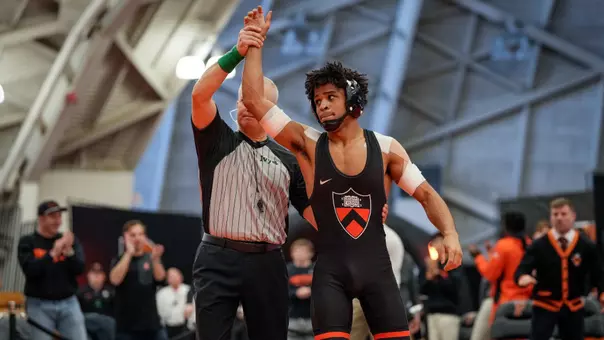
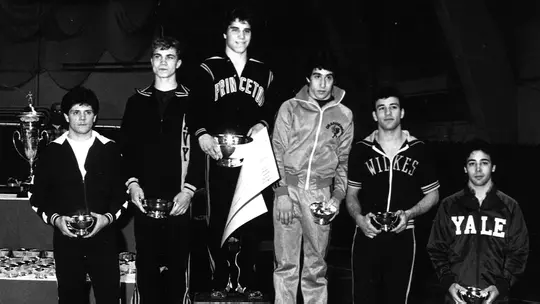
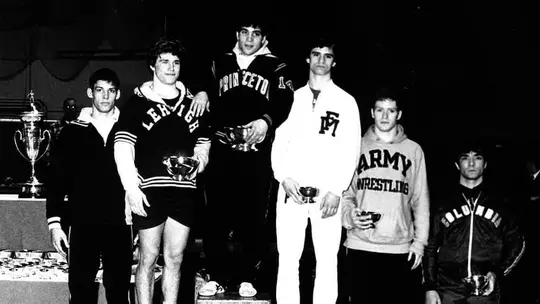
David Crisanti ’86 spent 34 years as the last Tiger to win the Ivy League’s Wrestler of the Year honor. He and his teammates spent 34 years as the last Tigers to win an Ivy League title, a drought rare at Princeton, which has seen now 36 programs, with wrestling, win a league title since 2000.
Crisanti’s 1986 EIWA title, the second of his career, was Princeton’s sixth in a 10-year span since 1977. It came during a 24-year run, from 1966-89, in which Princeton had at least one wrestler place (top eight) at the EIWAs every year and had 92 place-winning finishes over that time. It remains the longest place-winning streak in program history, ahead of a 20-year run from 1925-44.
It was the two decades after that program-best run ended that deepened the appreciation for 2020’s success from everyone connected with the program. From 1990 through 2009, Princeton left the EIWAs without a place-winning finish on eight occasions, including five times in the first nine years of that stretch.
Crisanti’s ’86 EIWA win turned out to be the last for the program until Greg Parker ’03 broke through in 2002, and that title and another one Parker won in 2003 were the program’s only ones from 1987 through 2015.
Though the Ivy title drought was long, its potential was simmering throughout the past decade. Princeton’s last EIWA trip without a wrestler finishing in the top eight was in 2009, and the program has turned in multiple such finishes every year since. By the time Brett Harner ’17 broke through with a win in his junior year in 2016, Princeton made it 30 place-winning finishes since 2010. What was rare became expected, with Harner’s 2016 win as the first of eight over the past five seasons. That run gave Princeton three multi-champion EIWA meets in a four-year span, something that last happened for the program from 1938 through ’41.
“They’ve gotten to such a standard, and so they’re fun to watch, but they’re great guys,” Crisanti said. “The team puts on a good show in terms of the setup at Jadwin Gym, the wrestlers are exciting, they’re competitive, and all that was remaining was to get, in our eyes, that title after so many years. We thought that this was going to be the year and they went out and did it.”
Chris Ayres took over as the program’s coach in 2006. Two of his teams' first three trips to the EIWA Championships were among those without a place-winning finish, but the turnaround since has seen 61 top-eight finishes in 11 years.
Coach Ayres and his assistants have done what Coach (John) Johnston and (assistant coach Chet) Dalgewicz did when my teammates and I were wrestling. They made certain that the alums feel very welcome and included. I know the wrestlers from my years, as well as before and after, feel the current team appreciates our support and recognizes that they're now becoming part of our long history. So, I think there's a continuity that Coach Ayres has carried on from the previous coaches. And, having a great team, as he does, helps too.David Crisanti '86
Princeton went winless in Ivy League duals in 15 of 17 seasons from 1993 through 2009, part of a stretch that saw the program go without a winning season in the Ivy from 1988 through ’09. After going winless in the league in 2013, Princeton has had winning Ivy seasons every year since, but hadn’t been able to solve a Cornell program that brought a 17-year Ivy title winning streak into 2020, going undefeated in the Ivy every year along the way.
The 2020 season, though, would be different, and those connected to the program weren’t the only ones to see it coming. The National Wrestling Coaches Association preseason poll had Princeton ranked 15th in the nation, tops in the Ivy by three spots over Cornell.
Despite a 34-7 loss to Cornell in 2019 that saw Princeton’s points come from just two match wins, none of those 10 wrestlers were seniors, and four were freshmen.
Patrick Glory was among those making their first run through the Ivy in 2019, and though it didn’t result in an Ivy title, it did result in Glory being one of those four freshmen to finish in the top eight in their weight class at EIWAs, along with Travis Stefanik, Marshall Keller and Quincy Monday. He was also one of a program-record three All-Americans that year.
“That’s almost half the lineup of freshmen alone,” Glory said of the usual 2019 dual-match lineup. “It was definitely a transition, and I think the alumni saw the class coming in and got really excited, and we were starting to put multiple All-Americans on the podium every year and starting to do some cool things.”
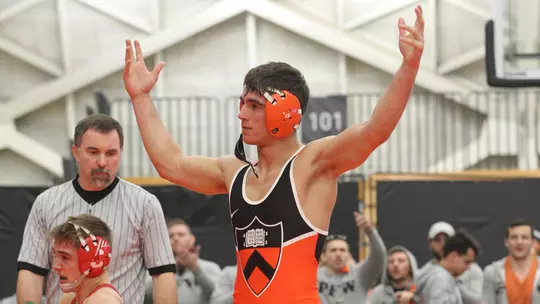
The cool things continued in 2019-20, and early. A November win over Lehigh gave Princeton its first back-to-back wins over the Mountain Hawks since the 1930s. No. 1-ranked Iowa came to Jadwin in December, and Glory, Monday and Stefanik all won their matches. Later that month, Glory gave Princeton its third Midlands winner in two years.
That was all a prelude to February and March, when seasons are made.
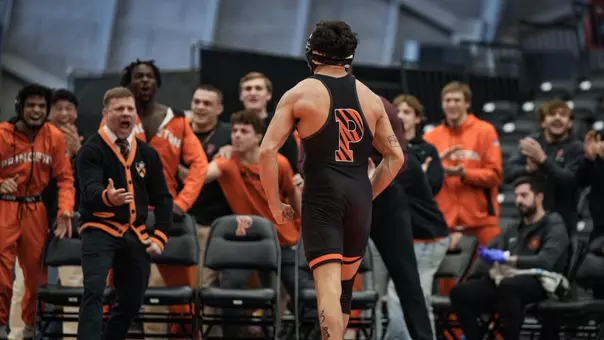
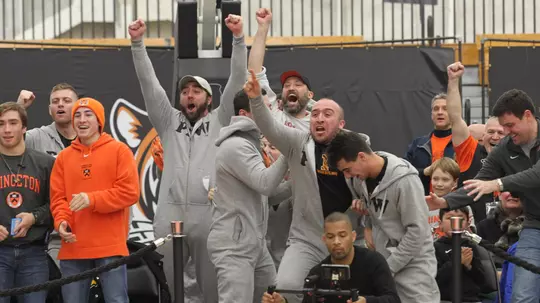
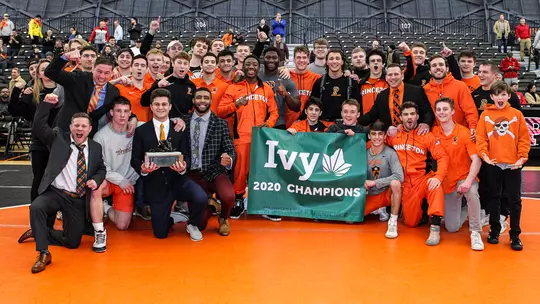
Following a 3-0 Ivy League start, Princeton hosted Cornell knowing that the winner would claim at least a share of the 2020 Ivy League title. In front of a spirited Jadwin Gym crowd, Cornell got out to a 10-4 lead with wins in three of the first four matches – Glory’s was the lone exception in that stretch – before Princeton won five in a row, capped by Travis Stefanik’s clincher in what became a 19-13 win.
STEFANIK WINS! TIGERS CLINCH! IVY LEAGUE CHAMPIONS!
— Princeton Wrestling (@tigerwrestling) February 9, 2020
Watch the finish here! https://t.co/ldKQszh9mV pic.twitter.com/QbsMZSYyUP
Travis Stefanik tells you all you need to know about what this moment means for our program. #GoTigers pic.twitter.com/fg2DDD37Ag
— Princeton Wrestling (@tigerwrestling) February 9, 2020
With that, 1986 had some long-awaited company.
“You see guys like Dave Crisanti and Johnny Orr (’85) and Mike Novogratz (’87) coming to the matches – especially the Cornell match, which is the one that I always think about in terms of looking back on this year – they’re all there in their white (captain’s) sweaters and getting into the match and getting all rowdy,” Glory said. “It’s just super exciting to see what the potential truly is for our program, and I think that’s what the alumni and what I know I’m most excited about, is to see where this program can go in the future.”
As Glory acknowledges those who came before him, so does Crisanti with his predecessors.
“Johnny Johnston, our coach, would always talk about the old wrestlers. I don’t know if it’s like that everywhere, but I had never experienced that. Our high school was not like that, and you felt really great about the whole organization and you wanted to be a part of that history,” Crisanti said. “The previous guys would come back. I remember Henry Milligan (’81) came in for a practice, John Sefter (’78) came in for a practice. They were guys from the previous team that had won it, and you could see how much they cared about the tradition of the program, so we picked up on it.”
Sefter and the 1978 team, which was the last in a 12-year stretch in which Princeton won the Ivy League title eight times, only had to wait until the Orr-captained team in 1985 to see a successor as an Ivy champ, followed quickly by the Crisanti-captained team in ’86.
Now, the other end of a bridge that spent 30-plus years being built has its moorings at the other side, affirmed by an award that hadn’t found its way to Princeton in all that time.
Finishing his season undefeated, Glory became the first Princetonian to win the Ivy League Wrestler of the Year award since Crisanti did in 1986. Orr won the award the first two years it was given, in 1984 and ’85.
Glory also claimed a couple honors unavailable to those in Crisanti’s and Orr’s era, with Glory becoming Princeton’s first finalist for the Hodge Award, college wrestling’s top honor since 1995, and first EIWA Wrestler of the Year, which was inaugurated in 1998.
That makes the last two Tiger winners of the Ivy award as wrestlers from the lightest weight class, with Crisanti having wrestled at 118 and Glory at 125. The lightest class has changed over the years, standing at 118 from 1970 through 1998 before it became 125 in 1999.
“I naturally feel a real kinship to the guys (at the lighter weights), and Pat is no exception,” Crisanti said. “Pat is special. He’s a tremendous wrestler. His style is really fun to watch. I can’t think of a more fearless wrestler. He puts himself in danger more than any top wrestler I can recall, and it almost always turns out well. Winning aside, the entertainment factor is a real plus for the program.”
Those who come to see Glory compete will learn as much about him off the mat as on it, as his intensity and enthusiasm is no switch flipped when it’s time to wrestle.
“It’s great for everyone who’s going to come out and watch, and it’ll bring more people out to watch, but you can tell he’s also a great teammate. I saw him wrestle a couple times in high school, and he was very into how the team was doing,” Crisanti said. “It’s a two-for-one there, that one of your best wrestlers and most exciting wrestlers has also just a great effect on the rest of the team, and he’s great with the alums too. He’s always got a word for the alums, and we all appreciate that.”
Though Princeton was able to break other droughts after the Ivy season ended, with a win over Rutgers as the program’s first since 1990 and allowing it to complete a New Jersey sweep of Rider and Rutgers for the first time since 1983, there’s still more history to be made, even with all the 2020 team accomplished.
The COVID-19 cancellation of the NCAA Championships denied Princeton the chance to make 2020 the year that Bradley Glass ’53 got company atop the NCAA podium. Princeton has had 10 All-American finishes in the last five years, including four honored in 2020 based on season results with the NCAAs not held, but the late Glass, who passed away in 2015, remains Princeton’s only NCAA champion.
The 1911 and 1941 EIWA championship teams from Princeton found their successors, but the 1978 team awaits the one to follow it as the current Tigers try to crack the Cornell-Lehigh duopoly that has held the EIWA crown for the last seven years.
While the motivation to repeat as Ivy League champions will be there, so will the chance to end those droughts and keep the history coming. Glory knows that the support from those competing currently and those who did in the past is part of what it will take.
“You’re not doing the things that we accomplished this year without the full support of not only the starters, but the next guys up,” Glory said. “Those other 22 guys (outside of the dual-match lineup) are really the reason that we were able to do this stuff, because without them making all of those starters better and getting in the room and coming in at 6 a.m. to go roll around with (Matthew) Kolodzik, coming in at 8 a.m. and doing technique with me for an hour, without those guys being willing to put the extra effort in for us, there’s no way we could have accomplished half of the things we did this year.”
While as an underclassman, Glory doesn’t have that captain’s letter sweater yet, but he is already appreciative of joining Orr and Crisanti as winners of the Ivy League’s top award. It’s a theme of the program, with photos of the growing club of All-Americans on the walls of the wrestling room, not far from a larger image of Glass, awaiting another next to him as Princeton's second NCAA champion.
“It’s just a really cool thing. I can look back and say that I was in good company,” Glory said of joining Orr and Crisanti as Princeton’s Ivy Wrestlers of the Year. “There’s no way I’m doing what I do or the team’s doing what the team did without the support of the alumni, the Princeton family of wrestling. It’s a very, very big family that’s going to continue to grow, but it takes every single person in that family to accomplish all the things that we did.”