Championship Tradition: A History of Princeton Women's Fencing
10/21/2020
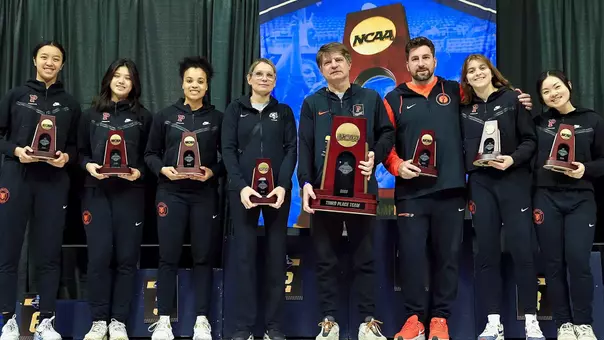
With Princeton Athletics celebrating 50 years of women's athletics at the university, here's a look back at the history of the women's fencing program, a run that includes an NCAA team championship, five NCAA individual champions, and 10 Ivy League titles among its accolades.
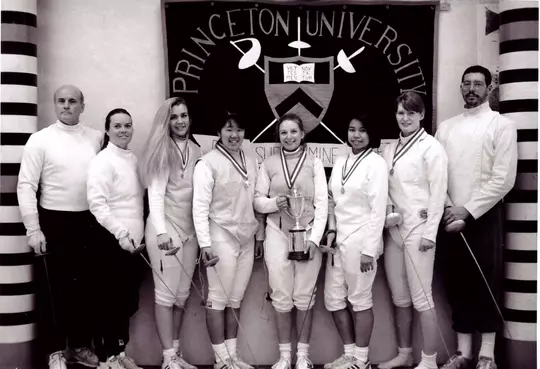
The program attained full varsity status for the 1988-89 season, and though it began competing in Ivy League championship events for the 1987-88 season and won one of its five bouts that year, its climb toward a winning record, both overall and in the Ivy League, lasted until 1993, when it finished 3-2 in the league to tie for second. That year, Princeton also won its first National Intercollegiate Women's Fencing Association title, a championship it won again in 1994.
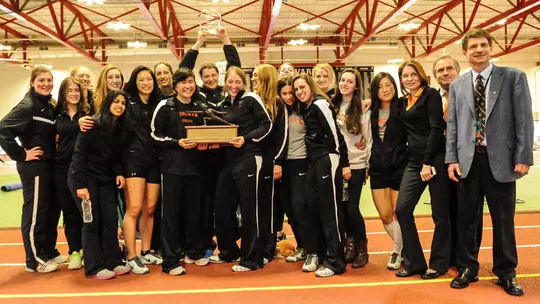
Princeton's run of five straight Ivy League titles from 2010 through 2014 was the longest streak in the league since the 1980s, but it would be more than a decade from the time that Princeton began competing in Ivy League competition in 1988 until it won its first title in 1999.
The team achieved milestones along the way in pursuit of that first Ivy title, among them the program's first winning Ivy record and runner-up finish in 1993, equaling that then-best finish in 1996, and then breaking through to the top spot in 1999 as one of three teams with a 4-1 record. The following year, in 2000, Princeton won outright for the first time, recording its first Ivy sweep at 5-0. Princeton made it three in a row in 2001.
Princeton returned to the top of the Ivy League to win seven titles in eight years from 2010 through 2017, including the five-year run that still stands as the second-longest in Ivy League history behind Penn's run of six in a row from 1983-88.
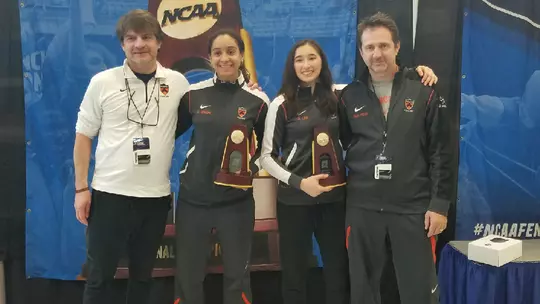
Princeton has had just two coaches in the history of the women's fencing program, Michel Sebastiani and Zoltan Dudas.
Sebastiani's teams won better than 61 percent of their dual matches from the program's varsity beginnings in 1998 through the end of his tenure in 2006, and his 141 dual-meet wins stood as the program standard until Dec. 8, 2013, when Dudas passed Sebastiani's win total.
Dudas has since more than doubled what was the record number when he began with the program, finishing the 2020 season with 308 dual-meet wins. From Feb. 3, 2013 through Nov. 16, 2014, Princeton won 52 straight dual meets, including a perfect 31-0 season in 2013-14, and Princeton's 10 winningest seasons have all come during Dudas's tenure. Szilvia Gyore, who has been on staff with Dudas for his entire tenure and was named Assistant Head Coach in 2018, specializes with the foil fencers, a group that has earned 15 All-America recognitions and eight first-team All-Ivy honors during her time.
The Ivy League has awarded an Ivy League Coach of the Year honor since 2015, and Dudas has won that three times, in 2015, 2016 and 2017.
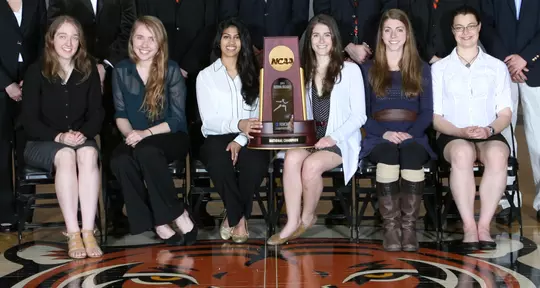
In 1993, Princeton first competed at the NCAA Championships, finishing fifth in the combined men's/women's standings, the format that decides the NCAA fencing champion still today.
Princeton jumped to fourth the next year at the NCAAs, but that remained the program's ceiling for more than a decade and a half, as Princeton finished in the top 10 every year since 1993, but not higher than fourth until 2012.
The Tigers finished 10th at the NCAAs in each of Dudas's first two years, in 2007 and 2008, before beginning a steady climb that saw an eighth-place finish in 2009, a sixth-place finish in 2010, and a fourth-place finish in 2011, then its best since 1999.
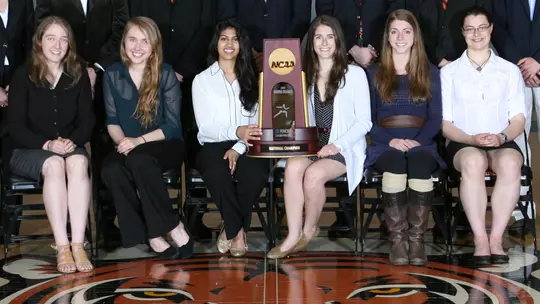
The pattern of jumping two spots every year continued, as Princeton turned in a program then-best runner-up finish at the NCAAs in 2012 before winning the NCAA title in 2013.
Princeton's women were essential to winning that title, as the Tigers added 99 wins on the women's side after the men had 83 wins over the first two days. Two of Princeton's three best weapon performances came on the women's side, with saber sisters Eliza Stone and Gracie Stone finishing first and third with a combined 38 wins, and with épées Susannah Scanlan and Katharine Holmes finishing second and fifth with 35 wins. Foils Eve Levin and Ambika Singh added a crucial 26 wins to the total, third-most of any school in that weapon.
The 2013 title came during a span in which Princeton had or shared the top women's win total at every NCAA Championship from 2011 through 2014. It also came with an outstanding act of team above individual, as Diamond Wheeler qualified through the combination of NCAA regional and regular-season results but gave her spot to Eliza Stone, who went on to win 21 of 23 pool bouts and the NCAA individual saber title.
After the 2013 title, Princeton brought home top-four trophies from the NCAA Championships each of the next four years, making it an annual event from 2011 through 2017 to add to the trophy case by finishing in the top four in the nation, the only school to achieve that over that span.
In Princeton's last event before the 2020 season came to an early end prior to the NCAA Championships, May Tieu and Alexis Anglade won NCAA Mid-Atlantic/South Regional titles and Princeton qualified the maximum six women, and six men as well, to the NCAA Championships.

Eva Petschnigg became Princeton's first NCAA individual champion in women's fencing in 2000, when, after earning the third seed with 18 wins in her 23 round-robin bouts, she defeated Penn State's Charlotte Walker 15-14 in the semifinals and then upset Stanford's top-seeded Monique de Bruin, who went 23-0 in the round-robin bouts, 15-13 in the final to win the foil title.
Foil was the NCAA's only championship weapon for women from the first women's participation in the NCAA Championships in 1982 until épée competition joined in 1995, followed by saber in 2000. Petschnigg stood alone as a Princeton woman to win an NCAA individual title until 2013, when Eliza Stone defended her top seed and won the saber title.
Three more titles came between 2017 and 2018. Épée Anna Van Brummen, seeded third in what was the first all-Tiger final in NCAA Championship history, defeated top-seeded Katharine Holmes 15-13 in the final to become Princeton's third NCAA individual women's fencing champ.
A year after the first all-Tiger final, Princeton had two individual champs in the same year for the first time. Maia Chamberlain, seeded third, upset top-seeded Zara Moss of Penn State 15-11 in the final, and Kasia Nixon, seeded second, beat fourth-seeded Veronika Zuikova of St. John's 15-13 in her final to win the épée title.
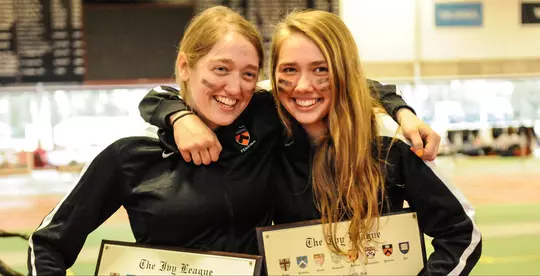
Since 1995, the Princeton women's fencing program has turned in 80 All-America performances, and six fencers have earned four All-America honors. It's a group that spans nearly two decades of the program's history, from the first to accomplish the feat in épée Maya Lawrence in 2002 through to fellow épées Susannah Scanlan in 2014 and Katharine Holmes in 2017. Princeton has had at least one fencer in every weapon earn four All-America honors, including foil Jacqueline Leahy in 2006 and sisters Eliza and Gracie Stone in 2013 and 2016.
The program has had similar success with All-Ivy League honors, with 71 first-team all-league honorees since the first such honor in 1993.
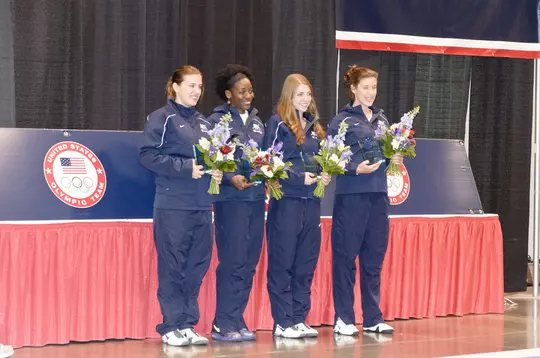
The Princeton women's fencing program has made its mark on the Olympic stage as well. Princeton women have competed in fencing four times in the Games, first with Kamara James in 2004, then with Maya Lawrence and Susannah Scanlan helping the U.S. épée women win bronze in 2012, and most recently with Katharine Holmes in 2016.
Princeton's international success has extended beyond the Olympic Games, in recent years with Eliza Stone winning 2019 Pan-Am gold and a bronze at the 2018 World Championships, Katharine Holmes winning individual gold at both the 2015 and 2019 Pan-Am Games, and team gold at the 2015 and 2019 Pan-Am Games and at the 2018 World Championships, and Holmes teaming with Anna Van Brummen for gold at the 2015 Pan-Am Games.