20 Years Later: Looking Back at the 2000 Ivy League Champs
12/16/2020

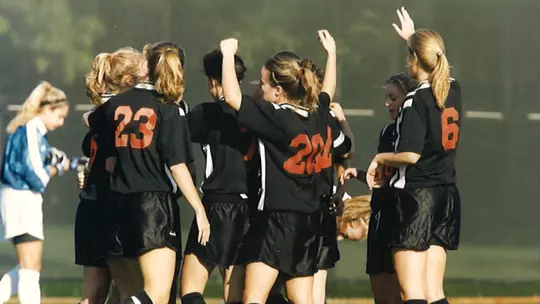
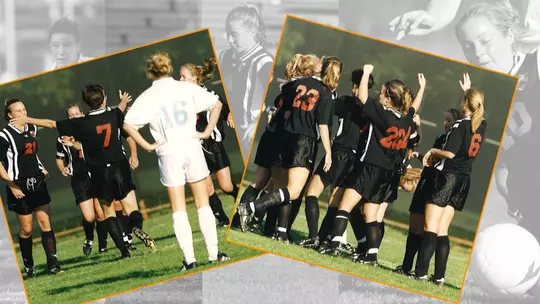
When the 2000 Princeton women’s soccer team took the field, it did so with optimism from making the NCAA tournament the year before for the first time in 16 years, and with eight starters back from that 1999 team.
But what the Tigers didn’t have at that time was all the history the program has built in the 20 years since. Of the program’s 10 Ivy League titles through 2020, it had only one when the 2000 season began, from 1982. The team’s third-place Ivy League finish in 1999 was its best since 1988, and its 12 wins in 1999 were the program’s most in 11 years.
“We were extremely focused on getting that crown back. We were very motivated coming out of the 1999 season. We had a good record there and felt the momentum of the program building, and certainly the next goal or target for us was to capture the Ivy League crown,” Kelly Sosa ’02, one of the three captains from that team, said. “It was on our minds all the time and we were very motivated to go after it.”
Among the Tigers’ graduation losses from the 1999 season was Dana DeCore ’00, who led that team with six goals and 15 points. Even so, of the 14 players who scored a total of 38 goals for Princeton in 1999, nine of those goal scorers, accounting for 24 goals, were back for 2000, as were both of the team’s keepers from 1999, Jordan Rettig and Catherine Glenn, who helped hold opponents to .70 goals against per game in that season.
“We certainly missed Dana for many reasons, including her goal-scoring abilities, but we had a lot of confidence in the depth and the breadth of our team,” Sosa said. “We were excited, we were hungry, we were motivated, and while there was some uncertainty in terms of how we would score those goals, we had a tremendous amount of confidence in our defense. We had a lot of very versatile players, and while we weren't entirely sure where the goals would be coming from, we were pretty confident that not too many goals would be scored on us, and that that ended up holding up.”
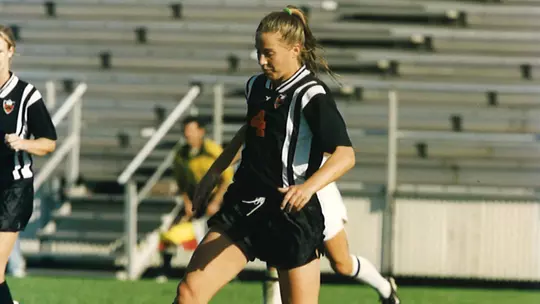
That confidence proved to be for good reason, as the 2000 team began the season with five consecutive shutouts, a program-best unsurpassed in the 20 years since and equaled only by the 2001 and 2017 teams in that time. Included in those five games was a 2-0 Ivy League start, with wins over Yale and Dartmouth.
After a 1-0 loss to Rutgers that ended the perfect start to the season, Princeton went on to win five of its next six games, all by shutout, and add league wins over Columbia and Brown to start 4-0 in the league and 10-2 overall heading into a visit from Harvard. The Crimson were the defending Ivy champs, going 7-0 in the league in 1999, and hadn’t lost to Princeton since 1992, winning 13 of the last 14 against the Tigers coming into that game.
A 2-0 shutout made it 14 of 15 for the Crimson, and while the Tigers’ hopes for a first-ever 7-0 Ivy League season were dashed – that would have to wait until 2004 – the Ivy title was still within Princeton’s reach. The result against Harvard put both teams at 4-1 in the league at that point, and every team had at least one league loss, with Brown and Dartmouth joining Princeton and Harvard at one loss apiece. If Princeton could keep winning, the Ivy title would be theirs, shared at least.
“I think that game in particular was a good motivator for the rest of the season,” Sosa said of the Harvard loss. “We had very few goals scored against us on our home turf, so it was definitely disappointing, but the group really rallied together. We knew we could still win the crown and with that an automatic bid to the NCAA tournament, so we kept focused on that and tried to move past it as quickly as we could.”
A 1-0 non-league loss to Loyola followed, but after that, Princeton closed out the Ivy season with wins over Cornell and Penn to finish at 6-1. Dartmouth, too, was perfect down the stretch to join the Tigers at 6-1 and share the Ivy League title, while Brown had a late-season loss at Dartmouth to fall off the pace and Harvard stumbled to the finish with losses to Dartmouth and Columbia after the win over Princeton.
The Tigers had their Ivy League title, giving the 1982 team some company after 18 years as Princeton’s only Ivy League women’s soccer champion.
By virtue of its win over Dartmouth, Princeton earned the league’s automatic bid to the NCAAs, but the Big Green and Harvard both received at-large bids to what was in its final year as a 48-team tournament before expanding to 64 in 2001. The NCAA sent the Tigers to Big Ten runner-up Wisconsin, which scored a double-overtime goal to advance, 1-0. Princeton’s first NCAA tournament win since 1982 would have to wait one more year.
Building was a consistent thread throughout that time in Princeton women’s soccer history. The 2000 season was the sixth for head coach Julie Shackford, who took over in 1995 after the program had not had a winning season since 1990. By the start of that sixth season, Shackford had 47 wins to stand as the program’s second-winningest coach, and she passed Bob Malekoff in 2000 to gain a status as the winningest coach in program history that, after 203 wins over 20 seasons until she stepped down in 2014, she will hold for a long while yet.
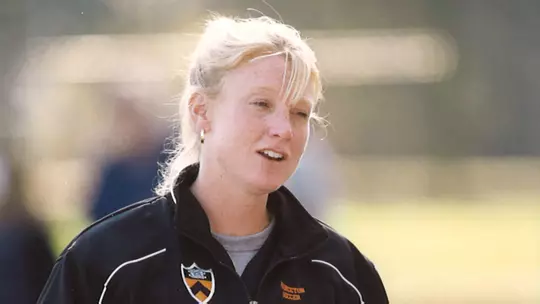
All nine returners who scored a goal in 1999 did so again in 2000, but two of the program’s top scorers in 2000 were not among that group. Theresa Sherry ’04, who made it two Ivy League titles that academic year by helping the women’s lacrosse team to one – Sherry would graduate as that program’s third-leading career goal scorer – scored eight goals to lead the women’s soccer team in 2000. That was more than double the total of any of her veteran teammates, and Sherry was the only freshman to score a goal in 2000.
“Theresa is a tremendous competitor and she stepped up right away and certainly earned the respect of her teammates,” Sosa said. “I think we all embraced it. The senior class, when they were younger, were also a very strong class, so we weren't as conscious, I think, of which class was contributing. I think at the end of the day we just all wanted to make sure we got the right end result and Theresa was a big part of that.”
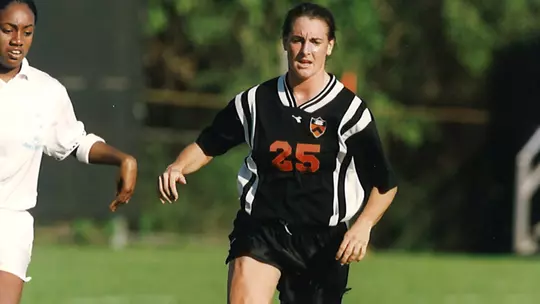
Heather Deerin, a sophomore defender, was one of five players to finish second on the team in goals, with three. On the road to earning her second straight first-team All-Ivy League honor and eventually becoming just the third player in program history to win four first-team All-Ivy recognitions, Deerin’s goals in 2000 were the first of her career.
Sherry earned honorable mention All-Ivy for her breakout freshman year, as did fellow rookie, midfielder Liz Bell. All three captains were All-Ivy honorees in 2000, with midfielder Julie Shaner ’01 joining Sosa on the second team and midfielder Jennifer Lankford ’01 on the first team.
Behind Deerin, keeper Rettig was a second-team All-Ivy pick, starting all 18 games and carrying an 0.48 GAA as Princeton turned in 13 shutouts in 18 changes on the way to its 13-5 record, outscoring opponents 31-8.
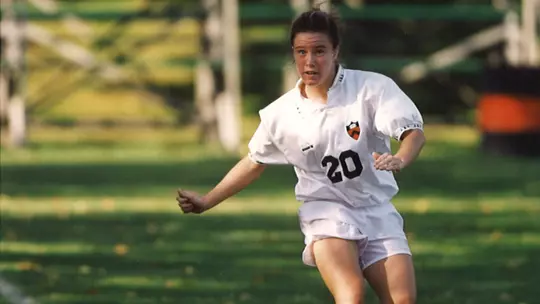
Twenty years after that Ivy title-winning 2000 season, Princeton’s program has 10 Ivy championships to its credit, has made the NCAA tournament 13 times, has advanced in the NCAA tournament six times, and has made the quarterfinals twice and semifinals once.
When many of the members of that 2000 team committed, however, Princeton had one Ivy title to its credit, from 1982, had been to two NCAAs, in 1982 and ’83, and had one NCAA tournament win, in ’82. Despite being just 15 seasons in, the program had five coaches, including four in a six-season span from 1989-94.
By 1997, Shackford’s third season, Princeton had won 10 games for the first time since 1989, and that year began a run of consecutive winning seasons that would last through 2006. Before Shackford arrived, Princeton’s longest streak of winning seasons in a row was four.
Beginning with the 1999 season, Princeton began a run of six straight trips to the NCAA tournament, and the 2000 Ivy League title was the first of four in five years during that time. That run, of course, had yet to begin when many of those who would make it so had to decide on a college, but Princeton had all that comes with the university as well as a growing program to offer.
“Princeton offers an academic opportunity that is certainly second to none, even on a global scale,” Sosa said. “There was something about the opportunity to create something, that was powerful and motivating to me and to my teammates, and I think Julie Shackford certainly was a big part of that, and we all believed we could do it. It's fun to be the underdog, and certainly we took a lot of pride in being able to put the program in a place where it was when we left and all moved on. I think it's something that we still find a lot of pride in today and feel very fortunate to be part of that.”