


Princeton University Athletics
Seeing 30-30
February 23, 2007 | Men's Lacrosse
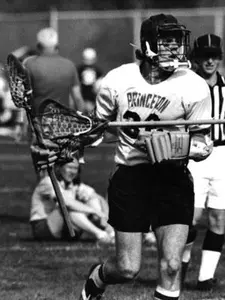
It's hot. At least it looks that way in the grainy, black-and-white picture. There's one umbrella in the crowd, and it is there to block the sun, which appears to beat down on the crowd.
Some in attendance stand. Some sit. All but one is in shorts. Most of the men wear no shirts. Sunglasses are everywhere.
Together, they watch the only player in Princeton men's lacrosse history ever to have at least 30 goals and at least 30 assists in the same season. Really? Only one man has ever done that? Then this must be a picture from the 1990s, right? Lowe? Hess? Or maybe one of the great players from earlier this decade. Boyle? No? Maybe Striebel? He could score and pass. Not him either?
Wait. It couldn't be any of those guys. Look at the picture. Look at the short shorts. See how the socks on the players reach most of the way to the knees? The sunglasses. The hair.
These are the 1970s, obviously. Can that be? The only player in Princeton lacrosse history to score at least 30 goals and have at least 30 assists did so before Bill Tierney became head coach? There was lacrosse at Princeton before Tierney?
Then who could it be?
The player's name is David Tickner.
The picture–and the accomplishments of the player featured in it–scream out an all-too-often forgotten fact: Princeton men's lacrosse history actually does predate Bill Tierney.
“When I came to Princeton, people asked me why I wanted to take over a program that was struggling like that,” Tierney says. “I told them that in coaching, I've always believed that if it's happened in the past, it can happen in the future. I knew Princeton was a place with great history.”
Tierney took over Princeton at a time when the program had won 12 games in the previous four years combined. It had been 20 years since the last Ivy League championship; Princeton had never been to the NCAA tournament.
His accomplishments during his first 19 years are, by now, well known: six NCAA championships, 10 NCAA Final Fours, 13 Ivy League championships. He was right in every respect: It had happened before; it could happen again.
“Nobody has a greater respect for the history of lacrosse at Princeton than I do,” he says. “When I first came here, that's one of the things I talked about most in recruiting. I know better than anyone that Princeton lacrosse did not start 20 years ago.”
Princeton's first national lacrosse championship came back in 1937 and was followed by titles in 1942, 1951 and 1953. Its first first-team All-America dates to 1922. Yale won the first Ivy League championship in 1956, but Princeton won the next seven (sharing two of them) and eight of the next nine before Cornell took over as the dominant Ivy power.
The 1967 Ivy title would be the last for Princeton until Tierney's first, in 1992. Princeton also would sit out the first two decades of the NCAA tournament before Tierney took the Tigers there in 1990.
Tierney has brought some of the greatest offensive players in college lacrosse history to Princeton. Kevin Lowe '94 scored 247 career points, and he is joined by Ryan Boyle 04, Jon Hess '98 and Jesse Hubbard '98 in the 200-point club. Chris Massey '98 just missed, finishing with 192 career points.
None of them, however, ever had a season of at least 30 goals and at least 30 assists. Neither did Josh Sims or Justin Tortolani or B.J. Prager or Sean Hartofilis or Matt Striebel or Taylor Simmers or Jason Osier or anyone else. Hess, with 30 goals and 29 assists in 1996 and 26 goals and 48 assists in 1997, came closest.
No, none of them could do what Tickner did during the 1976 season, a year that saw the then-junior score 34 goals and add 32 assists on a team that went 6-7, 3-3 in the Ivy League.
“I didn't realize that I was the only one who had done it until it was pointed out to me last year,” says Tickner, now a 51-year-old who works in business development in the financial services sector for IBM in Maryland. “It's ironic, because I think that with the better team you have, the more unlikely it is that anyone will match it. With a really good team, you're moving the ball around more, and more people are scoring. It's only when your team gets a little unbalanced that things like that happen.”
He grew up in Baltimore literally on the campus of the Gilman School, where his father taught for 41 years and where today there is a Tickner Writing Center. He came to Princeton at a time when freshmen were ineligible, and he left his mark as one of the greatest players in program history.
“I had been accepted to Brown and Virginia,” he says. “I had a full scholarship offer to UVA and turned it down for the opportunity to attend Princeton.”
Tickner's place in the Princeton record book extends beyond his 30-30 season. His 163 career points were good enough for second place all-time at Princeton when he graduated in 1977, and they are still good enough for ninth. His 94 goals have him in 11th place; his 69 assists tie him for ninth. None of those numbers include the 33 goals and 17 assists he had in 10 freshman games in 1974.
In addition, he was the first Princeton player ever to be a three-time first-team All-Ivy League selection.
“When I matriculated at Princeton, I think a lot of Ivy League teams had great teams,” says Tickner. “Cornell won the NCAA tournament twice during my time at Princeton. Brown went to the semifinals my junior year, and Penn made the quarters or semis my senior year.
“One of the carrots that they dangled at us was that the presidents had just voted to let freshmen play on the varsity, so there were a whole lot of good freshmen back then. It actually didn't end up happening for me, but we had a really good freshman team. We scrimmaged the varsity three times and beat them twice.”
Princeton played its home games on Finney Field back in the 1970s. It would be another 20 years before Class of 1952 Stadium opened for games and, more importantly, early-season practice.
“We sometimes had to practice on the parking lot outside of Jadwin Gym,” says Tickner. “You'd try not to fall. Everyone cut his gloves out back then, and you landed on flesh when you hit the ground. I still have a scar on my hand from one of those falls.”
Tickner's three varsity seasons saw Princeton twice go 4-2 and once go 3-3 in the Ivy League. Cornell was the only Ivy team Princeton did not beat in Tickner's three seasons, and Princeton's run of futility against Johns Hopkins–“we were cannon-fodder to them back then”–was in the middle of a stretch that would run from 1967
until 1990, when the Tigers beat the Blue Jays for their first ever NCAA tournament win.
In 1975, Princeton knocked off Navy 15-14 at Finney Field; Navy would advance to the NCAA championship game against Maryland tht year.
“When some of the big teams came in, we'd have some big attendance,” says Tickner, who played for Art Robinson as a sophomore and junior and then Mike Hanna his senior year. “We always had a big crowd for Rutgers, for Cornell, for Hopkins. The game against Navy my sophomore year was very exciting.”
Tickner played attack until his senior year, when he switched to midfield. He was a second-team All-America as an attackman sophomore year, a third-team All-America as an attackman junior year and a second-team All-America as a middie senior year. His classmate Wick Sollers graduated as Princeton's all-time leading scorer with 174 points, 11 more than Tickner would score.
Tickner graduated four years after Tierney graduated from Cortland State. It would be 11 more years before Tierney would take over at Princeton.
“My first introduction to him was when we came back for an alumni game,” he says. “The alumni had beaten the varsity the year before. This time, it was a rude awakening. He'd instilled some fire in them.
“If you had told me in 1977 that Princeton was going to start winning national championships, I'm not sure anyone would have believed it. The people I know are happy and ecstatic about Princeton's being where it is in lacrosse. It's exciting. There's no bitterness at all from anyone.”
Tickner was in the stands at Franklin Field when Princeton won its first national title in 1992, and he has tried to stay close to the program through the years.
“He's a great guy,” says Tierney of Tickner. “He's very supportive. He comes to the alumni events. I feel it's a very symbiotic relationship. I feel like I owe something to those guys for laying the groundwork for Princeton lacrosse and for being so loyal, and on the other side I hear a lot from alums who are thankful that the program has gotten to where it has. It's very healthy for both sides.”
Tickner is not the only college lacrosse player in his family. His youngest daughter, Alexandra, is a freshman at Cal, where her assistant coach is former Tiger women's All-America Theresa Sherry. His middle daughter Marcy plays field hockey at Sewanee, while his oldest Laura played in high school before attending SMU.
Tickner himself, even in his 50s, has another claim that few of the alums to play for Tierney can match: He still plays.
Last summer, while four Princeton alums were representing the U.S. at the World Championships in London, Ont., Tickner was also on site competing in age-group events.
“A group of us, mostly from the Annapolis area, got with a club and began playing in tournaments, off and on, the last 10 years,” says Tickner. “We call ourselves 'The Geezers.' We played in an event around the world championships. The measure of success of those tournaments, of course, is to come back without being too badly hurt. We went 7-0 up there. It's still fun to put the ball in the net.”
He's a Geezer now, if not an actual geezer. His days at Princeton, as evidenced by photos with old gloves and helmets, were a long time ago.
Yet they're not forgotten, nor will they ever be. They're right there, in a special place in the record book, one that remains, all these years later, unmatched.
— By Jerry Price
Some in attendance stand. Some sit. All but one is in shorts. Most of the men wear no shirts. Sunglasses are everywhere.
Together, they watch the only player in Princeton men's lacrosse history ever to have at least 30 goals and at least 30 assists in the same season. Really? Only one man has ever done that? Then this must be a picture from the 1990s, right? Lowe? Hess? Or maybe one of the great players from earlier this decade. Boyle? No? Maybe Striebel? He could score and pass. Not him either?
Wait. It couldn't be any of those guys. Look at the picture. Look at the short shorts. See how the socks on the players reach most of the way to the knees? The sunglasses. The hair.
These are the 1970s, obviously. Can that be? The only player in Princeton lacrosse history to score at least 30 goals and have at least 30 assists did so before Bill Tierney became head coach? There was lacrosse at Princeton before Tierney?
Then who could it be?
The player's name is David Tickner.
The picture–and the accomplishments of the player featured in it–scream out an all-too-often forgotten fact: Princeton men's lacrosse history actually does predate Bill Tierney.
“When I came to Princeton, people asked me why I wanted to take over a program that was struggling like that,” Tierney says. “I told them that in coaching, I've always believed that if it's happened in the past, it can happen in the future. I knew Princeton was a place with great history.”
Tierney took over Princeton at a time when the program had won 12 games in the previous four years combined. It had been 20 years since the last Ivy League championship; Princeton had never been to the NCAA tournament.
His accomplishments during his first 19 years are, by now, well known: six NCAA championships, 10 NCAA Final Fours, 13 Ivy League championships. He was right in every respect: It had happened before; it could happen again.
“Nobody has a greater respect for the history of lacrosse at Princeton than I do,” he says. “When I first came here, that's one of the things I talked about most in recruiting. I know better than anyone that Princeton lacrosse did not start 20 years ago.”
Princeton's first national lacrosse championship came back in 1937 and was followed by titles in 1942, 1951 and 1953. Its first first-team All-America dates to 1922. Yale won the first Ivy League championship in 1956, but Princeton won the next seven (sharing two of them) and eight of the next nine before Cornell took over as the dominant Ivy power.
The 1967 Ivy title would be the last for Princeton until Tierney's first, in 1992. Princeton also would sit out the first two decades of the NCAA tournament before Tierney took the Tigers there in 1990.
Tierney has brought some of the greatest offensive players in college lacrosse history to Princeton. Kevin Lowe '94 scored 247 career points, and he is joined by Ryan Boyle 04, Jon Hess '98 and Jesse Hubbard '98 in the 200-point club. Chris Massey '98 just missed, finishing with 192 career points.
None of them, however, ever had a season of at least 30 goals and at least 30 assists. Neither did Josh Sims or Justin Tortolani or B.J. Prager or Sean Hartofilis or Matt Striebel or Taylor Simmers or Jason Osier or anyone else. Hess, with 30 goals and 29 assists in 1996 and 26 goals and 48 assists in 1997, came closest.
No, none of them could do what Tickner did during the 1976 season, a year that saw the then-junior score 34 goals and add 32 assists on a team that went 6-7, 3-3 in the Ivy League.
“I didn't realize that I was the only one who had done it until it was pointed out to me last year,” says Tickner, now a 51-year-old who works in business development in the financial services sector for IBM in Maryland. “It's ironic, because I think that with the better team you have, the more unlikely it is that anyone will match it. With a really good team, you're moving the ball around more, and more people are scoring. It's only when your team gets a little unbalanced that things like that happen.”
He grew up in Baltimore literally on the campus of the Gilman School, where his father taught for 41 years and where today there is a Tickner Writing Center. He came to Princeton at a time when freshmen were ineligible, and he left his mark as one of the greatest players in program history.
“I had been accepted to Brown and Virginia,” he says. “I had a full scholarship offer to UVA and turned it down for the opportunity to attend Princeton.”
Tickner's place in the Princeton record book extends beyond his 30-30 season. His 163 career points were good enough for second place all-time at Princeton when he graduated in 1977, and they are still good enough for ninth. His 94 goals have him in 11th place; his 69 assists tie him for ninth. None of those numbers include the 33 goals and 17 assists he had in 10 freshman games in 1974.
In addition, he was the first Princeton player ever to be a three-time first-team All-Ivy League selection.
“When I matriculated at Princeton, I think a lot of Ivy League teams had great teams,” says Tickner. “Cornell won the NCAA tournament twice during my time at Princeton. Brown went to the semifinals my junior year, and Penn made the quarters or semis my senior year.
“One of the carrots that they dangled at us was that the presidents had just voted to let freshmen play on the varsity, so there were a whole lot of good freshmen back then. It actually didn't end up happening for me, but we had a really good freshman team. We scrimmaged the varsity three times and beat them twice.”
Princeton played its home games on Finney Field back in the 1970s. It would be another 20 years before Class of 1952 Stadium opened for games and, more importantly, early-season practice.
“We sometimes had to practice on the parking lot outside of Jadwin Gym,” says Tickner. “You'd try not to fall. Everyone cut his gloves out back then, and you landed on flesh when you hit the ground. I still have a scar on my hand from one of those falls.”
Tickner's three varsity seasons saw Princeton twice go 4-2 and once go 3-3 in the Ivy League. Cornell was the only Ivy team Princeton did not beat in Tickner's three seasons, and Princeton's run of futility against Johns Hopkins–“we were cannon-fodder to them back then”–was in the middle of a stretch that would run from 1967
until 1990, when the Tigers beat the Blue Jays for their first ever NCAA tournament win.
In 1975, Princeton knocked off Navy 15-14 at Finney Field; Navy would advance to the NCAA championship game against Maryland tht year.
“When some of the big teams came in, we'd have some big attendance,” says Tickner, who played for Art Robinson as a sophomore and junior and then Mike Hanna his senior year. “We always had a big crowd for Rutgers, for Cornell, for Hopkins. The game against Navy my sophomore year was very exciting.”
Tickner played attack until his senior year, when he switched to midfield. He was a second-team All-America as an attackman sophomore year, a third-team All-America as an attackman junior year and a second-team All-America as a middie senior year. His classmate Wick Sollers graduated as Princeton's all-time leading scorer with 174 points, 11 more than Tickner would score.
Tickner graduated four years after Tierney graduated from Cortland State. It would be 11 more years before Tierney would take over at Princeton.
“My first introduction to him was when we came back for an alumni game,” he says. “The alumni had beaten the varsity the year before. This time, it was a rude awakening. He'd instilled some fire in them.
“If you had told me in 1977 that Princeton was going to start winning national championships, I'm not sure anyone would have believed it. The people I know are happy and ecstatic about Princeton's being where it is in lacrosse. It's exciting. There's no bitterness at all from anyone.”
Tickner was in the stands at Franklin Field when Princeton won its first national title in 1992, and he has tried to stay close to the program through the years.
“He's a great guy,” says Tierney of Tickner. “He's very supportive. He comes to the alumni events. I feel it's a very symbiotic relationship. I feel like I owe something to those guys for laying the groundwork for Princeton lacrosse and for being so loyal, and on the other side I hear a lot from alums who are thankful that the program has gotten to where it has. It's very healthy for both sides.”
Tickner is not the only college lacrosse player in his family. His youngest daughter, Alexandra, is a freshman at Cal, where her assistant coach is former Tiger women's All-America Theresa Sherry. His middle daughter Marcy plays field hockey at Sewanee, while his oldest Laura played in high school before attending SMU.
Tickner himself, even in his 50s, has another claim that few of the alums to play for Tierney can match: He still plays.
Last summer, while four Princeton alums were representing the U.S. at the World Championships in London, Ont., Tickner was also on site competing in age-group events.
“A group of us, mostly from the Annapolis area, got with a club and began playing in tournaments, off and on, the last 10 years,” says Tickner. “We call ourselves 'The Geezers.' We played in an event around the world championships. The measure of success of those tournaments, of course, is to come back without being too badly hurt. We went 7-0 up there. It's still fun to put the ball in the net.”
He's a Geezer now, if not an actual geezer. His days at Princeton, as evidenced by photos with old gloves and helmets, were a long time ago.
Yet they're not forgotten, nor will they ever be. They're right there, in a special place in the record book, one that remains, all these years later, unmatched.
— By Jerry Price
Into the Ivy: 2026 Princeton Men's Lacrosse
Sunday, May 10
Sticks and Stripes - May 8, 2026
Friday, May 08
Sticks and Stripes - April 17, 2026
Friday, April 17
Sticks and Stripes - March 4, 2026
Thursday, March 05