Golf After Princeton: Alumni Stay Connected to the Game
5/7/2020
Golf, unlike many other sports, relies greatly on meritorious objectivity for advancement. Anyone, regardless of background or when you’ve started playing, could end up on a professional tour or in the U.S. Open, just by finishing high enough at a sometimes lengthy series of qualifying events.
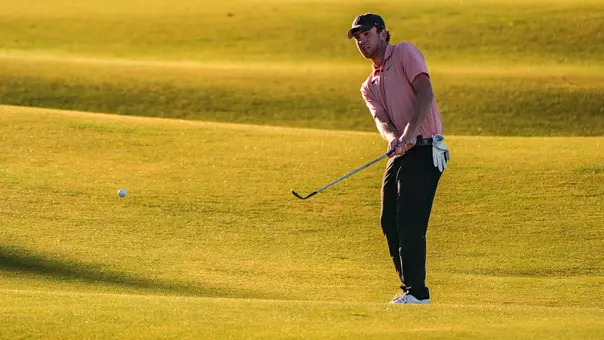
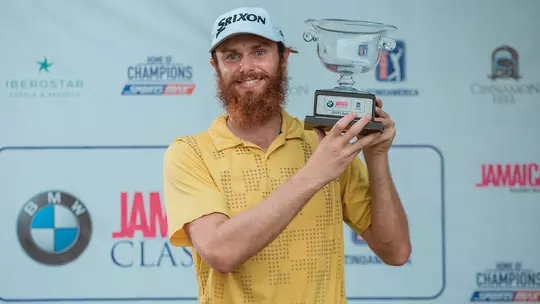
That’s one way to make a career in golf. Evan Harmeling ’12 is a recent example of that among Princeton alums, having competed on the PGA Latin America tour since graduating from Princeton until his 2019 season finish gained him admittance to the Korn Ferry Tour, one step away from the PGA TOUR.
But, similar to other sports, there are also other ways to make a career out of golf, or to keep golf as a part of one’s life long after a competitive career is through. Several Princeton alums are an example of that as well, from serving as an officer in the sport’s national organization to working at one of the world’s most well-known collection of courses to designing the courses themselves.
Golf and cross country may be the only varsity sports at Princeton where the playing field itself is the primary obstacle to be overcome, and one’s fellow competitors are secondary, used as barometers to determine the success of one’s performance.
Steve Dana ’94 is someone who has made a career around the intricacies of courses that can both beautify and bedevil, providing a round of golf memorable both for the setting and for the challenge.
A senior designer and vice president at Jerry Pate Design in Pensacola, Fla., Dana’s firm has dozens of courses across the country in its portfolio, among them Old Overton Golf Club in Alabama, which hosted the Tigers in Alabama’s Jerry Pate National Intercollegiate Tournament last fall, the Innisbrook Copperhead course in Florida, which hosts the PGA TOUR’s Valspar Championship, Indianwood in Michigan, which hosted the U.S. Senior Open in 2012, and a course in southern Germany at Schwanhof.

Dana’s architecture path was long in the making, he said.
“I was introduced to the game by a friend when I was eight or nine and just immediately took to it,” Dana said. “Very early on, I wanted to figure out how to design golf courses.”
Dana’s upbringing in Southern California allowed him to experience a rich range of designers’ courses, and coming east to Princeton expanded that.
“I certainly became more familiar with Seth Raynor, for sure, we had a Charles Blair Macdonald (course at Yale),” Dana said, mentioning Raynor, a Princeton student in the late 19th century. “It definitely exposed me more toward the very early architects in the country from the Northeast.”
Dana was able to integrate his career interest with his academic pursuits.
“While I was there, I tried to find courses that lent themselves toward landscape architecture,” Dana said. “My thesis was about sustainability, environmentalism in architecture, which was just then beginning to be talked about – of course now, it’s what you do – and how architecture and design can influence behavior and attitudes. That sort of went in to how golf courses can do the same thing. Golf is an emotional thing, and how you design a golf course can create a lot of emotions with what you’re faced with.”
While Dana was able to see his long-held interest in shaping land for the game of golf through to a career, creating a place for others to play a round doesn’t involve his own play as often as one might think.
“Certainly, there’s jobs and industries and careers that lend themselves to play more golf than others, for sure,” Dana said. “With my job, a lot of golf courses you design, you never see them with grass on them or with golfers on them until years later sometimes, but I always try to prioritize to still play and keep playing, because I love it.”
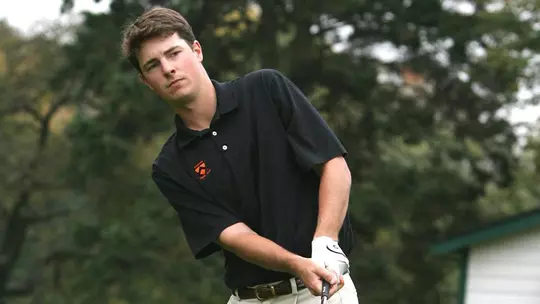
Finding ways to get on the course was a common theme in conversations with alums who have maintained a connection with golf outside of being a professional golfer.
That’s true for John Sawin ’07 as well, who didn’t have the golf-connected career he has now when he graduated from Princeton. Originally from the Philadelphia area, Sawin moved out to California in 2009, where he is the Vice President and Director of Golf for the Pebble Beach Company, which operates the world-famous Pebble Beach Golf Links as one of its four area courses.
“I would say that it was unexpected and it was always more of a pipe dream for me to make my career in golf, but for the longest time I was just so focused on playing golf,” Sawin said. “I got going in finance and then it took about 11 or 12 years before an opportunity in golf happened to come my way that really was intriguing.”
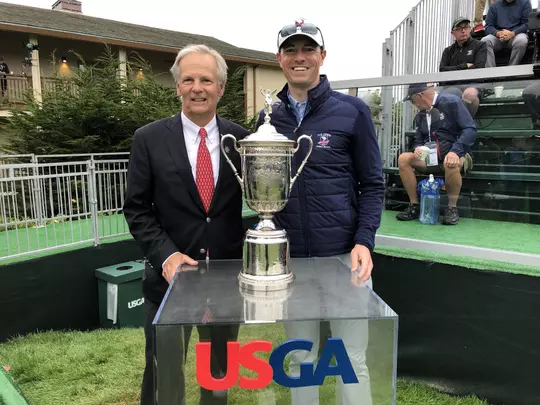
Sawin helps to oversee operations at an entity that has hosted 14 national championships, including the 2019 U.S. Open and 2018 U.S. Amateur, and is scheduled to host several more in the coming decade. The group of courses, which includes The Links at Spanish Bay, Spyglass Hill Golf Course, and Del Monte Golf Course, hosts three professional tournaments a year, including the PGA TOUR's AT&T Pebble Beach Pro-Am.
Even though helping to administer a bucket-list course wasn’t Sawin’s initial plan, the path that brought him through Princeton also led him to Pebble.
“Golf continues to be helpful to almost all of us (Princeton golf alums) in our careers,” Sawin said. “It definitely helped me make connections that furthered my career, and those connections that I had made helped make me an attractive candidate for the job here at Pebble Beach.”
As his career has grown, so has Sawin’s life away from the course. Like many of his peers, all of those worthy outlets for attention require effort to include alongside getting on the course, even when you work at one.
“The beautiful thing about golf, regardless of whether you’re an amateur or professional, you can keep competing for your whole life and find the right level of competition,” Sawin said. “I competed nationally for two decades but now get my enjoyment from competing around here. There are enough good players in Northern California to get some good competitive reps and stay active that way while minimizing my time away from family and work. I’ve made a lot of my friends through competitive golf. And then, of course, there is just going out and playing the occasional round with your work colleagues, your family, or your friends. Just getting out on the range with my wife and son, that's as much fun as anything for me these days.”
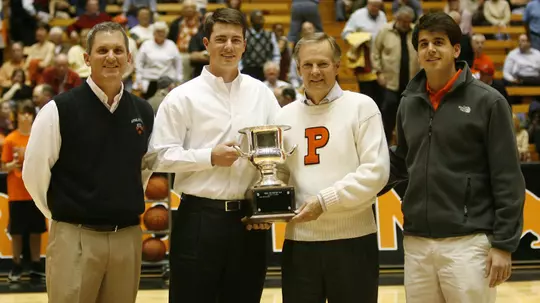
Stu Francis ’74 preceded both Sawin and Dana in going through the Princeton golf program, but unlike his fellow Tiger alums, Francis has maintained close ties with the sport while having a principal career that has nothing to do directly with golf.
“What I tried to do was to have a career, have a family, but continue to compete on a state and national level in amateur golf,” Francis said. “What that required was a fair amount of effective time management.”
Francis, who was elected president of the U.S. Golf Association earlier in 2020, has built a continuing and long career in investment banking and has given back to the Princeton golf program by helping to endow the men’s head coaching position. He has also stayed close to the sport by competing in amateur events through the years, and through that, he grew his connection with the USGA. In 2015, that resulted in a position on the USGA’s Executive Committee, and five years later in the USGA presidency.

“It was finally at a point in time where my career had gone pretty well over 35 years and our kids were grown and out of college,” Francis said of his increased involvement with the USGA. “I was asked to put my name in the hat and was fortunate enough to be selected.”
That time has allowed Francis to come up with a succinct way to explain the different ways that those who want to keep golf in their life and aren’t professional golfers can do so. His continued connection with the Princeton program allowed him to impart that knowledge to the current Tigers in a video call this spring.
“There’s social golf, there’s competitive golf, and there’s business or career-related golf, and so for me, I said it was going to be very hard to play all three types of golf,” Francis said. “Competitive golf is the most important to me, and business golf can be helpful in certain situations, so most likely I would limit my amount of social golf, and that’s how I’ve done it. That was one of the questions that came up on the Zoom call with the team is, how have you been able to combine business, family and competitive golf?”
#OnceATigerAlwaysATiger
— Princeton Golf Team (@princetongolf) April 9, 2020
Stu Francis ‘74, current President of the USGA, dispensing wisdom and guidance to the program about life, careers, and his love of the game. pic.twitter.com/VHVPGCiFq7
As Dana, Sawin and now the current Tigers have spoken about, how to maintain ties with the sport is a question that outlasts generations. For some, it will include a career in a golf-related profession. It could also mean maintaining ties with the Princeton program, as Francis and many others have. But for most, it will mean getting out on the course when you can, or playing in the course of other business.
“They’re all trying to grapple with, I do love competitive golf, how do I combine it with the rest of my life? Those questions come up every day, every week, every month, every year for the rest of your life, because you have commitments you might make to a tournament, then you have something come up at work or your kids have a soccer game, and you have to figure out how you prioritize it. Each person has to figure out, what do they want?” Francis said. “I think the teams overall, the student-athletes are just very impressive people who are going to select their path and do well with whatever they decide to do, but I was trying to help them understand that you need to select the path. It doesn’t get selected for you.”
Francis, Dana and Sawin have selected their paths, all different, and all maintaining a relationship with golf in some way. The paths, despite their differences, are all well-worn, and they’re about to be tread by the Princeton golf Class of 2020 and beyond.