Joey Daniels '20 Chases Olympic Dream
1/11/2021
Life is full of hurdles, but true champions find a way to overcome them. Despite setback after setback, the Olympic dream is well and truly alive for Princeton men's track & field alumni Joey Daniels '20, who is competing for one of the three spots on the Canadian national team in the 110-meter hurdles for the 2021 Tokyo Olympic Games.
In order to qualify, he must first run the Olympic standard time of 13.3 seconds and be in the top three in his country. In normal times, should an athlete not qualify that way they can qualify through world rankings, which requires attendance at meets. It is a severe understatement to say qualifying for the Olympics is not an easy thing to do in the most normal of times.
“The tough part about this season has been finding competitions,” explained Daniels. “I know people who've already made the Olympics from Canada are getting nervous because Canada's not looking like it’s going to have any competitions in the near future and traveling abroad they'll have to quarantine for 14 days or 10 days or whatever it is just to even get out there and get to the meets. It's going to be a little interesting how qualification works worldwide.”
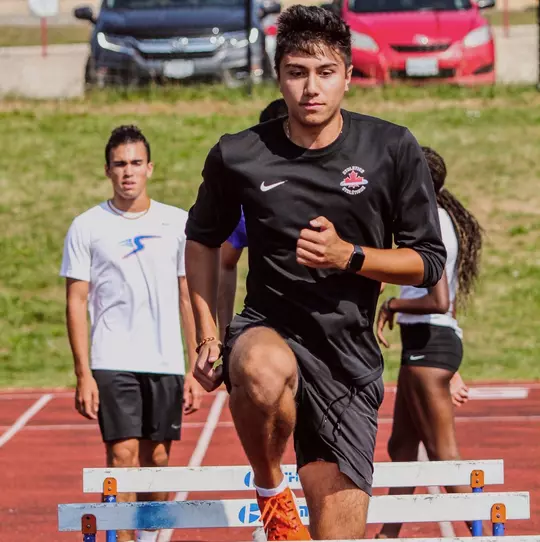
Daniels will be using his final year of eligibility at the University of Nebraska, who is planning on having a reduced season. Whether at an intra-squad meet or a meet against local schools, there is a likelihood Daniels will have an opportunity to meet the Olympic standard time.
“I always had high hopes when I was a kid,” said Daniels. “I was a hockey player and I wanted to make the NHL then as soon as I made the switch to track I wanted to make the Olympics. I never settle for anything but the best and I always push myself."
While he had long wanted to qualify for the Olympics, it was not until 2015 that Daniels began to believe it was a realistic possibility. The turning point was the Under-18 World Championships.
“I surprised myself and kind of had a breakout meet,” proclaimed Daniels. “I won a silver medal at the championships and then it was at that moment that I was like ‘okay you know what? This could actually happen.'"
Ever since that day I’ve made sure that I was putting myself in the best position possible come 2020 or 2024.Joey Daniels
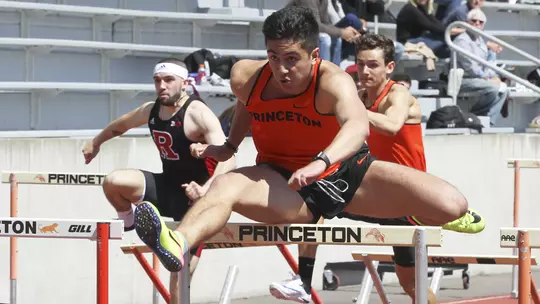
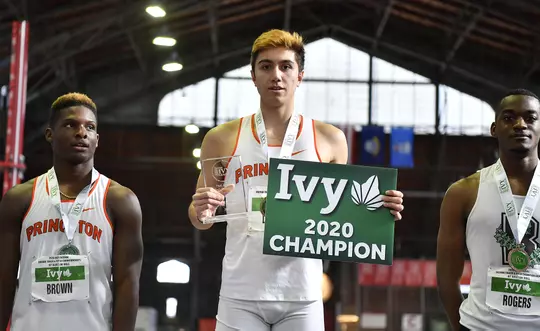
Daniels certainly did put himself in the best position possible during his years at Princeton. He was an Outdoor All-American in the 110 hurdles in 2019 and was the Ivy Heps Most Outstanding Performer in 2018. He was a three-time Ivy League Champion in the 60 hurdles, a two-time Ivy League Champion in the 110 hurdles and was part of the Ivy League title-winning quartet in the 4x100 in 2018. Daniels holds school records in the 60 hurdles (7.77), 110 hurdles (13.70) and 4x100 (39.90). Olympic qualification seemed to be part of his trajectory as an athlete.
Then came COVID-19.
The past year has been a rollercoaster. Daniels helped the Tigers win an Ivy League Championship in February, but when the outdoor season was canceled he still remained on campus for the remainder of the semester. While weight room access was cut off, Daniels had access to the outdoor track and was able to train there throughout the spring provided he followed all COVID-19 health and safety protocols.
I tried to kind of shut out all the emotions of that announcement and everything that was happening in the world.Joey Daniels
“When it comes something as big as the Olympics you just have to keep your head down,” proclaimed Daniels. “I was like ‘hey, they haven't said anything about the Olympics as of that week so I just have to assume that it's still going on.’ I remember right after that that meeting I went straight over to the track, started practice as per normal and trained. That was pretty much what happened those two weeks and I just kind of put my head down. I was like ‘I can't think about what could happen, what couldn't happen.’ I remember getting mad at my friends who were trying to talk about the possibilities of how COVID was going to play out from the perspective of sports being canceled and I was like ‘it doesn't matter, all you can do is make sure you're prepared if it happens and there's no point thinking about whether it is or not.'”
Since returning to Canada, Daniels was fortunate enough to have a rubberized track five minutes from his house.
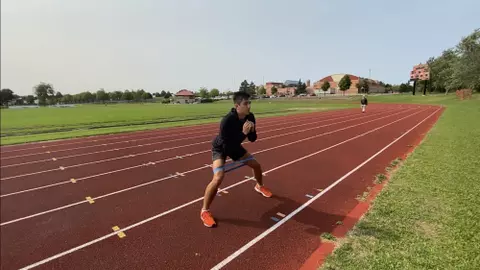
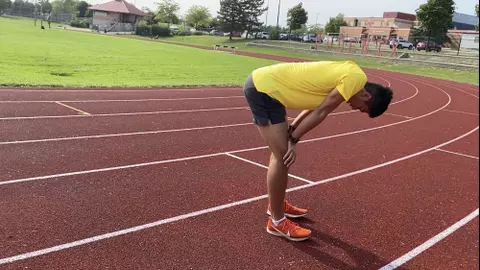
This was fantastic for the summer and fall, before the freezing temperatures and permanent layers of snow hit in the winter. He quickly realized that being out on the track by himself was not the same as practicing with his teammates at Princeton. Often, Daniels is accompanied by his girlfriend Tamara, who is on the women's track & field team at the University of Pennsylvania. After years of practicing in such a high-energy, team environment at Princeton, the change to solo training has been an adjustment. Tamara's presence has been crucial.
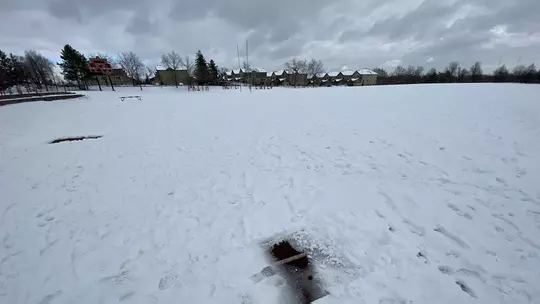
“It's been tough, there's so many days when you wake up and you just don't want to go to practice, especially when it's long run day,” said Daniels. “There's no one standing there who's going to call you and be like ‘Where are you? Get to practice!’ It's tough. If my girlfriend wasn't here with me some days I just wouldn't have gone. It was really nice having her and we just kept pushing each other to get out there and keep training. I'm sure if I was alone it would be really tough, but that just goes back to the team at Princeton. Being in that atmosphere makes you so much better and it's really tough training by yourself.”
Fortunately for Daniels, there have been occasional lighter moments that have helped him through the grind.
“I have a weight sled that I use on the outdoor track and because it's a public track there's a bunch of people walking around it during the evenings,” explained Daniels. “For some reason, dogs are always interested the sled pull when it's moving and I had to start going to going to train at that track during the middle of the day when nobody was around instead of the evening because every time I pulled that thing, dogs would just come, run and take out my legs like they were trying to come steal the sled from me. It's just a little funny thing that made me smile and because I’m training by myself and with my girlfriend for months at a time, it's just me and her at the track, it is tough. It was just nice having a little thing to laugh about."
When the cold, Canadian winter set in, things really began to get interesting. Given what was at stake, Daniels was willing to make a significant commitment both time-wise and financially to ensure he was giving himself the best shot at qualifying for Tokyo.
“I’m really grateful to have had facilities open to me by Athletics Canada,” said Daniels. “They’re in Toronto and London, but those are both an hour-and-a-half commute each way for me and it's kind of made me run into a couple injury problems, having to drive, sitting in traffic every day, 90 minutes both ways.”
Despite the obvious inconveniences, Daniels was willing to suck it up and commit to the commute.
“At the peak, I was doing it five days a week and it kind of takes up the whole day,” explained Daniels. "Lots of driving, lots of gas money.It takes a toll on your body," said Daniels. "With COVID you're only allowed in the facility for a set amount of time, sometimes an hour, hour-and-a-half, so you don't have time to let your body relax, to stretch, to warm up properly so it's been really tough that way trying to stay healthy and get good training at the same time.”
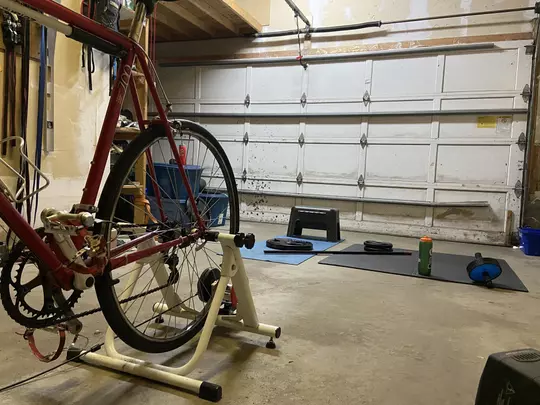
Over the past six weeks, Daniels’ training has had another change of scenery due to all of the issues presented by the commute. He admits it hasn't been easy, but has made the best of the situation and stayed the course.
I’ve mostly been training in my garage on a stationary bike. I have a 55-pound barbell that I've been using creatively to build strength, but this last month's been really tough with the weather.”Joey Daniels
While Daniels may have graduated and left Princeton, Princeton has certainly not left him. Since moving back to Canada, he has followed assistant coach Robert Abdullah’s workouts and remained in frequent contact with him. The pair’s relationship has developed into a deep one over the years.
“What makes Coach Abdullah special is that he's like a father to all of us on the team.Joey Daniels
“He’s relationship-first and then performance second and that’s what makes him stand out from other coaches. That's why I chose Princeton in the end, because of him. We built a really great relationship over the four years. For sprint hurdlers, the hurdle height goes up three inches from high school to university and it's really hard for a lot of people to make that change. A good number of hurdlers lose performance just because the height changed, I know I struggled with it the first year but he got me over that hump and pushed me in the direction of the Olympics. Everything is thanks to him. This year was such a disappointment with COVID and everything and we were expecting really big year, that's why I was just like 'hey, our story's not over. You and me coach, it's still working, it ain't broke, don't fix it.'”
Abdullah’s attention to detail is rare, and one of the key reasons why to this day Daniels developed into the caliber of hurdler he is today.
“He’s ruthlessly technical,” explained Daniels. “He takes video and breaks it down way more than anybody else does. That coaching style may not work for everyone, I know there are a lot of hurdlers that just like to keep it simple but for me especially and I'm sure the type of person that goes to Princeton, we love to break it down and make sure we're understanding every single little thing, making sure the angles of your legs are to the degree that they should be. Every single run he gave feedback, pushed me to be better and never took his foot off the gas. He's a perfectionist and that’s what works with him as a whole.”
Along with Abdullah, Daniels is beyond grateful for his Princeton experience as a whole.
“It's the people, it's the people academically and athletically,” said Daniels. “It’s hard academically, really time-consuming but I feel I got most out of Princeton was studying with my friends, I became a much better writer. English was my really weak point when I got into Princeton and my writing got way better just because my friends were amazing writers and being with them, talking with them, reading over each other's essays made me better. Athletically, the guys on the team being at such a high level pushed me to be at a higher level. The coaches, their personalities made me a better person, made me a better man, more mentally strong as an athlete, a better athlete."
It’s the people at Princeton that really make it special and that's what I always will always be grateful for.Joey Daniels
Whatever the future holds, Daniels will look back on his time at Princeton filled with joy. While the present is a fluid situation, Daniels is making the best of it.
“I made a YouTube channel because I just wanted to document the year,” said Daniels. “It’s a really big year for me personally, in my athletic career because now that I'm graduated and I'm using it at my last year instead of eligibility, it's kind like the end of the road if things don't go well. A lot of a lot of people don't realize that that this is kind of the end of the road performance-wise, it's either you make it or you don't. There's not a lot of money in track and field unless you're Usain Bolt and it's going to be tough figuring out how to continue financially career-wise, whether things go well or not. I wanted to document the pressure that I feel.”
Daniels has always been one to make the best of situations – and this one might just end in Tokyo.