


.png&width=24&type=webp)

Princeton University Athletics
Players Mentioned

/ Men's Squash

/ Men's Squash

/ Men's Squash

/ Men's Squash

/ Men's Squash
/ Men's Squash
/ Men's Squash
/ Men's Squash
/ Men's Squash
/ Men's Squash
/ Men's Squash

/ Men's Squash
/ Men's Squash
/ Men's Squash
/ Men's Squash
/ Men's Squash
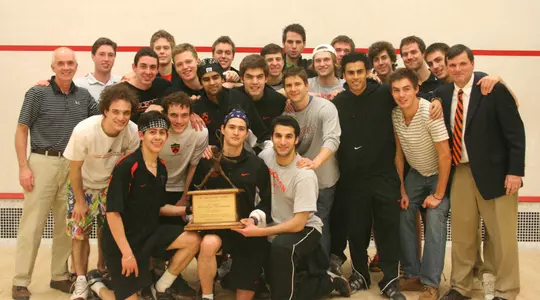
Fifth Straight Ivy Title Remains Top Goal For Upcoming Men's Squash Season
November 20, 2009 | Men's Squash
The last time it took the court, the Princeton men's squash team was locked in a 6.5-hour epic for the national championship. The Tigers came as close as anybody over 12 years and 200 matches to unseating Trinity, but they fell two points short here, four points short there.
Months later, the 2009-10 Tigers have reloaded and will begin their journey to, ideally, a fifth straight Ivy League championship and a fifth straight berth in the national championship final. But with traditional Ivy League powers Yale and Harvard looming and rising programs like Cornell and Rochester looking to stake their own claim in the national scene, Princeton knows it will be a long road to such lofty goals.
A long road, of course, that won't include “The Amigos.” For the first time in four years, the likes of Mauricio Sanchez, Kimlee Wong and Hesham El Halaby won't be powering the top of the lineup. In fact, for the first time in seemingly forever (or, for the sake of accuracy, the 2001-02 season) there won't be an El Halaby anywhere in the lineup.
But some of the names you became accustomed to over the last three seasons are returning, and a new name that much of the squash world knows well could end up leading the charge.
For the first time since four-time national champion Yasser El Halaby debuted at No. 1 to start the 2002-03 season, a freshman will open the season atop the Princeton lineup. A graduate of the Episcopal Academy in Philadelphia, a school that once produced veteran head coach Bob Callahan, Todd Harrity comes into the collegiate season with arguably one of the top American résumés ever. A former U.S. Junior Open Championship and the U.S. Junior Championship winner and the top-ranked boys U-19 player for more than three years, Harrity is a relentless shotmaker who never beats himself. Others rarely do, either.
He will lead a lineup that has players from each class near the top of the ladder. Seniors David Canner and Santiago Imberton, who join classmate James Thorman as 2009-10 captains, are the veteran presences for the men's squash team. Canner was a somewhat unheralded recruit who has grown into one of Princeton's most reliable players through his work ethic and power game. He has won three of his last four matches against Trinity and has never lost a regular season match in Ivy League play.
Imberton has been a mainstay in the lineup as well and peaked as the No. 18 player his sophomore year. He won every non-Trinity match he played last season and will be one of the most experienced mid-lineup players in the nation this season.
The junior class is nine-deep and includes a pair of brother tandems, the Sophers and the Callahans. The name you will see near the top of the lineup is David Letourneau, a two-time first-team All-America and the 2008 Ivy League Rookie of the Year. One of the most creative shotmakers in college squash, Letourneau has won 11 matches in each of his last two seasons and has reached the national individual quarterfinals in each year he competed. Callahan believes Letourneau took a big step forward this past offseason and posted the kinds of results that make him optimistic about an even better junior year. Like many of his teammates, he has never lost an Ivy League match.
The next-highest junior in the lineup is likely to be Peter Sopher, a tireless worker both on the court and in practice sessions. Sopher won 12 matches last season, but his final one might have set him up for even greater future success; in the national team final, he earned a 3-1 win at No. 9 over Trinity that should give him a significant boost in confidence this year.
Classmate Nikhil Seth and Philip Sopher could also factor into the lineup, especially early as Princeton deals with injuries. A pair of the key injuries affect the sophomore class, which has a chance to go down as one of the great ones in Tiger history.
It starts with last year's Ivy League Rookie of the Year, Chris Callis. A first-team All-America selection, Callis went 12-1 last season playing No. 2 or No. 3 and only lost a five-game thriller in the national final to Trinity senior captain Manek Mathur; that match came one day after Callis won a 3-2 thriller over Rochester's Hameed Ahmed. Callis is powerful on the court and a tough competitor, and his health will go a long way in determining Princeton's fate this season.
The same holds true for Kelly Shannon, who was the more touted recruit last season. Shannon spent most of last season dealing with a back injury and fought hard just to get back for the final two weeks of the season. He made the most of it, rallying from a 2-0 deficit in the national team final to earn a 3-2 win over Trinity and then reaching the national individual quarterfinals before falling in a fairly competitive match to eventual champion Baset Chaudhry of Trinity. Shannon, who has won multiple Canadian Junior and American Junior Open Championships, has the kind of game to someday compete for an individual championship, but he has yet to be at 100 percent.
Both David Pena and Clay Blackiston may not have the history of their classmates, but don't look past either this season. Pena will start the season in the lineup after winning 10 of 11 matches last season, while Blackiston had success in limited varsity action last season. Both are talented and could be counted on for key wins in the seven through nine spots.
Another freshman who could factor into the lineup is Steve Harrington, a Penn Charter graduate who has reached as high as third in junior rankings.
College squash scores will have a new look this season; the C.S.A. has adopted the professional tour rules, so each game will be played to 11 (instead of 9) with rally scoring rules. Thus, instead of only scoring points on your own serve, you score on every point. All games must be won by two points, and there is no ceiling; in previous years, when games went to nine, you could win a game 10-9. One-point victories will no longer happen in college squash. Matches are likely to be shorter and should provide more exciting finishes in several individual games and matches.
Months later, the 2009-10 Tigers have reloaded and will begin their journey to, ideally, a fifth straight Ivy League championship and a fifth straight berth in the national championship final. But with traditional Ivy League powers Yale and Harvard looming and rising programs like Cornell and Rochester looking to stake their own claim in the national scene, Princeton knows it will be a long road to such lofty goals.
A long road, of course, that won't include “The Amigos.” For the first time in four years, the likes of Mauricio Sanchez, Kimlee Wong and Hesham El Halaby won't be powering the top of the lineup. In fact, for the first time in seemingly forever (or, for the sake of accuracy, the 2001-02 season) there won't be an El Halaby anywhere in the lineup.
But some of the names you became accustomed to over the last three seasons are returning, and a new name that much of the squash world knows well could end up leading the charge.
For the first time since four-time national champion Yasser El Halaby debuted at No. 1 to start the 2002-03 season, a freshman will open the season atop the Princeton lineup. A graduate of the Episcopal Academy in Philadelphia, a school that once produced veteran head coach Bob Callahan, Todd Harrity comes into the collegiate season with arguably one of the top American résumés ever. A former U.S. Junior Open Championship and the U.S. Junior Championship winner and the top-ranked boys U-19 player for more than three years, Harrity is a relentless shotmaker who never beats himself. Others rarely do, either.
He will lead a lineup that has players from each class near the top of the ladder. Seniors David Canner and Santiago Imberton, who join classmate James Thorman as 2009-10 captains, are the veteran presences for the men's squash team. Canner was a somewhat unheralded recruit who has grown into one of Princeton's most reliable players through his work ethic and power game. He has won three of his last four matches against Trinity and has never lost a regular season match in Ivy League play.
Imberton has been a mainstay in the lineup as well and peaked as the No. 18 player his sophomore year. He won every non-Trinity match he played last season and will be one of the most experienced mid-lineup players in the nation this season.
The junior class is nine-deep and includes a pair of brother tandems, the Sophers and the Callahans. The name you will see near the top of the lineup is David Letourneau, a two-time first-team All-America and the 2008 Ivy League Rookie of the Year. One of the most creative shotmakers in college squash, Letourneau has won 11 matches in each of his last two seasons and has reached the national individual quarterfinals in each year he competed. Callahan believes Letourneau took a big step forward this past offseason and posted the kinds of results that make him optimistic about an even better junior year. Like many of his teammates, he has never lost an Ivy League match.
The next-highest junior in the lineup is likely to be Peter Sopher, a tireless worker both on the court and in practice sessions. Sopher won 12 matches last season, but his final one might have set him up for even greater future success; in the national team final, he earned a 3-1 win at No. 9 over Trinity that should give him a significant boost in confidence this year.
Classmate Nikhil Seth and Philip Sopher could also factor into the lineup, especially early as Princeton deals with injuries. A pair of the key injuries affect the sophomore class, which has a chance to go down as one of the great ones in Tiger history.
It starts with last year's Ivy League Rookie of the Year, Chris Callis. A first-team All-America selection, Callis went 12-1 last season playing No. 2 or No. 3 and only lost a five-game thriller in the national final to Trinity senior captain Manek Mathur; that match came one day after Callis won a 3-2 thriller over Rochester's Hameed Ahmed. Callis is powerful on the court and a tough competitor, and his health will go a long way in determining Princeton's fate this season.
The same holds true for Kelly Shannon, who was the more touted recruit last season. Shannon spent most of last season dealing with a back injury and fought hard just to get back for the final two weeks of the season. He made the most of it, rallying from a 2-0 deficit in the national team final to earn a 3-2 win over Trinity and then reaching the national individual quarterfinals before falling in a fairly competitive match to eventual champion Baset Chaudhry of Trinity. Shannon, who has won multiple Canadian Junior and American Junior Open Championships, has the kind of game to someday compete for an individual championship, but he has yet to be at 100 percent.
Both David Pena and Clay Blackiston may not have the history of their classmates, but don't look past either this season. Pena will start the season in the lineup after winning 10 of 11 matches last season, while Blackiston had success in limited varsity action last season. Both are talented and could be counted on for key wins in the seven through nine spots.
Another freshman who could factor into the lineup is Steve Harrington, a Penn Charter graduate who has reached as high as third in junior rankings.
College squash scores will have a new look this season; the C.S.A. has adopted the professional tour rules, so each game will be played to 11 (instead of 9) with rally scoring rules. Thus, instead of only scoring points on your own serve, you score on every point. All games must be won by two points, and there is no ceiling; in previous years, when games went to nine, you could win a game 10-9. One-point victories will no longer happen in college squash. Matches are likely to be shorter and should provide more exciting finishes in several individual games and matches.
Tuesday, June 04
Saturday, February 10
Wednesday, June 22
Monday, June 06