


Princeton University Athletics
Working OT On Memorial Day
June 19, 2001 | Men's Lacrosse
June 19, 2001
They were 16 seconds away from a championship. Sixteen seconds. And then, bang, tie game. Overtime.
Surely there was no way for Princeton's men's lacrosse team to regroup. Syracuse would win the face-off, and Princeton would probably never touch the ball before it was over.
Only the most devout could still believe in the Tigers, a team that 15 minutes earlier had been nursing a four-goal lead and who had been in control the entire day. And now the Orangemen, the biggest nemesis, the powerhouse, the team that had handled Princeton four straight times, were on the verge of snatching it all away.
Except for one thing. This was overtime. And nobody does overtime like Princeton.
In a riveting 3:19 of sudden death, each team had the ball twice. Princeton first. Then Syracuse. Then Syracuse again.
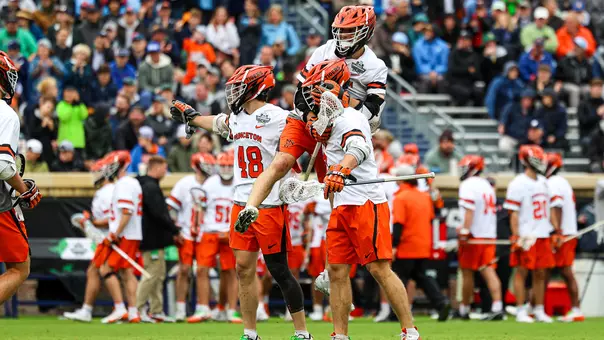
And then it was Princeton again. Ryan Mollett with the key check to get the ball. Ricky Schultz and Chris Harrington with the clear. Sean Hartofilis with the ball behind the net to Ryan Boyle. And finally the feed in front to B.J. Prager, who did was he does better than anyone in the game. Prager lost his man on the crease and, taking Boyle's feed, flipped it past Syracuse goalie Rob Mulligan for the championship.
Princeton 10, Syracuse 9.
While it was another heartstopper, it was also somewhat predictable. Keep in mind, these are the Tigers.
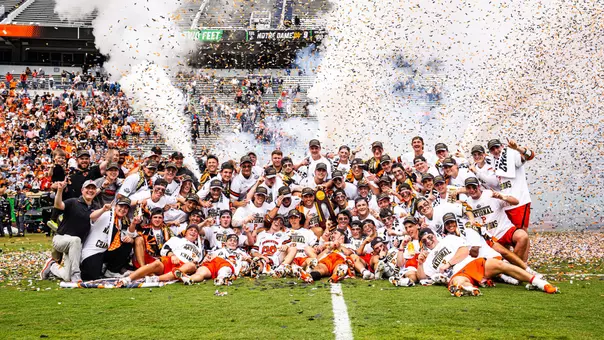
The victory gave the 2001 Princeton Tigers their sixth NCAA championship, all in the last 10 years. Of the six championships, a staggering four have now come in overtime. Princeton is now 4-0 in overtime in championship games.
The title completed a remarkable run through the NCAA tournament, which saw Princeton defeat Loyola, Towson and finally Syracuse by one goal each. The three wins ran Princeton's winning streak in one-goal NCAA games to an unbelievable 11 straight.
The Tigers finished the year 14-1, with their only blemish a 14-8 loss at Syracuse on the final Saturday of March. That loss left Princeton with four straight losses to the mighty Orange, including a 13-7 defeat in the 2000 NCAA final and a 16-4 loss at home in the 2000 regular season.
In a year in which college lacrosse saw more than its share of upsets and upstarts -- most notably Towson and Notre Dame, who both reached the Final Four -- the two best teams were clearly Syracuse and Princeton, who have now combined to win 12 of the last 14 NCAA championships. While fans of the respective teams may have wanted to see the other get upset before the final, there would have been a certain hollowness to a title won without victory over the other, especially for Princeton.
The Tigers were a young team in 2000, one that might have been satisfied with merely making the NCAA final. It was clear in 2000 that Syracuse was the better team.
The Princeton team that began its 2001 season at home against Johns Hopkins in early March suffered two major hits from graduation the year before, but those losses had been offset by another great recruiting class led by the dynamic feeder Boyle and the return intact of the nation's best defense.
Princeton opened its season with an 8-4 win over Johns Hopkins, backed by four assists from Boyle in his debut. Princeton did not allow a goal until the third quarter and led 8-1 at one point.
The following week saw Princeton score three times in the fourth quarter to match that 8-4 win against Virginia, and then a trip to Hofstra featured a 10-1 lead that became a 10-5 win.
That set the stage for a trip to snowy Syracuse, where the game would be played inside the cozy Carrier Dome. The Orange had lost there the previous week against Johns Hopkins to fall from the No. 1 spot in the rankings, now occupied by Princeton. On this day, though, Syracuse was by far the best team in the country. Princeton played from behind the entire day and had no answers for the Orange, who won easily 14-8. Princeton may have fallen from No. 1 with the loss, but as a prophetic Mark Eckel wrote in the Trenton Times: "The only thing decided on this day was which team will get to wear white uniforms on Memorial Day."
Princeton now stood at 3-1 with eight regular season games to play, and the Tigers would be a prohibitive favorite in all eight. In fact, Princeton was a combined 40-0 against its remaining eight opponents -- six Ivy schools plus Rutgers and Hobart -- over the previous five seasons.
The 2001 run through this group began with a 14-5 win at Rutgers on a frigid Tuesday night. The Ivy League season began next with a trip to Yale, where the pesky Bulldogs had it 0-0 after the first quarter before striking first early in the second before Princeton ran off to a 12-3 win.
Next up was Penn, where Boyle would have two goals and six assists despite playing half the game in a 19-8 win. Brown and Harvard then fell on consecutive Saturday's at home by a combined 30-3.
This set the stage for a trip to Cornell and a matchup between 4-0 Ivy teams. The winner would clinch the league's automatic bid to the NCAA tournament, and for 14th ranked Cornell, it would be the only way into the field.
The inspired Big Red, led by goalie Justin Cynar, led 3-1 at intermission and 4-1 in the third quarter before Princeton made its move. Matt Striebel scored to make it 4-2, and then Sean Hartofilis scored three straight to give the Tigers the lead early in the fourth. Kyle Baugher and Prager sealed it with late goals, but the defense had everything under control long before that, holding Cornell scoreless for the final 28 minutes. Mollett, who wiped out Cornell's David Key while adding a key assist himself, would be named Ivy Player of the Week, but the entire defense could have shared the honor.
All that stood between Princeton and an outright title was a Dartmouth team playing its fourth game in eight days, and the Big Green was no match in a 19-2 Princeton win. That victory gave Princeton its seventh straight league title and eighth in the last nine years. Princeton also ran its Ivy winning streak to 37 games, leaving it two off the all-time record (set by Cornell from 1972-79) entering 2001.
Princeton knocked off Hobart 16-8 to end the regular season, and the No. 1-ranked Tigers earned the second seed behind Syracuse for the NCAA tournament. First up was Loyola, who had defeated Georgetown in the opening round of the tournament and Syracuse in the regular season. This would be a tough defensive struggle, and Loyola would lead 4-3 at halftime before Princeton turned things around, grabbing an 8-5 fourth quarter lead. The Greyhounds would score twice more to cut it to one with two minutes left, but a key defensive play by freshman Drew Casino gained possession of the ball after a lost face-off and the Tigers ran out the clock to earn a spot in their eight Final Four in 10 years.
Towson, 3-11 a year ago, had more than turned its program around under veteran coach Tony Seaman, who was taking his third team to the Final Four. Princeton would lead by as many as four early and in the fourth quarter at 10-6, but back came the high-flying Towson team, who tied it 11-11 with three minutes left.
Hartofilis, though, scored the game-winner on a feed from Mollett, who had first stripped the ball away. For Hartofilis, it was his fourth goal of the day and ninth in two NCAA semifinal games.
All that was left was Syracuse. Since the start of the 1992 tournament, Princeton was now 18-0 against all other opponents and 3-4 against Syracuse in NCAA games. More importantly, Princeton was 24-0 against all other opponents and 0-3 against Syracuse in its last 27 games.
But those three previous losses to Syracuse, by a combined 49-17, had seen the Orangemen get off to flying starts each time. This time, it was Princeton, led by Brad Dumont's two goals, who got out quickly.
It was 3-0 Princeton after the first quarter and 5-1 at one point of the second quarter before the Orangemen made it 5-3 at intermission. Princeton, though, built it to 7-3 in the third and then 8-4 entering the fourth.
Just when it looked comfortable, Syracuse scored four straight in seven minutes to tie it at 8-8. Princeton regained the lead on Matt Striebel's goal with 6:17 to play, and it looked as though the Tigers would weather the storm before a turnover gave Syracuse one more chance with 28 seconds to go. The Orange got the ball to freshman Mike Powell, along with Boyle the two best rookies in the game, and Powell scored with 16 seconds left to send the game into the OT.
Prager, who had missed the 2000 tournament with a torn ACL, was the key man for Princeton. After seeing his 31-game goal-scoring streak snapped against Loyola, Prager scored three times against Towson, and his overtime goal against Syracuse was his fourth of the final. He joined Andy Moe, Kevin Lowe and Jesse Hubbard as Tigers who had scored NCAA-winning goals in overtime. Prager finished the season with 36 goals, of which Boyle had an assist on 20.
Boyle would lead the team in scoring with 53 points (16 goals, 37 assists) to become the first freshman since Lowe in 1991 to do so. He would also be the Ivy Rookie of the Year.
Mollett would be the Ivy Player of the Year, and he was joined by goalie Trevor Tierney, attackman Hartofilis and middies Striebel and Rob Torti as first-team All-Ivy. Boyle, Prager and defenseman Damien Davis were second-team picks, while defenseman Scott Farrell was named honorable mention.
Mollett and Tierney were first-team All-Americas, while Hartofilis and Davis were second-team.
Mollett and Tierney also won USILA awards as the top defenseman and goalie in the country, and they were the top two picks in the Major League Lacrosse draft. Striebel and Torti were also selected by the MLL.
Mollett, Tierney, Striebel, Boyle and 1994 Ivy Player of the Year Kevin Lowe were named to the U.S. team for the 2002 World Championships.