


Princeton University Athletics
Picture Perfect
April 27, 2007 | Men's Lacrosse
Time heals, they say, and they would be wrong. Time creates distance, and it is the distance that heals.
What time does is blur. It takes what was certain in the moment and distorts it in the memory. Reality now is not the remembrance of an hour from now, a day from now, a year from now. The more time goes by, the more it blurs.
And so it is that Ben Strutt remembers how “Brendan Glass scored six goals against us” when he really scored three. And that Mark Whaling mixed up the details of the two NCAA championship games he played against Maryland. And how Becket Wolf had a sequence of key goals from a semifinal win in the wrong order. And even how Bill Tierney remembered that his 29-game winning streak ended against Virginia when “they got up on us by nine or something and the final score made it seem closer than it was,” even though that was the game that preceded the start of the winning streak and not the one that ended it.
There are, nevertheless, some events so vivid, so strong, so indisputable, that no amount of time will ever shake their memory. And in this case, all four remembered the most paramount detail about their involvement with the 1997 Princeton men's lacrosse team:
“We were undefeated,” Tierney says.
“We were undefeated,” Strutt says.
“We were undefeated,” Wolf says.
“We were undefeated,” Whaling says.
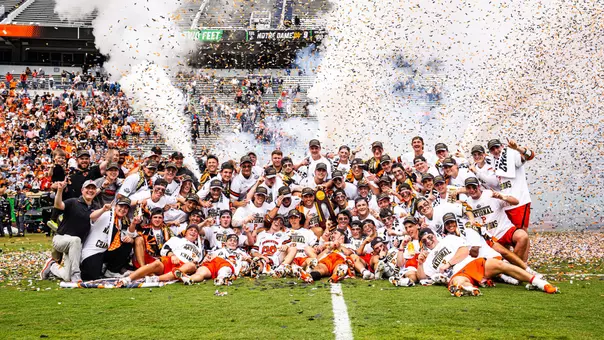
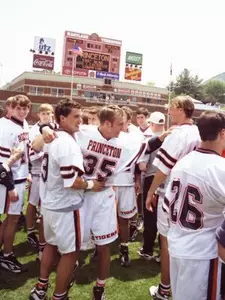
It has been 10 years since the 1997 Princeton Tigers went 15-0, capping the season with a 19-7 win over Maryland on the Terps' home field of Byrd Stadium in the NCAA final.
“I have never had another perfect team,” says Tierney, the Tigers' Hall-of-Fame coach. “Never. On any level. Not even the Hillsborough Dukes midget football team. Even they were 11-1.”
Between North Carolina in 1991 and Johns Hopkins in 2005, only the 1997 Princeton Tigers went undefeated and won the NCAA championship. At Princeton, the 1997 team is the only undefeated team since it was done back in 1935.
Princeton opened the 1997 season with back-to-back overtime wins, 7-6 over Johns Hopkins when freshman Josh Sims scored 1:42 into the OT and 14-13 over Virginia when senior Todd Eichelberger scored 1:32 into OT. The season ended with a 12-goal win over Maryland in the title game, with the unlikely sight of the Tigers as they reached Tierney's self-imposed 19-goal rule on the biggest stage for the sport.
It is arguable as to whether or not it was the best Princeton team ever. The year before and the year after also ended with NCAA championships, and the only blemish on either year was a loss at Virginia in Week 2. A case can be made for any of the six NCAA championship teams under Tierney, or even perhaps the 1993 team or 2002 team, which both fell just short.
The 1997 team was not the highest scoring team (1996) nor the best defensive team (2001) under Tierney. The 1996 team had a larger average margin of victory; the 1998 team featured the senior season of perhaps the greatest attack unit of all time of Jesse Hubbard, Jon Hess and Chris Massey.
“The other teams all lost somewhere,” Tierney says. “The 2001 team got blown out at Syracuse during the season, for instance. We lost at Virginia in 1996 and 1998. I think 1997 was the best team. Maybe it was the fact that they lost one less game than the others. Maybe that changes the way we remember them.”
Princeton entered the 1997 season coming off the third NCAA title in school history, all of which had come in overtime. The 1992 team was a huge underdog when it emerged at Franklin Field in Philadelphia on Andy Moe's goal to start the second overtime of a 10-9 win over Syracuse. The 1994 team defeated Virginia at Byrd Stadium on Kevin Lowe's overtime goal and in doing so it gave legitimacy to the Princeton program as more than just a fluke national champion.
The 1996 team was the start of something completely different. This time, Princeton had established itself as a legitimate power in the sport, and it was loaded with talent at every position. The main rival at the time was Virginia, whom Princeton defeated in a classic final in 1996. The Tigers appeared to be in control until a furious UVa rally evened it, forcing Hubbard to knock in a goal in overtime for a 13-12 win.
Both teams had their nucleus returning for 1997, and it seemed like a good chance for a third Princeton-UVa final in four years. Princeton had nine players back who had been All-Ivy League in some capacity in 1996, including first-team selections Eichelberger, Hess, Hubbard and Wolf.
“Our motto the whole year was ?Back to Byrd,'” says Wolf, then a converted attackman on defense and now working with a hedge fund in Chicago and the father of a 15-week-old boy, Turner. “Every huddle we had that season, no matter what the situation, no matter what point we were at, Eichelberger would yell ?Back to Byrd.'”
The season began with the overtime win over Hopkins the same weekend that Syracuse defeated Virginia 22-21 at the Carrier Dome. The next weekend, when Princeton knocked off UVa, the Tigers were already ranked No. 1, while UVa was ranked third behind Syracuse. The Princeton win gave the Tigers a school-record 15th straight win.
The third week saw Princeton take on North Carolina in Chapel Hill in a game that was 8-8 after three quarters. Carolina would then take the lead, only to see Princeton tie it on Lorne Smith's goal and win it on Craig Katz' goal with 1:59 to go.
“Those first games didn't really represent what we thought our goals for the year were,” Wolf says. “Early on, we were a little nervous that it might not come together for us.”
Princeton was basically without Hubbard for the first three games. Coming off a school-record 53-goal season (a record that still stands), Hubbard suffered a preseason shoulder injury and wasn't fully healthy and able to start until Week 4, when Princeton played at Penn State in a game moved indoors to a football practice facility due to snow and extreme cold. Hubbard scored four times against the Nittany Lions, and Princeton won 18-6.
Princeton would tear through the final eight games of the regular season, winning seven by at double figures with only an 8-5 win against Brown on a day when Bear goalie Greg Cattrano would make 20 saves closer than 10. Princeton would reach the 19-goal limit on four consecutive occasions in midseason, including a game at Rutgers in which the Tigers scored their 19th goal 41 seconds into the fourth quarter and then held it the rest of the way without a shot.
Princeton began the Ivy season by building a 10-0 lead at Yale. Before the league season ended, Princeton had reached 19 goals three times and 18 goals once. The aggregate score for the six league games was 98-33; the average score at the end of the third quarter of the six games was 15.0-3.2.
Princeton was rewarded at season's end with the top seed in the NCAA tournament, which was still a 12-team event then. After a first-round bye, Princeton took on UMass at Hofstra in the quarterfinals.
“That game was a huge wakeup for us,” says Strutt. “I think we may have underestimated them. That game refocused us and toughened us up.”
The game went back-and-forth until it was 4-4 in the first quarter before the Tigers scored five straight to build a 9-4 lead. UMass never really threatened, but Princeton struggled before holding on 11-9 as Hubbard scored six.
“UMass was a difficult game,” says Wolf. “Our attack really carried us through that game. We made a lot of mistakes. I think we came out of that still wanting to put together a complete game on both ends of the field.”
The win accomplished one part of the “Back To Byrd” goal, as the Tigers returned to the Final Four against Duke in one semifinal while Syracuse took on Maryland in the other. Maryland had shocked Virginia in the quarterfinals.
“We fully expected to play Virginia again,” Wolf says. “It was a huge surprise when they weren't there.”
If Princeton thought it was going to be easy minus its biggest rival, there was nothing in the first quarter against Duke to change anyone's mind. Princeton raced out to a 6-1 lead and threatened to blow the Blue Devils out. Instead, Duke came roaring back, shocking the Tigers to tie the game at 6-6 at intermission. The rest of the day would be an incredible struggle that would completely test Princeton's character.
“We got out on them big,” says Strutt. “They came back on us in the second and third, but we took care of them in the fourth. We could bookend teams like that. Get out on them strong; finish them at the end.”
Hess scored the first goal of the second half, but Duke would score three straight, including an Ed Fay goal with two seconds left in the third quarter that made it 9-7 Blue Devils with 15 minutes to go.
More than eight minutes would elapse in the fourth quarter without a score change. During that time, Tiger goalie Patrick Cairns made a miraculous save on Fay to keep it a two-goal game. Finally, Jason Osier?who back in March had gotten national publicity for playing lacrosse and basketball for Princeton on the same day?scored with 6:28 left to make it a one-goal game, and Eichelberger tied it a minute later. It would take Princeton just 35 more seconds to take the lead, when Hess found Massey on a perfect backdoor cut, and the Tigers had the lead at 10-9.
Princeton would then win the face-off and spend the final 4:50 of the game playing keepaway from the Blue Devils, who would never regain possession. After a huge test, Princeton was back in the championship game.
“The Duke game,” Wolf says, never finishing the thought. “There were some great individual performances. Pat Cairns stopped Ed Fay one-on-one. If he didn't do that, the season would have ended right there. Eichelberger scored a diving goal. Some people say he was in the crease, but I've finally seen a tape that puts that to rest. Massey went backdoor perfectly. All those plays were the difference. All of those individual efforts. Had we not won that game, we'd have had to live with that forever.”
Maryland bounced Syracuse in the other semifinal, setting up a game in which Princeton was a prohibitive favorite, even on the opponent's home field. To that point, the last five games of the tournament had all been one-goal games, and all three of Princeton's title game appearances had gone overtime.
“They were really confident,” says Whaling, a junior on the 1997 team. “They thought that they had a great offense. They were at home. To play the way we did was very rewarding.”
Princeton completely dominated the first seven minutes of the game?and had absolutely nothing to show for it. Princeton threw shot after shot at the Maryland goal, only to hit pipes, miss the cage or watch Terp goalie Sean Keenan make tough saves.
The score was 0-0 midway through the first quarter, at which time there were two possibilities: Maryland had either taken Princeton's best shot and would be in the game the rest of the way or it was just a matter of time before Princeton erupted.
Hess finally broke through with 7:37 gone. Between then and the end of the first quarter, Katz had scored twice and Hubbard, Massey, Eichelberger, Smith and Jason Buttles had all scored once to make it 8-0 Tigers. The game was essentially over.
It was 10-3 at halftime and 16-5 at the end of the third quarter. Princeton reached the 19-goal limit with 4:36 to play, outshooting Maryland 52-34 along the way while matching the largest margin of victory ever in an NCAA final.
“We finally put it all together for the championship game,” Wolf says. “We worked out all the kinks. Everything clicked that day.”
Princeton would repeat the following year, even with the early-season loss to Virginia that ended the winning streak at 29 games. Hess, Hubbard and Massey would finish their careers with a combined 618 points in 60 games, including 127 in 11 NCAA tournament games.
As the years go by, the entire era of 1996-98 seems to run together, which isn't quite fair to the 1997 team.
“When I think of the 1997 team, I think of a team that had unique depth,” says Whaling, who works in finance and has two young children of his own. “You had nine guys or more who could score, who could have started for any team. More than that, it was a fun team. It was a team of great personalities. It was a team that had no cliques, where everyone from every class meshed. We had a lot of fun together. Granted, being undefeated helped.”
Princeton would win again in 2001, a team which had Strutt as an assistant coach.
“It was a lot different from the perspective of a coach,” he says from his Bank of Montreal office in New York. “That year, it was all Princeton-Syracuse. In fact, we spent a little time every week during the season working on Syracuse, knowing that if we were going to win the whole thing, we'd probably have to beat them. Back in 1997, it was different. We played three teams in the tournament that we hadn't played before. You never know.”
They're spread out throughout this country and even oversees now, the members of that team. Most are married, with little kids. They're in the late 20s, early 30s.
None of them graduated with one NCAA title. Every member of that team has at least two NCAA rings; most have three.
They have only one perfect season, though. The spring of 1997.
“We put very expectations on ourselves,” Wolf says. “Sometimes, that can be scary. If you don't live up to them, nothing else makes up for it.”
Not to worry. The 1997 team lived up to every challenge, from start to finish. Its legacy isn't one of disappointment or unfulfilled potential or anything negative.
In fact, it's just perfect.
- by Jerry Price
1997 RESULTS
Mar 1 JOHNS HOPKINS W 7-6
Mar 8 VIRGINIA W 14-13
Mar 16 at North Carolina W 10-9
Mar 22 at Penn State W 18-6
Mar 29 at Yale W 18-5
Apr 5 BROWN W 8-5
Apr 12 HARVARD W 19-6
Apr 19 at Cornell W 19-8
Apr 22 at Rutgers W 19-8
Apr 26 at Dartmouth W 19-5
Apr 30 at Penn W 15-4
May 3 HOBART W 17-3
May 17 UMass (NCAA quarter) W 11-9
May 24 Duke (NCAA semi) W 10-9
May 26 Maryland (NCAA final) W 19-7
USILA All-Americas
First team
Jon Hess, Lorne Smith
Second team
Jesse Hubbard, Becket Wolf
Third team
Christian Cook, Todd Eichelberger, Chris Massey
Honorable mention
John Harrington, Craig Katz, Jason Osier