


Princeton University Athletics
Players Mentioned
Defense
/ Men's Lacrosse
Attack
/ Men's Lacrosse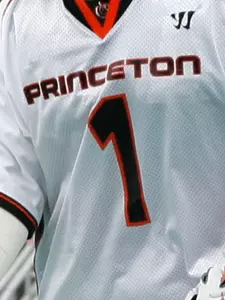
What's In A Number?
April 08, 2008 | Men's Lacrosse
Edwin F. Britten III was a member of the Princeton Class of 1936. An economics major, he wrote his senior thesis on Regulation of the Public Utility Holding Company. He died a young man, 20 years after graduating from Princeton.
So what do he and Dan Cocoziello have in common? The number one connection between the two is, well, the No. 1.
Britten was a first-team All-America goalie for the Princeton men's lacrosse team in 1936. According to the archives, his team was the first to wear uniform numbers at Princeton (or if teams that preceded his did so, there is no record of them), and Britten was the number one No. 1.
Today's Princeton squad features Cocoziello, also an All-America and also No. 1. Britten to Cocoziello is a lineage that stretches 72 years and features countless players who have worn the same number for the Princeton men's lacrosse team.
It's an intriguing way to look at Princeton lacrosse history, or the history of any team for that matter. Players who never met, who never heard of each other, are linked simply by the uniform number that they wore.
Princeton has not retired any uniform numbers?sort of. No Princeton men's lacrosse player has worn the No. 39 in awhile, largely because of head coach Bill Tierney's belief that the No. 39 is haunted.
Some numbers have had multiple All-Americas wear them. Others have had outstanding role players who wore their numbers. There are numbers that were worn by great goalies for one stretch and then great attackmen immediately afterwards.
The No. 16 is an interesting one at Princeton, in that perhaps the two greatest players in program history both wore it, one after the other. Kevin Lowe was No. 16 from 1991-94, a span in which Princeton won a pair of NCAA championships. Lowe scored 247 career points, the most in program history, and the last of those points came in overtime at Byrd Stadium in the 1994 NCAA final against Virginia.
Hubbard took the number from Lowe for the 1995 season and wore it on NCAA championship teams in 1996, 1997 and 1998. Hubbard scored 163 goals at Princeton, the most of any player in school history. As a sophomore, Hubbard scored 53 goals, the most in program history, and the last of those goals also came in overtime at Byrd Stadium in an NCAA final against Virginia.
Princeton's other NCAA championship game overtime goals were scored by the number 20 (Andy Moe) and the number 12 (B.J. Prager).
The whole concept of tracing a team's history through its uniform numbers has not been lost on Tierney, who is firm believer that his current players need to be as aware as possible of the program's tradition. To that end, he recently had each current player research a former player who had worn the same uniform number.
With this as a backdrop, a look at the best player at each number in Princeton men's lacrosse history, sort of the all-time roster, is in order. The ground rules were that one player had to be chosen at each number currently being worn by a Princeton player (1-38, 40-49), regardless of how difficult that choice would be, whether because of different eras, comparable players at different positions or, in the case of No. 16, all-time greats with the same number.
Some numbers were simple. Others, especially 6, were not. Here are the results:
1 Dan Cocoziello '08
Cocoziello has twice been an All-America and and was a first-team All-Ivy League selection as a sophomore. He was also the 2005 Ivy Rookie of the Year, when he became the only defenseman ever to win the award.
2 Torr Marro '93
The first tough decision is between Marro and John Harrington, an All-America defenseman on three NCAA champions. Marro was one of the key players in the turnaround of the program under Tierney, who often has mentioned Marro's OT goal against Navy in 1990 as the turning point for Princeton lacrosse. Marro was the 1990 Ivy Rookie of the Year.
3 Corey Popham '98
Popham spent two years as the starter in goal for Princeton and went 16-4. He also made 17 saves while allowing five goals to earn Most Outstanding Player honors at the 1998 Final Four, beating out, among others, Jon Hess, Jesse Hubbard and Chris Massey for the award.
4 Josh Sims '00
One of the easiest choices on the board, Sims was a three-time first-team All-America and the 1998 and 2000 Division I midfielder of the year.
5 Scott Sowanick '07
Sowanick was an All-America and first-team All-Ivy League selection who started every game of his career, shifting back and forth from midfield to attack throughout.
6 Ryan Mollett '01
Aside from the No. 16, this one is the toughest decision. Seven times in an 11-year stretch, Princeton's No. 6 was a first-team All-Ivy selection, beginning with Taylor Simmers in 1993 and continuing with Chris Massey, Ryan Mollett and finally Brad Dumont. Mollett gets the nod after a career that saw him become a first-team All-America, national defenseman of the year, two-time first-team All-Ivy selection and the first pick in the first Major League Lacrosse draft.
7 Rob Palumbo '88
Palumbo, an attackman, was a two-time first-team All-Ivy League selection and the first first-team All-Ivy selection under Bill Tierney.
8 Kevin Gray '77
Gray, a first-team All-Ivy League goalie, ranks second all-time in saves at Princeton with 610, behind only Scott Bacigalupo. Gray had 231 in 1975 and 211 in 1976, which rank 2-3 on the school single-season list.
9 Jon Hess '98
One of the top feeders in lacrosse history, Hess was the 1997 Ivy League Player of the Year and a two-time first-team All-America, as well as the 1997 NCAA Final Four Most Outstanding Player. He ranks third all-time at Princeton in career points and holds the single-season record for points.
10 Scott Bacigalupo '94
Arguably the greatest goalie in college lacrosse history, or at least on the short list of discussion, “Batch” was the 1992, 1993 and 1994 Division I goalie of the year and the 1992 and 1994 Most Outstanding Player of the Final Four. He was the 1994 Division I Player of the Year.
11 Scott Reinhardt '94
One of the best middies in program history, “Rhino” was a 1994 first-team All-America and two-time first-team All-Ivy pick.
12 B.J. Prager '02
B.J. Prager spent hours upon hours as a junior high player playing wall ball, and the result of that work was a career that included 118 goals, fifth-best all-time at Princeton. Prager, an All-America and three-time first-team All-Ivy pick, scored the game-winning goal in overtime of the 2001 NCAA final against Syracuse.
13 Trevor Tierney '01
More than just the coach's son, Tierney was the 2001 first-team All-America goalie. His career goals-against average of 6.65 is the second-lowest in Division I history.
14 Ryan Boyle '04
Boyle ranks second all-time in scoring and assists at Princeton, and he was a two-time first-team All-America, two-time Ivy Player of the Year and three-time first-team All-Ivy selection. He was at his best in big games, with an assist in overtime in the 2001 NCAA final and with an epic performance against Maryland in the 2004 quarterfinals to carry the Tigers to the Final Four.
15 Alex Hewit '08
Hewit was a first-team All-America as a sophomore and second-team All-America as a junior. He ranks third in Division I history in career goals-against average.
16 Jesse Hubbard '98
So who was better, the all-time leading point scorer at Princeton (Kevin Lowe) or the all-time leading goal scorer at Princeton (Jesse Hubbard)? With apologies to Lowe, the pick is Hubbard, a two-time first-team All-America who was the cornerstone of the greatest teams in school history, the NCAA championship teams of 1996, 1997 and 1998 and who is probably the greatest player ever to play lacrosse at Princeton.
17 David Morrow '93
One of the greatest defensemen of all-time, Morrow was a two-time first-team All-America and three-time first-team All-Ivy selection. Morrow won the Lt. Raymond Enners Award as the top player in Division I his senior year. He also is the founder of Warrior Lacrosse, which has helped bring the sport more into the mainstream of American society.
18 Bill Chaires '75
Bill Chaires was a two-time first-team All-Ivy League attackman who in three seasons scored 94 goals, the school record when he graduated and now 12th-best in school history. His 42 goals in 1973 were at the time the school record and today rank sixth at Princeton.
19 Scott Conklin '95
An All-America and twice a first-team All-Ivy selection, it was Conklin who played attack with Jon Hess and Chris Massey while Jesse Hubbard played midfield as a freshman. Conklin is tied for 10th all-time in goals scored at Princeton, and none of his 97 career goals was bigger than the one that tied the 1994 Johns Hopkins NCAA quarterfinal with 37 seconds remaining in the regulation, unless it was the one in overtime that won it.
20 Sean Hartofilis '03
There are four very good candidates here. William Griffiths wore the number when he scored 10 goals against Rutgers in 1951, still the school single-game record. Andy Moe was a two-time first-team All-Ivy middie who scored the biggest goal in school history?the one in the second overtime that beat Syracuse in the 1992 NCAA final. Peter Trombino graduated a year ago as one of the best and most consisten attackmen in school history. The nod, though, goes to Hartofilis, who finished third all-time at Princeton in goals scored with 127 and third in NCAA tournament goals scored with 27. Hartofilis might be the most underrated player in program history.
21 Justin Tortolani '92
The breakthrough recruit who helped launch a dynasty, Tortolani graduated as Princeton's career leader with 120 goals (three players have since beaten that mark). Tortolani, an All-America and two-time first-team All-Ivy selection, scored 20 NCAA tournament goals, fourth-best in school history. Also an Academic All-America, he has gone on to a career as a surgeon.
22 Becket Wolf '97
The 1994 Princeton roster lists him as a freshman attackman. This year's refers to him as a two-time first-team All-Ivy League defenseman, and he was also a two-time second-team All-America while serving as captain of the undefeated 1997 team.
23 Mal Meistrell '92
A very reliable scorer in the midfield, it was Meistrell who scored the game-winner against North Carolina in the 1992 NCAA semifinals in near 100-degree weather at Franklin Field. Meistrell gets points for his bloodlines, too; it was his great-uncle Harland who revived the sport of lacrosse at Princeton and Rutgers in the early 1920s and for whom the trophy the teams play for annually is named.
24 Scott Farrell '02
This is a tough choice between Greg Waller, a great face-off man and middie on the 1992 NCAA championship team, and Farrell, an All-America defenseman and four-year starter who played on the 2001 NCAA championship.
25 Damien Davis '03
Like the previous number, this one features two first-team All-America defensemen, Davis and Todd Higgins '95. Rules being rules, though, the choice is Davis, who started every game of his four years at Princeton, was a key member of the 2001 NCAA champion and also did the near impossible by holding Syracuse's Michael Powell without a point.
26 Ben Strutt '97
A captain of the only undefeated NCAA championship team in school history, Strutt was one of the great shortstick defensive middies Princeton has had.
27 Kurt Lunkenheimer '99
Lunkenheimer was a first-team All-Ivy defenseman as a sophomore and a junior on NCAA championship teams and an All-America both times. He tore his ACL early in his senior year, but he came back to play 42 days later
28 Howard Krongard '61
Henry Fish and Howard Krongard are both All-Americas who are in the lacrosse Hall of Fame. Redmond Finney was also an All-America. All wore No. 28. The pick? Give the benefit of the doubt to the goalie, Krongard, who was a two-time first-team All-Ivy pick who played on Ivy championship teams in every season.
29 Winship Ross '01
Another of the great shortstick defensive mids, Ross was a key to the 2001 team's defense and NCAA championship.
30 Matt Striebel '01
Striebel played attack for three years before moving to midfield as a senior when Ryan Boyle arrived. He earned first-team All-Ivy honors as a senior, and he is eighth all-time in assists. Striebel, who played in NCAA tournaments in lacrosse and soccer at Princeton, was the MVP of the Major League Lacrosse championship game last summer.
31 Al Keidel '68
Keidel was a two-time first-team All-Ivy League selection as a midfielder. He was also a member of the 1967 Ivy League title team.
32 David Tickner '77
A three-time first-team All-Ivy selection, Tickner remains one of the top offensive players in school history and the only player in school history to have a season with at least 30 goals and at least 30 assists (34G, 32A in 1976). He stands ninth all-time at Princeton with 163 points.
33 Art Hyland '62
Also a basketball player at Princeton, Hyland was a first-team All-Ivy League defenseman who played on three Ivy championship teams.
34 Kyle Baugher '02
He was never first-team All-Ivy League or All-America, but Kyle Baugher may be the best of all of the great shortstick defensive middies Princeton has had. He was a key member of the best defense Princeton has ever had (2001).
35 Tyler Campbell '42
Campbell was a two-time first-team All-America goalie. He was elected to the USILA Hall of Fame in 1973.
36 Zachary Jungers '07
Jungers spent two years as a longstick midfielder before moving to close defense. He graduated a year ago as a first-team All-America.
37 Christian Cook '98
This one comes down to two choices. Gerry Ronan was a first-team All-Ivy pick in 1983 who currently ranks 10th in both career goals and career points. The choice, though, is Christian Cook, a first-team All-America and two-time first-team All-Ivy selection who was also the 1998 Schmeisser Award winner as the top defenseman in Division I.
38 David Tait '53
David Tait was a first-team All-America defenseman on Princeton's 1953 national championship team.
40 Nick Lane '95
A defenseman, Lane was an honorable mention All-America as a senior and a three-time All-Ivy pick. He went from defending Princeton's goal to defending the United States when he entered the Marine Corps after graduation.
41 Ralph Willis '53
Bo Willis ranks seventh all-time in assists at Princeton, and he spent 27 seasons ranked second. Willis stands in 12th place all-time in points scored at Princeton, and he was a 1953 first-team All-America after Princeton won the national championship.
42 Wick Sollers '77
Wick Sollers is one of the best finishers in Princeton history Sollers scored 114 goals in his career, which was the school record until Justin Tortolani came along 15 years later and bettered it by six. Sollers also scored 49 goals in the 1977 season, still second-best in a single-season behind the 53 Jesse Hubbard scored in 1996 (and scored in 12 games, rather than the 15 Hubbard played in '96). Sollers scored more goals than any other Princeton player who did not play varsity lacrosse as a freshman.
43 Lorne Smith '99
Smith came to Princeton as an attackman a year behind the Hess-Hubbard-Massey group, which forced his move to midfield. He became a first-team All-America and two-time first-team All-Ivy League selection.
44 Paul Murphy '94
This is a choice between Murphy, an All-America and All-Ivy League middie and face-off man, and Mark Whaling, a hard-nosed defensive middie who was a key member of NCAA championship teams from 1996-98.
45 Herbert Foedisch '38
Herbert Foedisch was a first-team All-America in 1938 ? as a cover point.
46 Charles Dering '37
Dering was a first-team All-America attackman and member of the 1937 national championship team, Princeton's first.
47 Don Hahn '51
A first-team All-America in 1950 and 1951 and the 1951 Turnbull Award winner as the top attackman in the country, Hahn held the school career assists record from when he graduated until it was broken in 1980. Hahn finished his career with 146 points, which still ranks 13th at Princeton.
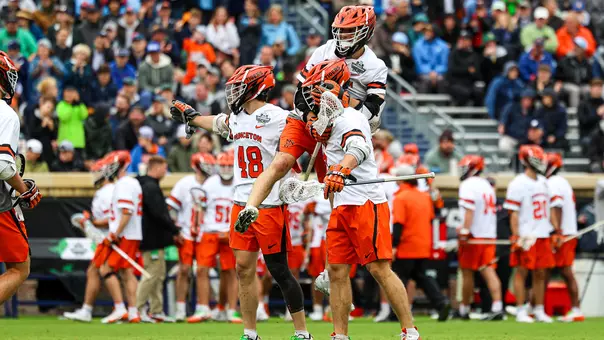
48 John Baker '67
A defenseman, Baker was a 1966 and 1967 first-team All-America and first-team All-Ivy League selection. He would be Princeton's last first-team All-America until Scott Bacigalupo and David Morrow 25 years later.
49 Tim Callard '62
A first-team All-America defenseman, Callard was also twice named first-team All-Ivy League. He played on three Ivy League championship teams.
?? by Jerry Price
So what do he and Dan Cocoziello have in common? The number one connection between the two is, well, the No. 1.
Britten was a first-team All-America goalie for the Princeton men's lacrosse team in 1936. According to the archives, his team was the first to wear uniform numbers at Princeton (or if teams that preceded his did so, there is no record of them), and Britten was the number one No. 1.
Today's Princeton squad features Cocoziello, also an All-America and also No. 1. Britten to Cocoziello is a lineage that stretches 72 years and features countless players who have worn the same number for the Princeton men's lacrosse team.
It's an intriguing way to look at Princeton lacrosse history, or the history of any team for that matter. Players who never met, who never heard of each other, are linked simply by the uniform number that they wore.
Princeton has not retired any uniform numbers?sort of. No Princeton men's lacrosse player has worn the No. 39 in awhile, largely because of head coach Bill Tierney's belief that the No. 39 is haunted.
Some numbers have had multiple All-Americas wear them. Others have had outstanding role players who wore their numbers. There are numbers that were worn by great goalies for one stretch and then great attackmen immediately afterwards.
The No. 16 is an interesting one at Princeton, in that perhaps the two greatest players in program history both wore it, one after the other. Kevin Lowe was No. 16 from 1991-94, a span in which Princeton won a pair of NCAA championships. Lowe scored 247 career points, the most in program history, and the last of those points came in overtime at Byrd Stadium in the 1994 NCAA final against Virginia.
Hubbard took the number from Lowe for the 1995 season and wore it on NCAA championship teams in 1996, 1997 and 1998. Hubbard scored 163 goals at Princeton, the most of any player in school history. As a sophomore, Hubbard scored 53 goals, the most in program history, and the last of those goals also came in overtime at Byrd Stadium in an NCAA final against Virginia.
Princeton's other NCAA championship game overtime goals were scored by the number 20 (Andy Moe) and the number 12 (B.J. Prager).
The whole concept of tracing a team's history through its uniform numbers has not been lost on Tierney, who is firm believer that his current players need to be as aware as possible of the program's tradition. To that end, he recently had each current player research a former player who had worn the same uniform number.
With this as a backdrop, a look at the best player at each number in Princeton men's lacrosse history, sort of the all-time roster, is in order. The ground rules were that one player had to be chosen at each number currently being worn by a Princeton player (1-38, 40-49), regardless of how difficult that choice would be, whether because of different eras, comparable players at different positions or, in the case of No. 16, all-time greats with the same number.
Some numbers were simple. Others, especially 6, were not. Here are the results:
1 Dan Cocoziello '08
Cocoziello has twice been an All-America and and was a first-team All-Ivy League selection as a sophomore. He was also the 2005 Ivy Rookie of the Year, when he became the only defenseman ever to win the award.
2 Torr Marro '93
The first tough decision is between Marro and John Harrington, an All-America defenseman on three NCAA champions. Marro was one of the key players in the turnaround of the program under Tierney, who often has mentioned Marro's OT goal against Navy in 1990 as the turning point for Princeton lacrosse. Marro was the 1990 Ivy Rookie of the Year.
3 Corey Popham '98
Popham spent two years as the starter in goal for Princeton and went 16-4. He also made 17 saves while allowing five goals to earn Most Outstanding Player honors at the 1998 Final Four, beating out, among others, Jon Hess, Jesse Hubbard and Chris Massey for the award.
4 Josh Sims '00
One of the easiest choices on the board, Sims was a three-time first-team All-America and the 1998 and 2000 Division I midfielder of the year.
5 Scott Sowanick '07
Sowanick was an All-America and first-team All-Ivy League selection who started every game of his career, shifting back and forth from midfield to attack throughout.
6 Ryan Mollett '01
Aside from the No. 16, this one is the toughest decision. Seven times in an 11-year stretch, Princeton's No. 6 was a first-team All-Ivy selection, beginning with Taylor Simmers in 1993 and continuing with Chris Massey, Ryan Mollett and finally Brad Dumont. Mollett gets the nod after a career that saw him become a first-team All-America, national defenseman of the year, two-time first-team All-Ivy selection and the first pick in the first Major League Lacrosse draft.
7 Rob Palumbo '88
Palumbo, an attackman, was a two-time first-team All-Ivy League selection and the first first-team All-Ivy selection under Bill Tierney.
8 Kevin Gray '77
Gray, a first-team All-Ivy League goalie, ranks second all-time in saves at Princeton with 610, behind only Scott Bacigalupo. Gray had 231 in 1975 and 211 in 1976, which rank 2-3 on the school single-season list.
9 Jon Hess '98
One of the top feeders in lacrosse history, Hess was the 1997 Ivy League Player of the Year and a two-time first-team All-America, as well as the 1997 NCAA Final Four Most Outstanding Player. He ranks third all-time at Princeton in career points and holds the single-season record for points.
10 Scott Bacigalupo '94
Arguably the greatest goalie in college lacrosse history, or at least on the short list of discussion, “Batch” was the 1992, 1993 and 1994 Division I goalie of the year and the 1992 and 1994 Most Outstanding Player of the Final Four. He was the 1994 Division I Player of the Year.
11 Scott Reinhardt '94
One of the best middies in program history, “Rhino” was a 1994 first-team All-America and two-time first-team All-Ivy pick.
12 B.J. Prager '02
B.J. Prager spent hours upon hours as a junior high player playing wall ball, and the result of that work was a career that included 118 goals, fifth-best all-time at Princeton. Prager, an All-America and three-time first-team All-Ivy pick, scored the game-winning goal in overtime of the 2001 NCAA final against Syracuse.
13 Trevor Tierney '01
More than just the coach's son, Tierney was the 2001 first-team All-America goalie. His career goals-against average of 6.65 is the second-lowest in Division I history.
14 Ryan Boyle '04
Boyle ranks second all-time in scoring and assists at Princeton, and he was a two-time first-team All-America, two-time Ivy Player of the Year and three-time first-team All-Ivy selection. He was at his best in big games, with an assist in overtime in the 2001 NCAA final and with an epic performance against Maryland in the 2004 quarterfinals to carry the Tigers to the Final Four.
15 Alex Hewit '08
Hewit was a first-team All-America as a sophomore and second-team All-America as a junior. He ranks third in Division I history in career goals-against average.
16 Jesse Hubbard '98
So who was better, the all-time leading point scorer at Princeton (Kevin Lowe) or the all-time leading goal scorer at Princeton (Jesse Hubbard)? With apologies to Lowe, the pick is Hubbard, a two-time first-team All-America who was the cornerstone of the greatest teams in school history, the NCAA championship teams of 1996, 1997 and 1998 and who is probably the greatest player ever to play lacrosse at Princeton.
17 David Morrow '93
One of the greatest defensemen of all-time, Morrow was a two-time first-team All-America and three-time first-team All-Ivy selection. Morrow won the Lt. Raymond Enners Award as the top player in Division I his senior year. He also is the founder of Warrior Lacrosse, which has helped bring the sport more into the mainstream of American society.
18 Bill Chaires '75
Bill Chaires was a two-time first-team All-Ivy League attackman who in three seasons scored 94 goals, the school record when he graduated and now 12th-best in school history. His 42 goals in 1973 were at the time the school record and today rank sixth at Princeton.
19 Scott Conklin '95
An All-America and twice a first-team All-Ivy selection, it was Conklin who played attack with Jon Hess and Chris Massey while Jesse Hubbard played midfield as a freshman. Conklin is tied for 10th all-time in goals scored at Princeton, and none of his 97 career goals was bigger than the one that tied the 1994 Johns Hopkins NCAA quarterfinal with 37 seconds remaining in the regulation, unless it was the one in overtime that won it.
20 Sean Hartofilis '03
There are four very good candidates here. William Griffiths wore the number when he scored 10 goals against Rutgers in 1951, still the school single-game record. Andy Moe was a two-time first-team All-Ivy middie who scored the biggest goal in school history?the one in the second overtime that beat Syracuse in the 1992 NCAA final. Peter Trombino graduated a year ago as one of the best and most consisten attackmen in school history. The nod, though, goes to Hartofilis, who finished third all-time at Princeton in goals scored with 127 and third in NCAA tournament goals scored with 27. Hartofilis might be the most underrated player in program history.
21 Justin Tortolani '92
The breakthrough recruit who helped launch a dynasty, Tortolani graduated as Princeton's career leader with 120 goals (three players have since beaten that mark). Tortolani, an All-America and two-time first-team All-Ivy selection, scored 20 NCAA tournament goals, fourth-best in school history. Also an Academic All-America, he has gone on to a career as a surgeon.
22 Becket Wolf '97
The 1994 Princeton roster lists him as a freshman attackman. This year's refers to him as a two-time first-team All-Ivy League defenseman, and he was also a two-time second-team All-America while serving as captain of the undefeated 1997 team.
23 Mal Meistrell '92
A very reliable scorer in the midfield, it was Meistrell who scored the game-winner against North Carolina in the 1992 NCAA semifinals in near 100-degree weather at Franklin Field. Meistrell gets points for his bloodlines, too; it was his great-uncle Harland who revived the sport of lacrosse at Princeton and Rutgers in the early 1920s and for whom the trophy the teams play for annually is named.
24 Scott Farrell '02
This is a tough choice between Greg Waller, a great face-off man and middie on the 1992 NCAA championship team, and Farrell, an All-America defenseman and four-year starter who played on the 2001 NCAA championship.
25 Damien Davis '03
Like the previous number, this one features two first-team All-America defensemen, Davis and Todd Higgins '95. Rules being rules, though, the choice is Davis, who started every game of his four years at Princeton, was a key member of the 2001 NCAA champion and also did the near impossible by holding Syracuse's Michael Powell without a point.
26 Ben Strutt '97
A captain of the only undefeated NCAA championship team in school history, Strutt was one of the great shortstick defensive middies Princeton has had.
27 Kurt Lunkenheimer '99
Lunkenheimer was a first-team All-Ivy defenseman as a sophomore and a junior on NCAA championship teams and an All-America both times. He tore his ACL early in his senior year, but he came back to play 42 days later
28 Howard Krongard '61
Henry Fish and Howard Krongard are both All-Americas who are in the lacrosse Hall of Fame. Redmond Finney was also an All-America. All wore No. 28. The pick? Give the benefit of the doubt to the goalie, Krongard, who was a two-time first-team All-Ivy pick who played on Ivy championship teams in every season.
29 Winship Ross '01
Another of the great shortstick defensive mids, Ross was a key to the 2001 team's defense and NCAA championship.
30 Matt Striebel '01
Striebel played attack for three years before moving to midfield as a senior when Ryan Boyle arrived. He earned first-team All-Ivy honors as a senior, and he is eighth all-time in assists. Striebel, who played in NCAA tournaments in lacrosse and soccer at Princeton, was the MVP of the Major League Lacrosse championship game last summer.
31 Al Keidel '68
Keidel was a two-time first-team All-Ivy League selection as a midfielder. He was also a member of the 1967 Ivy League title team.
32 David Tickner '77
A three-time first-team All-Ivy selection, Tickner remains one of the top offensive players in school history and the only player in school history to have a season with at least 30 goals and at least 30 assists (34G, 32A in 1976). He stands ninth all-time at Princeton with 163 points.
33 Art Hyland '62
Also a basketball player at Princeton, Hyland was a first-team All-Ivy League defenseman who played on three Ivy championship teams.
34 Kyle Baugher '02
He was never first-team All-Ivy League or All-America, but Kyle Baugher may be the best of all of the great shortstick defensive middies Princeton has had. He was a key member of the best defense Princeton has ever had (2001).
35 Tyler Campbell '42
Campbell was a two-time first-team All-America goalie. He was elected to the USILA Hall of Fame in 1973.
36 Zachary Jungers '07
Jungers spent two years as a longstick midfielder before moving to close defense. He graduated a year ago as a first-team All-America.
37 Christian Cook '98
This one comes down to two choices. Gerry Ronan was a first-team All-Ivy pick in 1983 who currently ranks 10th in both career goals and career points. The choice, though, is Christian Cook, a first-team All-America and two-time first-team All-Ivy selection who was also the 1998 Schmeisser Award winner as the top defenseman in Division I.
38 David Tait '53
David Tait was a first-team All-America defenseman on Princeton's 1953 national championship team.
40 Nick Lane '95
A defenseman, Lane was an honorable mention All-America as a senior and a three-time All-Ivy pick. He went from defending Princeton's goal to defending the United States when he entered the Marine Corps after graduation.
41 Ralph Willis '53
Bo Willis ranks seventh all-time in assists at Princeton, and he spent 27 seasons ranked second. Willis stands in 12th place all-time in points scored at Princeton, and he was a 1953 first-team All-America after Princeton won the national championship.
42 Wick Sollers '77
Wick Sollers is one of the best finishers in Princeton history Sollers scored 114 goals in his career, which was the school record until Justin Tortolani came along 15 years later and bettered it by six. Sollers also scored 49 goals in the 1977 season, still second-best in a single-season behind the 53 Jesse Hubbard scored in 1996 (and scored in 12 games, rather than the 15 Hubbard played in '96). Sollers scored more goals than any other Princeton player who did not play varsity lacrosse as a freshman.
43 Lorne Smith '99
Smith came to Princeton as an attackman a year behind the Hess-Hubbard-Massey group, which forced his move to midfield. He became a first-team All-America and two-time first-team All-Ivy League selection.
44 Paul Murphy '94
This is a choice between Murphy, an All-America and All-Ivy League middie and face-off man, and Mark Whaling, a hard-nosed defensive middie who was a key member of NCAA championship teams from 1996-98.
45 Herbert Foedisch '38
Herbert Foedisch was a first-team All-America in 1938 ? as a cover point.
46 Charles Dering '37
Dering was a first-team All-America attackman and member of the 1937 national championship team, Princeton's first.
47 Don Hahn '51
A first-team All-America in 1950 and 1951 and the 1951 Turnbull Award winner as the top attackman in the country, Hahn held the school career assists record from when he graduated until it was broken in 1980. Hahn finished his career with 146 points, which still ranks 13th at Princeton.
48 John Baker '67
A defenseman, Baker was a 1966 and 1967 first-team All-America and first-team All-Ivy League selection. He would be Princeton's last first-team All-America until Scott Bacigalupo and David Morrow 25 years later.
49 Tim Callard '62
A first-team All-America defenseman, Callard was also twice named first-team All-Ivy League. He played on three Ivy League championship teams.
?? by Jerry Price
Hunting History: Princeton Men's Lacrosse - 2026 National Champions
Tuesday, June 02
Into the Ivy: 2026 Princeton Men's Lacrosse
Sunday, May 10
Sticks and Stripes - May 8, 2026
Friday, May 08
Sticks and Stripes - April 17, 2026
Friday, April 17