


Princeton University Athletics
Players Mentioned
This Lefty Is All Right
April 10, 2009 | Men's Lacrosse
The dog turned the corner before its new owner, a little black mutt straight from the pound. She lingered in the doorway for a few minutes, tugging at the expandable leash, and then her owner peaked round the corner.
“Don't worry,” he says. “She's not going to bite or anything.”
He speaks slowly, in laid-back, elongated tones, talking about how “Tommy, Josh and I were at a McDonald's and saw an adoption event,” which led him to get the dog.
To the first-time listener, he could sound very much Southern Californian. It's not a stretch to imagine him walking along some beach somewhere, dog leash in one hand, surfboard in the other.
It took the long-time listener years to realize that the stereotype isn't close to accurate. His voice may never get excitable, may never start to race, may make you think its next word is always going to be “dude,” but all it's actually doing is masking a different reality.
This voice speaks more thoughtfully, more rationally than perhaps any in recent Princeton men's lacrosse history.
Speak softly, and carry a big stick.
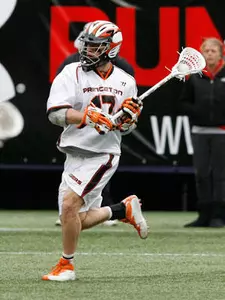
Or, as is the case for Mark Kovler, a stick that can rip corners at well upwards of 90 mph.
“He's such a great kid,” Princeton coach Bill Tierney says about his All-America midfielder. “He's got a different mentality. He's very intelligent, very driven. I've had some guys like him before, guys I call 'closet intellectuals.' He tries so much just to seem like one of the guys, but it comes out differently from him.”
Mark Kovler is in a much different place than he was 52 weeks ago, when he suffered a broken ankle the Thursday before the Harvard game during practice. The injury cost him the final four games of his junior year, as Princeton went 2-2 and fell out of the NCAA tournament picture.
Now Kovler is completely healthy and has been all year. From Day 1, this Princeton offense has been a different animal that pretty much any other Princeton team this decade, and much like the young dog he just adopted, Kovler is the one who holds the leash.
Yes, the Tigers do have Jack McBride and his team-best 25 goals, as well as four-year starter Tommy Davis and McBride's cousin Chris McBride on attack. And Kovler's midfield mates, Rich Sgalardi and Scott MacKenzie, have been piling up points at a rate that far eclipses their previous outputs. All five have reached double figures in goals through 10 games.
But there can be no doubt that the catalyst for it all is Kovler, Princeton's best midfielder since Josh Sims graduated in 2000. Kovler has been as good as any player in Division I men's lacrosse, and he has helped his team vault to No. 2 in the national rankings.
Kovler has been an All-America each of his first three years, including honorable mention honors a year ago despite missing a third of the season; he would become only the third Princeton player ever to be a four-time All-America, joining Scott Bacigalupo and Ryan Boyle.
“He's a great player,” Tierney says. “He practices at the same speed he plays, which is rare. He practices hard every day.”
What separates Kovler is his shot, a rocket that approaches triple digits on the gun. When he gets his feet set underneath him or has momentum to his left, he uncoils his shot like no other, or almost no other, who has ever played for Tierney.
“I was talking to Jesse [Hubbard] the other day and told him that Mark could shoot as hard as he could,” Tierney says. Then, after a pause, he adds: “Well, almost. But very, very close.”
Kovler's shot has enabled him to rack up 77 career goals, the most by a Tiger middie since Sims scored 103 for his career. Kovler ranks 17th all-time in goals scored at Princeton and is six away from moving into 14th. Considering that Princeton finished 29th, 20th and 27th in Division I in scoring offense his first three seasons, his totals are amazing.
“Metz [Associate head coach David Metzbower] told me when I was being recruited that you should shoot when you're hot or shoot to get hot,” Kovler says. “Shooting is always something that has been the biggest part of my game. I'm not really fast. I'm not really strong. My shot is something that I've been able to develop. Goalies in college are so good. You can't shoot from the outside unless you have some velocity. In high school, you can get away without being able to shoot, but not in college.”
Kovler grew up in Washington, D.C., and is a product of lacrosse powerhouse Landon School, where he lettered four times in lacrosse, three times in football and once in basketball. He chose Princeton over Johns Hopkins after scoring 45 goals as a senior, part of a highly regarded recruiting class that is now having a huge collective senior year.
“It took about five minutes of his first fall practice to see that he was something special,” Tierney says. “He's obviously developed a lot since then. To be a great shooter, you have to be willing to take shots. It sounds stupid almost, but it's true. One thing that separates him is his ability to create his shot. Not a lot of guys can do that. And he's so calm.”
Kovler put up 18 goals as a freshman to earn second-team All-Ivy and honorable mention All-America honors, and he followed that with 23 goals as a sophomore to be first-team All-Ivy and third-team All-America.
His junior year, which included a four-goal day in the rain against Virginia, was cut short by his broken ankle, suffered the day before the team left for Harvard. Beyond the end of the regular season, Kovler was also unable to play in the three games Princeton played during its trip to Spain and Ireland in June, and he was also slowed for much of the fall.
“It wasn't until the middle of the winter that I felt okay,” Kovler says. “It was really frustrating to have to sit there and watch, knowing I'd be out for the rest of the season. It's been great coming out this year knowing I was okay.”
His senior year has been great. He had consecutive four-goal games against Albany and Rutgers, and he single-handedly took over the RU game with four goals on four shots in the second half. He had three against Syracuse a week ago in the Big City Classic and had two against Hopkins in the Face-Off Classic. To stop Kovler is to stop Princeton: He was shut out by Hofstra in the Tigers' only loss.
He has also blended perfectly with Sgalardi and MacKenzie to form Princeton's best first midfield since Lorne Smith teamed with Jason Osier and Todd Eichelberger on the Tigers' undefeated 1997 team.
“We have been playing with a different confidence level than in the past,” Kovler says. “We're the same guys; we just have a different attitude towards scoring goals. I've personally never felt I should hold back on taking a shot because I was afraid of getting yelled at. To me, this hasn't been a change of coaches' attitudes. There's been a change of players' attitudes. If the coaches have changed, it's to focus more on us and who we are and not to be so worried about what team we are playing. They've been making sure we haven't forgotten our own strengths.”
Kovler's strengths extend beyond the field. He spent last summer working in an operating room with trauma surgeon Marty Eichelberger, Todd's father, and he will head to medical school himself after spending next year working as a research assistant.
Even with medicine in his future, though, he is very much reflective of his economics major.
“I saw a study that econ majors think differently,” he says. “I'm into rational thinking. I've always thinking 'does this make sense,” and I try to carry that over into lacrosse. We won this game; we lost that game. How does that help us now? How has this helped us get where we are now? I think I have less pure excitement after we win and less pure melancholy after we lose. I see both sides of the picture very well.”
As for the dog, it's something he's always wanted and a present for himself for his upcoming graduation. His mother Judy told him that he could do it if he scored five times against Albany, but he did it anyway, even if he was one goal short.
So now he sits there, talking about his shot, talking about how comfortable he is on the field now, talking about how his confidence in his shooting grows when he gets off to a good start, all in his surfer voice, all the while petting the dog.
Finally, there is time for one more question. What is the dog's name?
“Lefty,” he says.
The little lefty is chewing on her leash, playing with a tennis ball. She's on top of the world.
The same is true of the big lefty.
- by Jerry Price