
Princeton University Athletics



2008-09 Princeton Athletics Year in Review
June 26, 2009 | General
The runners began to emerge from the woods and head down the long final push to the chute. The first one was, appropriately for this Halloween Day, dressed in Orange and Black. So was the next one. And the one after that. And five of the first six. And seven of the first nine.
Princeton's first Ivy League championship of the 2008-09 academic year was put up by the women's cross country team at the Heptagonal championships on Halloween, and it came, prophetically enough, when the Tigers simply ran away from the pack.
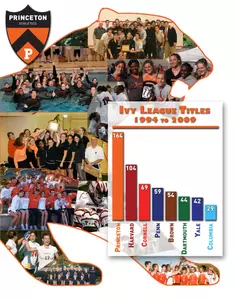
By the time the men's lightweight crew won the Temple Challenge Cup at the Royal Henley Regatta to bring the athletic year to its end, Princeton teams produced 11 Ivy League and two national championships, as well as another team that was the national runner-up and another that finished fifth out of the 350 Division I teams in that sport.
The 2008-09 year marked the 17th time in school history that Princeton has reached double figures in Ivy titles; the rest of the league combined has done so five times.
Princeton would win the Ivy League's unofficial all-sports points championship for the 23rd straight year, reaching its highest overall point total since the 1998-99 school year. The national championships won by the women's squash team and the men's lightweight rowing team brought to 23 the number of consecutive years with at least one team or individual national champion.
Of the 33 teams that competed in Ivy League sports, 18 finished first or second and 25 finished in the top three.
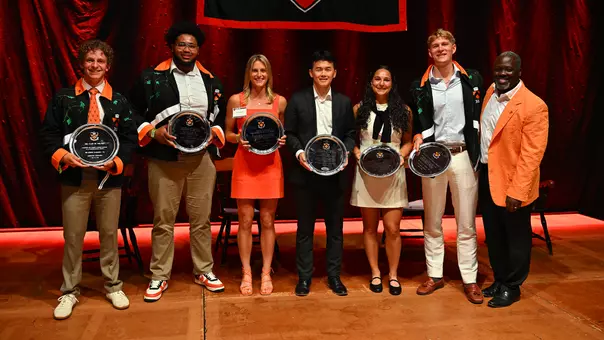
No wonder it was impossible to pick just one outstanding senior male and female athlete for the end-of-year banquet. Instead, five senior men and five senior women were honored.
Of course, the year wasn't devoid of its tougher moments, including some of the most excruciating losses in the entire history of Princeton athletics. Princeton also saw two of its coaching legends leave the school after a combined 80 seasons.
On balance, though, 2008-09 was an exceptional athletic year at Princeton University.
The women's cross country team shattered the old event record by winning Heps with 17 teams points with a 1-2-3-5-6 finish and then went on to win the Mid-Atlantic Regional on its home course and finish fifth in the NCAA finals – and Peter Farrell's team wasn't necessarily the best Princeton team of the year.
Princeton teams won four Ivy League championships in the fall, including a sweep of the cross country races as the men edged Dartmouth for the team title shortly after the women won their race.
Princeton unveiled its brand-new Roberts Stadium soccer complex in the fall of 2008, and the facility immediately impressed everyone who visited in the inaugural season. The women's team then went out and used an overtime goal against Penn to earn the program's fifth Ivy League title in the last nine years. Princeton, who spent much of the year in the national Top 25, lost to West Virginia 2-1 in the NCAA tournament.
The field hockey team went undefeated in the league to win the championship for the 13th time in 14 seasons. Princeton defeated Penn State in the opening round of the NCAA tournament and came within an overtime loss to Syracuse in the quarterfinals of reaching the Final Four.
The winter saw Princeton teams win three more Ivy championships, including men's and women's squash. The women then went on to win their third straight national championship at the Howe Cup.
The men's team continued arguably the best four-year run in the long history of the program with another dominant performance to win the league with a perfect record and reach the national finals.
The men's swimming and diving team recorded a perfect regular season and gave Florida a run in the annual Big Al Open, and then it capped the year with a brilliant wire-to-wire victory at the Ivy League championships. After winning a total of two events in the previous three years, Princeton won 12 events in the 2009 meet. Princeton finished 23rd at NCAAs with a handful of individual and relay All-America honors.
Princeton ran off four more Ivy titles in the spring. The men's lightweight rowing team was ranked No. 1 to start the year and went through all seven opponents, including defending champion Cornell. Princeton won by open water in both the Eastern Sprints and the IRA national championships to complete its first sweep of the two titles since 1998.
The men's lacrosse team went 13-3 and won two games in NFL stadiums, defeating Johns Hopkins at M&T Bank Stadium and eventual-NCAA champ Syracuse at Giants Stadium. Unfortunately for the Tigers, they couldn't solve Cornell in two meetings, a pair of losses that cost Princeton an outright Ivy title and a berth in the Final Four.
The women's tennis team returned to the NCAA team tournament and won an Ivy League title for the first time since 2000 by defeating six of seven Ivy teams and watching Yale, its only loss, lose on the last day of Ivy competition to allow Princeton to seal the automatic berth. Princeton also had an individual participant in the NCAA tournament for the first time since 2002, sending a doubles team to the postseason.
The women's outdoor track and field team won its first Ivy League outdoor title since 1989, jumping ahead of five-time defending champion Cornell, 145-130, after a strong finish in the 3000-meter run with two events remaining. The team earned eight All-Ivy awards, qualified 15 athletes for the postseason and sent two to the NCAA championships.
There were other strong performances by Princeton teams who did not win Ivy titles, including an 18th-place finish as the NCAA championships by the women's swimming and diving team, a Southern Division championship in men's water polo, a second-straight NCAA tournament appearance in men's hockey, a Gehrig Division co-championship in baseball, a quarterfinal appearance in women's lacrosse, a second-place finish in men's basketball, a six-game improvement in league wins for women's basketball and a program-record 17 wins in men's fencing.
As for the disappointments, Princeton teams suffered two for the ages. The men's hockey team spent the entire year in the national rankings, mostly in the Top 10, and earned an at-large NCAA tournament bid for the first time in program history. The Tigers then led Minnesota-Duluth 4-2 in the final minute of regulation in the opening round of the NCAA tournament in Minneapolis, but the first NCAA win for the Tigers vanished when the Bulldogs scored twice in the final 40 seconds, including the tying goal with less than a second left, and then won it in OT.
As tough as that loss was, the men's squash final against Trinity might have stung more. Princeton and Trinity, winner of 202 straight matches, slugged it out for six hours at Jadwin Gym in the national final, only to see the visitors win 5-4 by the oh-so-closest of margins. If there was consolation for Princeton, it was the knowledge that the 2009 men's squash final is one of the greatest championship events in the history of all of college athletics.
Glenn Nelson, who coached the Princeton men's and women's volleyball teams to the NCAA tournament and took the men to the Final Four, retired after winning 1,110 matches in his 58 total seasons.
Bill Tierney, who led Princeton men's lacrosse to six NCAA championships and 14 Ivy championships in 22 seasons, left to become the head coach at the University of Denver.
Golfer Susannah Aboff, diver Katie Giarra, volleyball player Parker Hentritze, field hockey/lacrosse player Holly McGarvie and distance runner Jolee van Leuven were named winners of the von Kienbusch Award for the outstanding senior female athletes.
Hockey player Lee Jubinville, men's lacrosse player Mark Kovler, swimmer Doug Lennox, distance runner Michael Maag and men's squash player Mauricio Sanchez were named winners of the Roper Trophy as the outstanding senior male athletes.