


Princeton University Athletics

Guiding Light - Randy Evans ?69
March 10, 2011 | Men's Lacrosse
The lighthouses surround Cape Cod, at places like Buzzards Bay and Nobska Point and Woods Hole. They sound almost like fictional points, with names that conjure up images of sons and daughters of privilege out on their schooners, tacking their sails in the waters off of Nantucket Sound and Cape Cod Bay.
They stand a constant vigil, as they have for generations, in service to those off their shores, seeing them safely back to dry land, without asking for as much as a thank you.
Take Point Gammon, for instance. The lighthouse there has been seeing ships into the harbor at Hyannis since 1816. That same year, all the way out in Provincetown, the lighthouse at Race Point opened, its purpose to stem the high rate of shipwrecks at the very end of the Cape.
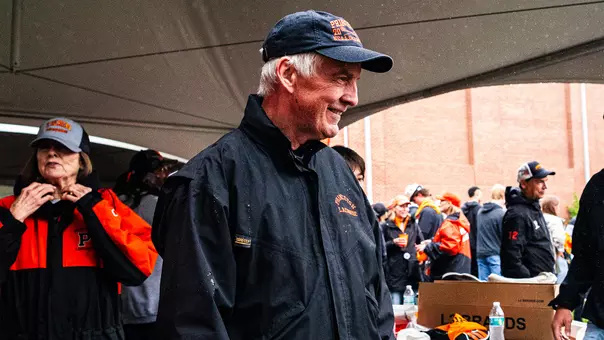
Randy Evans, Princeton Class of 1969, sails these waters, has done so his whole life. To him, the lighthouses are more than just stone buildings on the water's edge.
"I've always thought lighthouses have incredible integrity," Evans says. "Those lighthouses are a beacon that keep people from danger."
When it came time for him to put a name to his latest venture, the one that has already done so much to bring the sport of lacrosse to the inner-city kids in Jacksonville, he looked no further than the lighthouses he'd seen his whole life.
"It was that sense of integrity," Evans says. "It was the idea that the lighthouse kept watch, kept you away from danger."
And so it was. Lighthouse Lacrosse.
"Randy has such a passion for the game," says Matt Kerwick, who is the head men's lacrosse coach at Division I Jacksonville University, which first fielded a team a year ago. "He has such a great passion for helping kids who are from tough situations. You can't help but be impressed with him."
Evans is without question the driving force behind the growth of the sport in North Florida, beginning in its richest suburbs and private schools and continuing now with Lighthouse Lacrosse, which has grown to include players from the elementary school through the high school level in the city itself.
"One of the things I've always liked about lacrosse," he says, "is that lacrosse was a game played by gentlemen and ladies. The ethic of lacrosse was that you played hard, but you played clean. You respected the game. You respected your opponent. When the game was over, the guys you played with were part of the same fraternity that you were. I always thought that there were great lessons that I learned from lacrosse that I found different from other competitive sports, and I liked that. I'm trying to pass that on to the kids in the program."
Once you learn about Evans' background, it's not a stretch to picture him in a sailboat, off those New England shorelines. He grew up in North Jersey and attended what is now the Dwight-Englewood School before transferring to Andover as a sophomore.
A football and hockey player to that point, Evans was introduced to lacrosse first by the hockey coach - "he told me to take the hockey stick off the ice and put it in the air," Evans says - but it was a Princeton alum named Tim Callard who came to teach at Andover who really showed Evans how to play the sport, specifically defense.
Evans too would attend Princeton, where he would be the captain of the 1966 freshman team, a member of the 1967 Ivy League championship team and ultimately the captain of the 1969 team.
He also played four years of hockey, the last three on the varsity.
"The season started much later back then," he says. "I played hockey and lacrosse my entire career, and there were four of us who did that. We never had to miss a lacrosse game because of hockey. We'd open the lacrosse season every year with Army, Navy, Johns Hopkins and Maryland. We'd usually be 1-3 after those games. Then we'd play Rutgers and the Ivy League."
His memory is close to being right. In fact, they played those four teams to start each year, going 0-4 his sophomore year (and then going 6-0 in the league), 0-3-1 his junior year (a tie with Maryland that is the last tie game the program has had) and 1-3 with a win over Navy his senior year.
And then it was graduation - with a degree in civil engineering - in 1969, which meant the Vietnam War.
"My draft board had told me my junior year that I'd get a draft notice one day after graduation," he says. "I figured I could get drafted, or I could join the Navy and be an officer. They placed me into the Seabees [the Construction Battalions, or CBs, which became Seabees], and we'd go in and build things. I was mostly out of harm's way."
He spent four years in the Navy, and after that, he embarked
on a career path filled with interesting turns:
* a master's degree from the Kennedy School of Government at Harvard
* a job in Baltimore working with Mayor William Donald Schaefer as an urban planner, where his projects including helping to build the aquarium and much of the modern inner-harbor
* a tenure in Richmond working with the city's first black mayor as part of a political, economic and community development program called "Richmond Renaissance"
* A return to Maryland after Schaefer was elected Governor to work as the state's Secretary of Economic and Employment Development
It was while he was working in that last position that he went on the Freedom Flight to Kuwait after Desert Storm in 1991, working through massive oil fires, retreating Iraqi troops and the occasional live ammunition going off around him.
On the trip, he met John Snow, then the CEO of the CSX railroad and later to be Secretary of the Treasury under President George W. Bush, and he was offered a position in the company. He accepted it, and that took him to Jacksonville.
"One thing I noticed was that there wasn't any youth lacrosse in Jacksonville," Evans says. "My neighbor was the chairman of the board of directors at the Bolles School, and they were looking to expand their offerings. I met with the headmaster, and we started the lacrosse club in 1995."
The first year, he had 15 players on his team, including three middle school kids - and three girls. He also had no opponents within 150 miles of Jacksonville.
"We didn't have anyone to play," he says. "We had to pay the expenses of teams from Orlando to come play us."
Episcopal, another private school, started a team a year later, and a year after that, Evans donated equipment from Bolles to start teams at Stanton College Prep and Nease High School.
This brought the number of teams in the Jacksonville area to four.
"Now we're up to 20 teams in North Florida," he says. "Lacrosse has become an official state sport."
Evans retired from CSX in 2003 and began running a not-for-profit group.
"We were working to help poor people get jobs and housing," he says. "It was incredibly stressful. It was so stressful that I had a heart attack. After that, I resigned and took a few months off."
It was during that time that Lighthouse Lacrosse began to emerge.
"When I was reflecting on things, I saw that the kids in the inner city needed something to do," he says. "I knew lacrosse was a sport that would work well for kids who weren't big enough for football or basketball. We started out by going to the public schools, and I thought they'd welcome us with open arms. I was wrong."
Instead, he went through a different route, the Police Athletic League.
"They were always looking for new ideas," he says. "The real plus for us was that we got their endorsement, but they also helped us get field space. We had three fields in three different parts of the city."
Eventually, Lighthouse Lacrosse was able to gain traction in the public schools, and not just through the PAL.
"After hearing Randy and seeing the sport, I said I couldn't turn down this opportunity for our school," says Dawn Monroe, whose title is Intramural Coordinator but who actually fulfills the role of athletic director at Peterson Academy, a vocational high school in the city. "Through his foundation, Randy got us entirely started. He donated helmets, goals, everything. He and his group came out and introduced lacrosse to our kids in PE classes. Since then, there's been no looking back. The kids have gotten addicted to it. The kids were bringing sticks to school in September when season didn't start until January. They begged us to let us start practicing after Thanksgiving. The kids were driving us nuts."
With that kind of pressure, Monroe moved her tryouts up two months.
"When we started, we had 60 kids come out," she says. "That was huge, but we didn't wan to cut anyone. We wanted to keep it growing."
Because of the number, Monroe and her administration figured they would use a different selection process. She let it be known that nobody with less than a 2.0 grade point average could play.
"We pulled the GPAs," she says. "All 60 kids had at least a 2.0, and almost all of them were over 3.0. These are kids who are disadvantaged. They've been really affected by the economy. A lot of their parents are unemployed. This is an outlet for them, a motivation for them to keep their grades up."
Monroe's school is not the only one affected by Lighthouse Lacrosse.
"I can't speak highly enough about Randy Evans," she says. "He's gone into the inner-city areas, especially in the middle schools. That's where you can lose them educationally. In middle school. And he's made a huge difference."
Today, there are seven high schools in the city that have club teams with nearly 200 players on them. There are also four middle school teams with almost 100 players involved, as well as the grassest roots level, an elementary school program with nearly 50 kids involved.
"In the high school program," Evans says, "about 30 percent of the kids are African-American. On the elementary level, about 95 percent of them are. One of our goals was to diversify the sport."
It hasn't hurt Evans and his mission that Jacksonville started its team. Evans served as an advisor to the school during the planning stages, and he was a self-described "welcome wagon" for Kerwick.
"When I first met Randy, I had no idea what he was trying to do in the inner-city," Kerwick says. "I was happy to be a part of it. He cares so much about the area and giving back to it. It's hard not to follow his lead. He's done so much for the area youth. He's trying to grow the game in the different areas, non-affluent areas, introduce it to a lot of places that wouldn't otherwise be around it. It's taken a lot of hard work on his part."
As a result of the partnership, the players from Kerwick's team are often found working with the Lighthouse players on the middle school and elementary level, along with suburban high school players and coaches and some former Navy players who are stationed in the city who serve as Lighthouse coaches and officials. Nobody is paid for their services.
"We've tried to do what we could for him," Kerwick says. "It's been a great experience for our guys."
The flip side is that it's also provided Kerwick with a fan base, as Lighthouse players are regular fixtures at Dolphins' games.
"It's great to see those kids in the stands at our games," Kerwick says. "It's great to see them with sticks in their hands. Randy brings them there, and it's great give and take for us."
The growth of the sport in the city could also be seen last month, when the Sunshine Classic was played at the home stadium for the NFL's Jacksonville Jaguars. A crowd of nearly 10,000 gathered to see Jacksonville take on Georgetown and Duke play Notre Dame in a rematch of the 2010 NCAA final.
"To have that many people there for lacrosse was tremendous," says Evans. "Even the local paper took notice."
In the meantime, far away from the notice of any newspaper, Evans and his Lighthouse Lacrosse group keep plugging away.
"It's been a lot of dropped passes, a lot of ground balls that didn't get picked up," he says. "But we're getting started. We're trying to keep them in school. Trying to get them to see that lacrosse can open doors for them. Trying to get them to understand that there's been a tremendous growth of lacrosse now that could give them an opportunity to get noticed into schools. We have four or five North Florida kids playing Division I now, another 15-20 playing Division III. I want the Lighthouse kids to see that this opportunity exists for them too."
Evans has stayed close to Princeton through the years. His daughter Annie was a volleyball player who graduated in 2004, and he took every opportunity he could to come back to the school while she was here (he has an older son, Paul, who was one of the middle school kids on that original Bolles team and who went on to graduate from Florida).
His voice gets emotional when he mentions that he and Annie had the same thesis advisor 35 years apart. He mentions classmates and teammates with great fondness. He talks about how it's not accident that his lacrosse organization chose orange and black as its colors.
But far away from that world of privilege, of prep schools, of old and new money, Evans is on the ground in Jacksonville.
He's on the water's edge, actually.
He's the beacon of integrity, the light keeping an ever-growing number of kids in the city focused away from the danger that lies beyond his shores, pointed back to where the land is dry, the grass is green and the young people holding lacrosse sticks see a future with no limits.
- by Jerry Price