


Princeton University Athletics

Players Mentioned




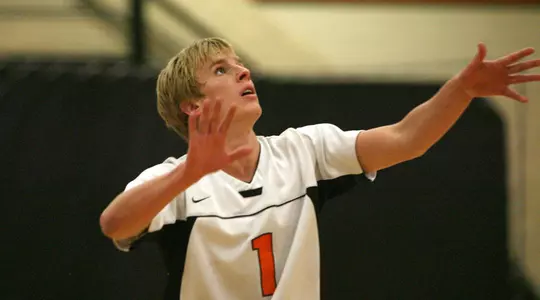
Volleyball Looks Towards Veteran Leadership, Talented Youth For 2012 Season
January 27, 2012 | Men's Volleyball
After the retirement of Glenn Nelson following the 2009 Princeton season, head coach Sam Shweisky took over a program with deep and sizable footsteps to follow. His first chapter couldn't have been more upbeat; he was named the EIVA Coach of the Year and led Princeton to its best regular-season finish in league history. The Tigers, who continuously found ways to win five-set thrillers, reached their first EIVA final since 1998 and gave Penn State two legitimate scares before ultimately falling short.
That year seemed to set up a promising 2010 season. Unfortunately, it only promised disappointment to a Princeton team that dealt with both injuries and inconsistency.
So here we stand, only days away from the 2012 season opener Monday night at Cal-Baptist, and the Princeton men's volleyball team is looking to return to the winning ways of 2010. Throughout preseason practices, a new energy has been present in Dillon Gym; unified and energized, the Tigers are determined to move back towards the top of the revamped EIVA.
Leading that run will be senior setter Scott Liljestrom, who will enter his third season in the starting lineup. Liljestrom has ranked as high as third in the EIVA in assists, and he has more than 175 sets of experience under his belt as he enters this season. As important as his play on the court will be - and with an offense that will be seeking early chemistry over the next month, that on-court play will be crucial - his leadership will be critical. Princeton could start five underclassmen this season, and helping guide them through tough matches will be invaluable.
The only other current starter who lined up with Liljestrom for the 2010 EIVA final is junior Michael Dye, who will be moving back to his natural middle position this season. He played opposite during parts of the 2011 season and still ranked second on the team in both kills and points, but he showed throughout his freshman season what he can do in the middle. He was named to the EIVA all-tournament team after a stirring postseason performance, and that followed a season when he ranked ninth in the league in hitting efficiency.
As the rest of the team finds its way, the connection between Liljestrom and Dye must be strong, and it must be successful.
The two sophomores who are looking to build on the experiences of 2011 are Jeff Stapleton and Davis Waddell. Stapleton was one of the bright spots from last season; he started every match and led Princeton in both kills (2.68) and points (3.29) in his first season as outside hitter. He was also Princeton's most dangerous server, though Shweisky is confident the team will be far more improved in that area this season. Stapleton will now look to make another step and become one of the top hitters in the league.
Waddell is one of the team's most versatile players, so he could play at either outside or right side. He recorded 85 assists, 49 kills and 18 blocks in nearly 80 sets of play last season; those are solid numbers, but Shweisky would like to see him become an even bigger factor on the court this season. He also provides an extra setting option on the court, and at 6-5, should be strong on the block.
Princeton could start three freshmen this season, including explosive outside/opposite Cody Kessel. At 6-5, he is one of the team's most athletic players, and he has the potential to become a go-to hitter. He led Cheyenne Mountain to third-place finish in 2009 state championships and competed in both the USA Winter Development Camp (2009) and Men's Junior National A2 Program (2010). His father is a director with the USA Volleyball program, so he has been around the sport throughout his life. Shweisky has been impressed with his on-court intelligence.
Classmate Will Siroky comes to Princeton after he earned AVCA All-America honors after his senior season at Carl Sandburg High. After leading his team to an Illinois state championship and earning finals MVP, he will be looking to team with Michael Dye to provide a strong 1-2 punch in the middle. Like Kessel, he has the experience of competing in several elite camps, so his volleyball IQ is strong.
The same can be said for Tony Ensbury, who will likely start at the libero position. The former Bay League Defensive Player of the Year, he helped Mira Costa to a 69-4 record, and he competed in the A2 High Performance Camp. Passing had been an issue for Princeton last season, and Shweisky is hopeful that Ensbury can be an immediate fix for that issue.
Two returners with significant experience are sophomore Brad Howard and senior Dexter Scobee. Howard played 73 sets at middle last season and recorded 53 kills and 51 blocks. He will compete with Siroky for the starting middle position.
Scobee, who will serve as co-captain with Liljestrom, can play libero or be utilized as a serve specialist late in close sets. Shweisky is quick to praise his leadership, especially after earning Academic All-EIVA honors last season.
The EIVA will take on a new look this season. Instead of two divisions, the Hay and the Tait, there will be only one division, comprised of eight teams. Each will be paired with another travel partner: Princeton will be with George Mason, while the other three duos will be Penn State/Saint Francis, NJIT/Rutgers-Newark, and Harvard/Sacred Heart.
Another change will be in the playoff format, and it will force teams to be stronger in the regular season. Instead of an eight-team playoff, including five from the Tait Division, only four teams will compete in the EIVA postseason. The top seed will host the championships. Penn State has won every EIVA title since 1998, when Princeton made its only trip to the NCAA Championships.