
Princeton University Athletics
Reflections: Black Student-Athlete Summit
June 29, 2023 | Diversity, Equity & Inclusion
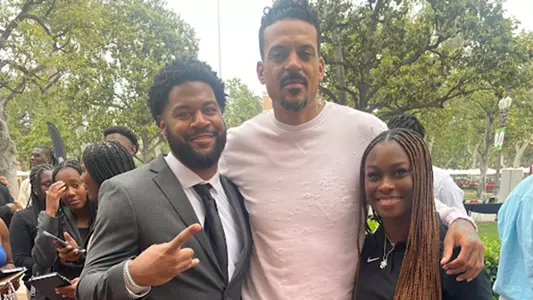
Princeton University student-athletes and staff recently represented the Princeton Tigers as they attended their first Black Student-Athlete Summit on the campus of the University of Southern California (USC) from May 21st to May 24th.
Associate Director of Athletics, Diversity, Equity and Inclusion Miles Smith, Jr. was joined by Mark-Anthony Prescott (football) and Adaora Nwokeji (women's basketball) for an educational and inspiring three-day summit.
The Black Student-Athlete Summit is a transformative event that allows Black student-athletes to engage with industry professionals, researchers, and other student-athletes from across the country. The summit touched on a wide variety of topics including keynote speakers such as former NBA Champion and co-host of the award-winning podcast All the Smoke, Matt Barnes, Chief Diversity, Equity and Inclusion Officer of the NBA, Lesley Slaton Brown and CEO of Klutch Sports, Rich Paul. Each shared key experiences in their lives.
"This was my first time attending the Black Student-Athlete Summit. The knowledge and networking opportunities that were provided for our student-athlete and athletic administrators was extremely impactful. At the end of the event I was inspired listening to Mark-Anthony and Adaora talk about the wisdom and knowledge they received, to put into application with the Black Student-Athlete Collective (BSAC) and Princeton Athletics. " said Miles Smith. "My goal next year is to bring more student-athlete to this event."
After attending, each of the student-athletes shared reflections on attending the Black Student-Athlete Summit for the first time.
WHAT WAS YOUR BIGGEST TAKEAWAY FROM THE SUMMIT?
Mark-Anthony: The biggest takeaway that I took from the summit is that it is one thing to be attentive but it is another to be involved. Change requires help, support, and energy from everybody. A lot of us minority athletes share the same struggles despite competing at different levels and being from different places. However, for the people who are able to attend events like the Black-Student Athlete Summit, it is important we share the info and guidance we gathered and take it back to our Universities so we can have a stronger network and community on campus.
Adaora: My biggest takeaway from the Summit is that as black student-athletes, we must push for our institutions to acknowledge our full selves. As black student-athletes, we have a unique experience and each of us has a different experience within that demographic. Seeing so many different styles, perspectives, and personalities at this summit further helped me realize that true support from our institutions will not come until these places recognize that each black athlete is different instead of putting all of us into the box of "black athlete". Our entirety and uniqueness as a person deserves to be acknowledged to the fullest extent in order for us to feel supported by our institution because we are not all the same. Additionally, a speaker at the Summit said, "If I give people the power to validate me, I give them the power to destroy me". Our validation as athletes should come from within by being completely and unapologetically ourselves, and we should continue to push for our institutions to recognize each of our distinct "selves" so that they can offer adequate support.
WHY DO YOU THINK THIS SUMMIT IS IMPORTANT FOR OUR ATHLETES TO ATTEND?
Mark-Anthony: I think it is important for our athletes to attend because it helped me and it would help others find their identity. The common thing is that everyone who attended the summit was an athlete or was involved in sports in some sort of way. Moreover, everyone was still so different in how they dressed, what they were involved in, what their passions were, etc. It helped me show me that being an athlete is a part of our identities, but it does not restrict us from being whatever we want to be. I think this is important for other college athletes who are developing and figuring out their way on a campus that may be hard to get adjusted to.
Adaora: I think it is important for our athletes to attend this Summit because of all the connections we made. I ran into athletes I've known for years, some that I haven't seen in a while and many that I had never met before and I made meaningful connections with these people through this summit. Everyone was so friendly and eager to meet people and I left the Summit having made many of what I see being long-lasting friendships. It makes you realize that our network is so close knit and supportive which is very comforting since many of us are the minority within the student body at our respective institutions. The Summit was such a rewarding experience and I believe it is essential that our athletes attend every year.
WHAT SESSION WAS MOST IMPACTFUL FOR YOU?
Mark-Anthony: Pro Day Sports Marketing | Athlete Reps. The reason why this session was this impactful is because the four speakers who spoke (Langston Morris-Walker, Amadi Udenyi, Marcus Monk, Jeme Obeime) not only told us athletes about the sports marketing industry, but they gave life advice that can be applied to our sports and our daily lives. Some of the things that stuck with me was to find the difference between a mentor and a sponsor, the importance of connecting with people at each level from the janitor to the president of a company by showing them you have value, and to be comfortable with being uncomfortable. For me personally, this session was the most impactful because Marcus Monk said "Why not be a pro in sports when you can be a pro in life." Although that may seem simple, I was personally struggling with the idea that I might not accomplish my dreams or might not even have a shot of playing professional football. Truly, after I walked out of the room, I tried to have a positive outlook on the different things I am involved in on-campus and off-campus and now I have clarity that my path might be different then I initially expected when I first entered college which I am okay with now.
Adaora: I think Pro Day Sports Marketing | Athlete Reps with speakers Langston Morris-Walker, Amadi Udenyi, Marcus Monk, Jeme Obeime was the most impactful session for me. Although I am pre-med and this session was out of my comfort zone, I'm glad that I attended because I learned a lot of valuable life lessons. Firstly, they said that "your network is your net worth". They emphasized tapping in with like minded people, being nice to everyone you meet, and taking advantage of many different opportunities that come your way. These were all important lessons because you never know what path your life will take and networking is a great way to help you figure out what you want to do and have some support to do it. Another gem from this session was when they said to be comfortable being uncomfortable and learn how to pivot and be a pro in something else after sports. This was essential for me to hear, because after I am done with my sports career, I will be out of my comfort zone because I have done sports my entire life. However, I can take the attributes I got from being an athlete and apply it to my life after sports in order to succeed.
WHAT INFORMATION CAN YOU BRING BACK FROM THE BLACK STUDENT-ATHLETE SUMMIT TO HELP ENHANCE THE PRINCETON ATHLETICS COMMUNITY AND BSAC?
Mark-Anthony: The stress of community and relationships is one of the biggest things that the different forums kept reiterating. Before we try to make a change on campus, we have to come together a little bit more and get to know each other. When we have built the foundation, then we will be able able to move like a community in which different people would be involved in different things that will help make being a minority student athlete on campus easier
Adaora: Something that I learned from the BSA Summit that I think will enhance BSAC is that there is strength in numbers. All of us coming together from across the country was inspiring and the sense of community we all felt was empowering. Also, there were many important conversations held because there were so many different perspectives due to the massive attendance. I think this sense of community on campus is going to BSAC moving forward because that will lead to more ideas being formed and hopefully consequent in more change.
CAN YOU EXPLAIN THE EMOTIONS YOU HAD REPRESENTING PRINCETON UNIVERSITY AND THE IVY LEAGUE AT THE BLACK STUDENT-ATHLETE SUMMIT?
Mark-Anthony: When I first arrived at the Summit, I did not have any emotions regarding representing Princeton because I was trying to fit in. I did not know how people were going to react to me being an ivy-league athlete because we are just so different from every other conference. However, after I spoke at the Black Athletes in the Ivy League Forum, there were so many people who thanked me for telling my story because they could relate to what I was saying. Some of the people who I watch on television or are talked about on ESPN were very interested in my life and it was weird initially. I quickly realized and embraced that although playing a sport at Princeton is a unique experience, it is truly an amazing experience that has many perks and will set me up for future success.
Adaora: I think I felt a sense of pride representing Princeton at the BSA Summit. Many people have a preconceived notion of what an Ivy-League athlete is like and I felt like I enjoyed being able to break that notion. I think many people were surprised at how social and chill I am since they may have assumed I would kind of be stuck up smarty pants, but at the end of the day I'm just a girl from Houston and I don't try to be anyone else. It was also nice to be able to show people that the Ivy League is competitive athletically since many people only know us for our academics. In conclusion it was very enjoyable telling people about my experience as a black student-athlete at an Ivy League and shifting peoples' perspectives about us.
Associate Director of Athletics, Diversity, Equity and Inclusion Miles Smith, Jr. was joined by Mark-Anthony Prescott (football) and Adaora Nwokeji (women's basketball) for an educational and inspiring three-day summit.
The Black Student-Athlete Summit is a transformative event that allows Black student-athletes to engage with industry professionals, researchers, and other student-athletes from across the country. The summit touched on a wide variety of topics including keynote speakers such as former NBA Champion and co-host of the award-winning podcast All the Smoke, Matt Barnes, Chief Diversity, Equity and Inclusion Officer of the NBA, Lesley Slaton Brown and CEO of Klutch Sports, Rich Paul. Each shared key experiences in their lives.
"This was my first time attending the Black Student-Athlete Summit. The knowledge and networking opportunities that were provided for our student-athlete and athletic administrators was extremely impactful. At the end of the event I was inspired listening to Mark-Anthony and Adaora talk about the wisdom and knowledge they received, to put into application with the Black Student-Athlete Collective (BSAC) and Princeton Athletics. " said Miles Smith. "My goal next year is to bring more student-athlete to this event."
After attending, each of the student-athletes shared reflections on attending the Black Student-Athlete Summit for the first time.
WHAT WAS YOUR BIGGEST TAKEAWAY FROM THE SUMMIT?
Mark-Anthony: The biggest takeaway that I took from the summit is that it is one thing to be attentive but it is another to be involved. Change requires help, support, and energy from everybody. A lot of us minority athletes share the same struggles despite competing at different levels and being from different places. However, for the people who are able to attend events like the Black-Student Athlete Summit, it is important we share the info and guidance we gathered and take it back to our Universities so we can have a stronger network and community on campus.
Adaora: My biggest takeaway from the Summit is that as black student-athletes, we must push for our institutions to acknowledge our full selves. As black student-athletes, we have a unique experience and each of us has a different experience within that demographic. Seeing so many different styles, perspectives, and personalities at this summit further helped me realize that true support from our institutions will not come until these places recognize that each black athlete is different instead of putting all of us into the box of "black athlete". Our entirety and uniqueness as a person deserves to be acknowledged to the fullest extent in order for us to feel supported by our institution because we are not all the same. Additionally, a speaker at the Summit said, "If I give people the power to validate me, I give them the power to destroy me". Our validation as athletes should come from within by being completely and unapologetically ourselves, and we should continue to push for our institutions to recognize each of our distinct "selves" so that they can offer adequate support.
WHY DO YOU THINK THIS SUMMIT IS IMPORTANT FOR OUR ATHLETES TO ATTEND?
Mark-Anthony: I think it is important for our athletes to attend because it helped me and it would help others find their identity. The common thing is that everyone who attended the summit was an athlete or was involved in sports in some sort of way. Moreover, everyone was still so different in how they dressed, what they were involved in, what their passions were, etc. It helped me show me that being an athlete is a part of our identities, but it does not restrict us from being whatever we want to be. I think this is important for other college athletes who are developing and figuring out their way on a campus that may be hard to get adjusted to.
Adaora: I think it is important for our athletes to attend this Summit because of all the connections we made. I ran into athletes I've known for years, some that I haven't seen in a while and many that I had never met before and I made meaningful connections with these people through this summit. Everyone was so friendly and eager to meet people and I left the Summit having made many of what I see being long-lasting friendships. It makes you realize that our network is so close knit and supportive which is very comforting since many of us are the minority within the student body at our respective institutions. The Summit was such a rewarding experience and I believe it is essential that our athletes attend every year.
WHAT SESSION WAS MOST IMPACTFUL FOR YOU?
Mark-Anthony: Pro Day Sports Marketing | Athlete Reps. The reason why this session was this impactful is because the four speakers who spoke (Langston Morris-Walker, Amadi Udenyi, Marcus Monk, Jeme Obeime) not only told us athletes about the sports marketing industry, but they gave life advice that can be applied to our sports and our daily lives. Some of the things that stuck with me was to find the difference between a mentor and a sponsor, the importance of connecting with people at each level from the janitor to the president of a company by showing them you have value, and to be comfortable with being uncomfortable. For me personally, this session was the most impactful because Marcus Monk said "Why not be a pro in sports when you can be a pro in life." Although that may seem simple, I was personally struggling with the idea that I might not accomplish my dreams or might not even have a shot of playing professional football. Truly, after I walked out of the room, I tried to have a positive outlook on the different things I am involved in on-campus and off-campus and now I have clarity that my path might be different then I initially expected when I first entered college which I am okay with now.
Adaora: I think Pro Day Sports Marketing | Athlete Reps with speakers Langston Morris-Walker, Amadi Udenyi, Marcus Monk, Jeme Obeime was the most impactful session for me. Although I am pre-med and this session was out of my comfort zone, I'm glad that I attended because I learned a lot of valuable life lessons. Firstly, they said that "your network is your net worth". They emphasized tapping in with like minded people, being nice to everyone you meet, and taking advantage of many different opportunities that come your way. These were all important lessons because you never know what path your life will take and networking is a great way to help you figure out what you want to do and have some support to do it. Another gem from this session was when they said to be comfortable being uncomfortable and learn how to pivot and be a pro in something else after sports. This was essential for me to hear, because after I am done with my sports career, I will be out of my comfort zone because I have done sports my entire life. However, I can take the attributes I got from being an athlete and apply it to my life after sports in order to succeed.
WHAT INFORMATION CAN YOU BRING BACK FROM THE BLACK STUDENT-ATHLETE SUMMIT TO HELP ENHANCE THE PRINCETON ATHLETICS COMMUNITY AND BSAC?
Mark-Anthony: The stress of community and relationships is one of the biggest things that the different forums kept reiterating. Before we try to make a change on campus, we have to come together a little bit more and get to know each other. When we have built the foundation, then we will be able able to move like a community in which different people would be involved in different things that will help make being a minority student athlete on campus easier
Adaora: Something that I learned from the BSA Summit that I think will enhance BSAC is that there is strength in numbers. All of us coming together from across the country was inspiring and the sense of community we all felt was empowering. Also, there were many important conversations held because there were so many different perspectives due to the massive attendance. I think this sense of community on campus is going to BSAC moving forward because that will lead to more ideas being formed and hopefully consequent in more change.
CAN YOU EXPLAIN THE EMOTIONS YOU HAD REPRESENTING PRINCETON UNIVERSITY AND THE IVY LEAGUE AT THE BLACK STUDENT-ATHLETE SUMMIT?
Mark-Anthony: When I first arrived at the Summit, I did not have any emotions regarding representing Princeton because I was trying to fit in. I did not know how people were going to react to me being an ivy-league athlete because we are just so different from every other conference. However, after I spoke at the Black Athletes in the Ivy League Forum, there were so many people who thanked me for telling my story because they could relate to what I was saying. Some of the people who I watch on television or are talked about on ESPN were very interested in my life and it was weird initially. I quickly realized and embraced that although playing a sport at Princeton is a unique experience, it is truly an amazing experience that has many perks and will set me up for future success.
Adaora: I think I felt a sense of pride representing Princeton at the BSA Summit. Many people have a preconceived notion of what an Ivy-League athlete is like and I felt like I enjoyed being able to break that notion. I think many people were surprised at how social and chill I am since they may have assumed I would kind of be stuck up smarty pants, but at the end of the day I'm just a girl from Houston and I don't try to be anyone else. It was also nice to be able to show people that the Ivy League is competitive athletically since many people only know us for our academics. In conclusion it was very enjoyable telling people about my experience as a black student-athlete at an Ivy League and shifting peoples' perspectives about us.
Hard Cuts | Season 8 - Episode 2
Friday, December 05
TAGD 2025 | Ready for Gameday
Wednesday, December 03
Thank You for your Record-Setting Support on TAGD (12.2.25)
Wednesday, December 03
Princeton Golf Coaches From St. Andrews
Tuesday, December 02