Princeton University Athletics
NCAA Championship Year In Review Part 3: Ryan Croddick Feature — Moments In Time
July 30, 2026 | Men's Lacrosse
A BALL moving at 80 miles per hour will travel 10 yards in 0.256 seconds. That’s two-hundred-fifty-six-one-thousandths of a second. Two-hundred-fifty-six-one-thousandths of a second.
The eye blinks at around the same rate. Even the complex computer that is the human brain, equipped with its billions of neurons, cannot process a moment in time so small. So how to explain the man on the other side of the table, then? Maybe it’s as simple as acknowledging that to him, traditional measures of time are irrelevant.
As such, the aforementioned two-hundred-fifty-six-one-thousandth of a second can seem like an eternity. At the same time, eternity in his world can be measured in milliseconds. This juxtaposition is impossible to miss — once you know the whole story.
Ryan Croddick is eating a cheeseburger. How long does each bite take him? Irrelevant. He is the one for whom time blurs.
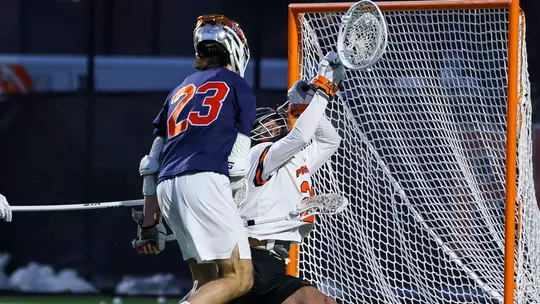
The aforementioned ball? Imagine that it’s a tight rubber lacrosse ball, approaching you at 80 miles per hour or even more. You have that two-hundred-fifty-six-one-thousandths of a second, or even less time, to do something about it. Ryan Croddick? He kept it out of the goal nearly six out of 10 times this past season, seven out of 10 times when it mattered most, as he led Princeton to the NCAA championship in what was his senior year.
How do you stop a ball when it’s upon you is less time than your brain can comprehend? You do so by slowing time down, and not just when you’re in the cage.
“His dedication to the craft of goaltending is beyond belief, and I am very proud of him,” his father, John Croddick, says.
Only he doesn’t really “say” it.
And that’s what brings you to the other side of Croddick’s inner clock.
THE CHEESEBURGER came to Ryan Croddick as he sat at a high top in the bar area of a restaurant in his hometown of Rumson, on the Jersey Shore. The Atlantic Ocean is about a mile from the high top. Croddick calls Rumson “the coolest place ever.”
He continues with this: “My friends and I say all the time that we lived in this bubble, this peninsula. We’re just about right on the beach. We’d bike to the beach every single day in the summer.”
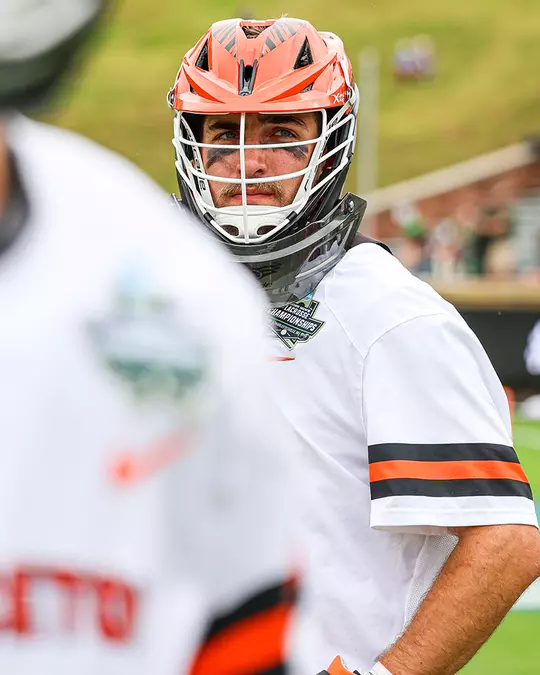
The goatee he had during Princeton’s championship run is gone; his unique personality remains. He is quiet, thoughtful, loyal, with the kind of easy smile that naturally draws people to him. He laughs and makes you laugh. He doesn’t have the massive dynamism of, say, his Princeton teammate Chad Palumbo or his predecessor in goal at Princeton Michael Gianforcaro, whose personalities reverberate off every wall in every room they enter.
What Croddick does have can be described as “presence.” It may be a calm, unassuming presence, but make no mistake — he too innately attracts your attention immediately. Palumbo and Gianforcaro exude energy; Croddick seems to move at slower pace. It showed every time he led the goalies out for pregame warmups. It can be an emotional moment. The goalies head out first. Everyone else yells and slaps the lockers. The noise cranks up several levels. The other goalies follow him out the lockerroom door, caught up in the moment as well.
Croddick? He’s dialed in, seemingly unflappably — and, to foreshadow, some of the reasons for his unflappability are the whole point of this story.
“I’m much more interested in the mental part of the position,” he says.
He takes his first bite and then points back over his left shoulder, to the flame coming off a grill.
“These are the best cheeseburgers,” he says. “They make them right over there.”
To his right is the Navesink River. On the other side of the bridge is Middletown. There are two other bridges, Croddick says, that take Rumson to Sea Bright and out to Sandy Hook. It’s clear that he loves his hometown. Then again, ask anyone close to him, and they’ll tell you about how love in all its variations is his most defining characteristic.
“He cherishes the people closest to him,” says his mother, Rachel Croddick.
“He’s special,” says his girlfriend, Anna Faulstich, one of the best players on Princeton’s field hockey team, itself the NCAA runner-up a year ago. “You have your ordinary people. He’s just a special person.”
“Anyone who’s close to Crod will tell you he’s a goofball at heart,” Palumbo says. “The dude loves laughing and having a good time.”
“He’s a great teammate, and he’s a great friend,” says Matt Madalon, his coach at Princeton.
Even after being a backup goalie at Princeton for two years, Croddick (who is now a rookie with the Premier Lacrosse League’s California Redwoods) still put together one of the greatest resumes any Tiger has ever had. Accolades? He has them all. First-team All-American? Check. Division I Goalie of the Year? Check. Most Outstanding Player at the Final Four this year? Check. Two-time Ivy League Goalie of the Year. Check.
He’s big at 6-3, and he’s very athletic. He loves to come out of the cage to cut off passing lanes, and his ability to throw outlet passes or to run the ball himself is a big part of what makes him so good.
None of that would matter if he couldn’t keep the ball out of the cage. This is how goalies always have been and always will be judged. Croddick can make every save in the deck — in close, from deep, bounce shots, rockets, sprawling, doesn’t matter.
“What makes Ryan so special is that every time a shot is about to be taken, he’s very balanced in the cage,” says Madalon, who was a longtime goalie in Major League Lacrosse and who, as a rarity among head coaches, is the one who warms up the goalies in practice and on game days. “That allows him to fight for every save. A lot of goalies, they’re falling, leaning. Ryan’s always focused on being set. That’s his approach to playing the game.”
“He may have a very relaxed nature about him,” says Gianforcaro, “but he can flip the switch to be ready for game speed at a moment’s notice.”
There is no position that can compare to being a goalie, regardless of the sport. It’s a calling, and those called shrug off the parts of the position that make the non-believers cringe. Who could want to stand in front of the soccer goal knowing that one mistake often means the difference between a win and loss? Who wants to get pelted with 30 or 40 or 50 pucks in front of an ice hockey goal? Would a right-thinking person tread water continuously and then have to explode into the air to stop a shot in water polo, while having as good a chance of getting whacked in the face by the ball as anything else? Is there an explanation for why someone would choose to put on all that gear to try and stop a rock solid field hockey ball?
All goalies tell similar tales. They either didn’t want to run as much as everyone else or the team needed a goalie in fourth grade and no one else wanted to do it or they weren’t afraid of getting hit. Ryan Croddick’s story includes the second and third.
“I started playing lacrosse in third grade,” he says. “That was a clinic. Fourth grade was the local travel circuit. I loved playing midfield, but then we started rotating goalies at a young age. I had a knack for it. I wasn’t scared of the ball. By fifth grade, I was the goalie.”
Most goalies either have a favorite bruise or downplay their bruises. For this Croddick is the second of those two categories. He laughs off what would seem to obvious and instead says that it’s no big deal to get hit by the ball. In all seriousness, though, what’s the key to being able to stop a shot that would be behind you in a literal blink?
“It’s hard to explain,” Croddick says. “Coach Madalon and I say we got this far by guessing. There’s more to it than that. There’s reading body language of the shooter. There’s reading the ball out of the stick. There are a lot of factors that go into the perfect save.”
Another bite of the cheeseburger has come and gone, and there is momentary silence, a brief pause in the conversation that starts the mind racing. Is there anything about Croddick that suggests he has some sort of gift that non-goalies could never understand? Does he see the world before it happens around him? Is his eyesight supernatural? Is it in his hands? In the most simplistic sense, could he catch a fly in his fist out of the air?
“Hah,” he says when asked about it. “No, none of that.”
Clearly, then, he must have learned the fundamentals of being a goalie from his coach, what with his background at the position.
“To be honest,” Croddick says between bites, “Coach Madalon never taught me anything about how to actually play goal.”
“I just wanted him to do what worked for his personality,” Madalon says. “That freedom helped him grow into the position. He’s different than I was. He’s bigger. Faster. I didn’t want to teach him to play like I did. I watched a lot of film on the shooters he’d face and prepared him for that. It was all about getting him dialed in for those moments. That’s a fun way to coach the position. We’d talk about the mental side. We’d talk about shooters. It made it fun for me to coach him.”
Fun to coach him? Okay. What about watching him? Being the goalie is unique and pressure filled. Maybe the only worse position is being the goalie’s parent. That is positively brutal.
“It’s nerve-wracking,” John Croddick says.
Only, again, he doesn’t really “say” it.
RACHEL CRODDICK has come directly from work to a pizza place in Colts Neck, about 10 miles inland from Rumson. She’s a speech therapist who works with “the little ones, three or younger” as she puts it. Little patients require big patience.
It’s a rainy evening. This conversation happens inside the small pizza shop, where the only others present are those behind the counter and one deliveryman. He is wearing a “Clemson Lacrosse” sweatshirt. Some small talk reveals he’s a club player there who played at Colts Neck High School; one of his opponents was Andy Croddick, the youngest of four Croddick children and a shortstick defensive midfielder who played for two years at Colgate and who will now play at Villanova, the alma mater of both Rachel and John Croddick, this coming season.
Rachel is wearing a rain jacket of a college team, only it doesn’t say “Princeton,” “Colgate” or even “Villanova.” It doesn’t even say “Lacrosse” for that matter. Instead, it proclaims “Stanford Field Hockey.” It’s where the lone Croddick daughter, Lily, the second oldest among the siblings, played. The oldest is Jack, who attended Notre Dame, though not as an athlete. It was Notre Dame whom Princeton defeated 16-9 this past Memorial Day to win the NCAA title.
“Jack said that this would be one time where he could root against Notre Dame,” Rachel says with a laugh.
She laughs easily and often. She talks quickly, drifting from one story to another as she slowly nibbles at her lone slice of Margherita pizza. About 60 percent of what she says follows “Don’t put this in the story but ...,” which is a shame, since those are great anecdotes, though a deal is a deal.
The on-the-record words tell a great American family story. Rachel grew up on Long Island and was part of the first class of girls to attend St. Anthony’s High School. She was part of a group who tried, unsuccessfully, to start a girls’ lacrosse team there, even though soccer was her main sport. She’d be recruited to play soccer in college but ultimately decided she wouldn’t.
Rachel met John Croddick while they were both undergrads at Villanova, though they didn’t start dating until after they graduated. John grew up in the same town where the pizza shop is, and he attended Christian Brothers Academy, a few miles away in the direction of Rumson. They will celebrate their 30th wedding anniversary this coming May. They settled into life in Rumson with their four little kids. The word to best describe both the town and the family would be “idyllic.”
Until it wasn’t.
“It started with a limp,” Rachel says. “Then it was his hands. And one foot. He’d fall. I spoke to a neurologist friend who said that he needed to see a doctor quickly.”
The “he” in question was John. Rachel took him to a local doctor, and then to other doctors at Johns Hopkins, Columbia, Mass General and Penn. The ultimate diagnosis?
ALS. Amyotrophic lateral sclerosis. Lou Gehrig’s Disease. This is from the Mayo Clinic website:
Amyotrophic lateral sclerosis (a-my-o-TROE-fik LAT-ur-ul skluh-ROE-sis) is a nervous system disease that affects nerve cells in the brain and spinal cord. Also known as ALS, the disease leads to muscle weakness and other symptoms that get worse over time. ALS often begins with muscle twitching and weakness in an arm or leg, trouble swallowing, or slurred speech. Eventually ALS affects the muscles needed to move, speak, eat and breathe. There is no cure for this fatal disease, but research into new therapies is ongoing. ALS is often called Lou Gehrig's disease after the baseball player who was diagnosed with it. The exact cause is still not known in most people.
John Croddick was 37 years old. He and Rachel had those four little kids.
“It was shocking,” Rachel says. “Four little kids? You couldn’t just stop everything. Life is going to throw things at you, and you have to keep going. We weren’t just going to succumb to the diagnosis.”
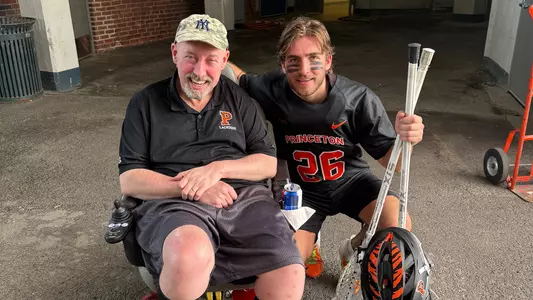
John is 55 now. He’s nearly 18 years down the road now with the disease. It’s cost him his mobility, his career, his ability to walk. He can no longer speak, something that Ryan Croddick mentioned when asked if his dad would be willing to talk about the disease. He can text still. That’s his main way to communicate.
“You can have his number,” Ryan says. “He’ll get back to you.”
Yes, he will — and did. Maybe his sentences run on just a bit, and maybe his punctuation can use some work. Still, if you were expecting someone feeling sorry for himself or someone who has lost his zest for life, you texted the wrong John Croddick.
Question: What were the emotions around hearing the letters “ALS” when you were in your 30s with 4 young kids?

Answer: Well it took a while to diagnose me, but I have the Steven Hawking kind not the dying kind. I was diagnosed in 2009 but actually it was a relief since I thought I had brain cancer.
Question: How did you know something was wrong?
Answer: I was tripping a lot. I used to play a lot of beer league hockey, and I was falling, which I never did before.
John Croddick is still John Croddick. ALS? It has attacked his body. It hasn’t attacked his sense of humor. Just ask his wife.
“He’s funny,” Rachel says. “He has a big personality. And he loves being a dad.”
Ask Anna Faulstich.
“I’ve been around him a fair bit,” she says. Faulstich is in Amsterdam for the summer. Her parents are Dutch. She will tell you she’s Dutch, even though she has spent much of her life in England, something her accent and vernacular give away easily.
She and Ryan have been dating for more than a year, ever since her freshman year at Princeton. It was Faulstich, by the way, who broke a scoreless tie with a goal with 3:45 to go in the Tigers’ 2-0 win over Harvard in the NCAA semifinals last fall.
“Ryan and his dad are very similar,” she says. “He has a very quirky side, and he gets that from his dad. They have a shared love of ‘Star Wars’ and the Grateful Dead. Ryan 100 percent got that from his dad. They both have random knowledge about everything. I remember when I first told Ryan’s dad that I loved Liverpool. He left the room and came back and was wearing a Liverpool jersey. He must have a million jillion of them. It was really funny. That humor — it comes out in Ryan too. They are very similar.”
Question: What is a typical day like for you?
Answer: My wife gets me up I sleep in a recliner then I get myself ready brush my teeth and then change my shirt then get on toilet need. I help with that on and off then I get in my wheelchair then most days I play video games all day it help with my hands lol. I'm retired now like the Iron Horse not being able to walk or talk will do that to a fella. I’m very much a NERD and I play video games all day and go to my local game store to play MAGIC THE GATHERING at Peninsula Games in Long Branch NJ, a store which I used to own.
What do you remember from when you were six? Anything? Ryan Croddick was six years old when his father was diagnosed.
“It’s getting harder for me to conceptualize when he was healthy,” Ryan says. “I’ll always have one memory though. He won this big golf tournament at Navesink Country Club. “
The more the cheeseburger disappears, the deeper the questions get. He pauses between bites and points across the river outside the window.
“It’s right over there,” he continues. “I remember on the 18th hole. His best friend hit the wrong ball for a one-stroke penalty. They went to a playoff. The other team missed a three-foot putt in the playoff and my dad’s team won.”
Imagine, if you possibly can, what that must be like, your lone image of your father as an athlete taking you back nearly two full decades, back to when you were barely in grade school. Since then, Ryan has had to watch, along with the rest of the family, as John’s condition worsened, eventually forcing him into a wheelchair.
Question: How do you text? Is there a special device?
Answer: Regular phone not special just 1 press at a time.
“It’s not smooth sailing,” Faulstich says. “They all put up a great front, but they go through some really tough moments. Ryan has a way to deal with it. He relies on his friends and the people around him. And lacrosse is a big part of that too. It made him so happy that his dad could see him play. He’d always say ‘my dad is with me.’ The last two years he’s gotten a lot stronger. He’s gotten better at realizing what’s happening. He has huge battles in his head, with a lot of ups and downs. There are times you think your world is ending, right? He’s gotten so much stronger from that. His mental resilience is insane — and that certainly has helped him as a goalie.”
The four Croddick children all grew up as athletes. All four played ice hockey. Ryan, as he said, came to lacrosse in third grade and the goalie position in fourth grade. As he evolved into one of the best in the country, his father watched as often as he could. Everything became normalized.
“He really lost a lot of his independence after he couldn’t drive anymore,” Rachel says. “That made things more challenging. He was pretty feisty about it. And pretty determined. All of us dealt with different phases of this. We’ve had to take it day by day. Literally. It’s something that’s always progressing. The kids have dealt with it pretty much their whole lives.”
“I was six when he was diagnosed,” Ryan says. “I didn’t understand anything at that point. You really didn’t start to feel it until he stopped walking on his own. As the years have gone on, his muscles have contracted more. He can move less and less. He needs a lot of help. My mom does a lot. Little brother has done a lot. My mom has done a great job of having it have the least impact on us. I went to high school across the street from my house and saw him every day. In college you go away for long periods of time. When you come back you can see he has progressed. It seems like it’s progressing at a faster rate now.”
Ryan Croddick attended Rumson-Fair Haven High School, playing varsity hockey and lacrosse for four years and being the team captain for both as a senior. He was the 2021 Vail Lacrosse Shootout Most Valuable Player, as well as a USA Lacrosse All-American and the Shore Conference Specialist of the Year.
“Recruiting was a bit wonky,” he says. “It was really just schools I didn’t want, and then COVID happened. I was planning on going to Ohio State to just join a fraternity and be a regular college kid.”
He began to change his mind after his senior season. He’d accept an offer from Richmond but decided to do a post-graduate year as a boarding student at the Hun School, which is walking distance from the Princeton campus. He first heard from Madalon just before he said yes to Richmond. It was two days before he left for Hun that he decommitted from Richmond.
“My sister had an opportunity to go to Princeton but turned it down to go to Stanford,” he says. “She said to me ‘are you crazy? You can’t turn down Princeton.’ My mother and sister both told me that. I felt really badly about turning down Richmond. I have a lot of respect for Coach [Dan] Chemotti [the Richmond head coach]. He actually texted me after we won the championship.”
Croddick came to Princeton in the fall of 2022, after Madalon’s first trip to the NCAA Final Four. It had been 18 years since the Tigers had been there. Erik Peters, the goalie on that team, graduated, leaving a race for the starting spot between Gianforcaro and Griffen Rakower, with Croddick pretty much penciled into the No. 3 spot.
And there, again, is one of the unique challenges of being a goalie. There’s only one on the field at a time. High school attackmen are moved to offensive or even shortstick defensive midfield all the time if they’re good enough to help at an already deep position. Defensemen become longstick midfielders. Middies become attackmen. Goalies? Nope.
“His body language wasn’t good,” Madalon says of Croddick. “To be honest, he sulked a bit. Thankfully he fixed it. Coming in and not playing is hard. You’ve always been the starter, the man, the big-time recruit. Like any young guy, he had to learn. He had to work to get better every day. He had to get used to sitting on the bench and get used to the process. He had to learn to grind, to produce, to manufacture saves — and he did all of that.”
Gianforcaro would eventually become the full-time goalie as a junior and senior, and he would lead Princeton to the NCAA tournament in both years. The man they all call “Gio” was the 2023 Ivy League tournament Most Outstanding Player and a fixture in goal.
“Gio was such a powerful figure on the team,” Madalon says. “He’s what our team needed at the time. We didn’t practice hard enough. We weren’t violent enough in our skill work or in the weightroom. Gio checked all those boxes.”
“Playing with Ryan for two years was incredible,” Gianforcaro says. “He brought a lot of creativity to the game and genuinely had fun doing it. I certainly tried to take some of that from him, and it helped keep me calm before games, which I often struggled with. Most goalies, me included, can get frustrated when they’re backing someone else up. That was never Ryan. He was always the first to congratulate me, pick me up or celebrate together. He was always prepared for game day but did everything he could to support me as well. Needless to say, he had incredible maturity at a young age.”
Croddick played a total of 4:45 as a freshman and then 24:21 as a sophomore. He made a total of five saves.
“It was hard at first,” Croddick says. “The goalie battle was between Mike and Rack, and I wasn’t even mentioned. I was pretty confident out of high school, and it was humbling not even being in the conversation. It helped with my perspective though. I knew I’d only get two years. It gave me the time to lock in academically, socially. When my time came, I thought I’d be ready.”
That time was the first game of his junior year, 2025. It was at Penn State. Nobody was really prepared for what happened.

BY OPENING DAY of his junior year, Ryan Croddick was locked in as the Princeton starter. There was no doubt about that
“I couldn’t wait for the world to see Croddick,” Madalon says. “We knew he was going to be special.”
The first game would be at Penn State, a team with its sights firmly set on a national championship and a team that would ultimately reach the Final Four. The game was scheduled for Feb. 15 in State College. To say it was cold outside would be an understatement.
The forecast for that day was snow, sleet, ice and temps in the 20s. The teams had two options: play through all that or move the game indoors to Holuba Hall, an indoor football practice facility that can accommodate a regulation-length lacrosse field and just a handful of spectators. The decision was made to play inside.
“All of the sudden we’re playing inside, with colored balls and white walls,” Madalon says. “We were given an 8:30 pm practice time the night before, and the only person that was for was Ryan Croddick. We had to see if he could see the green balls. So the whole team goes up there. Guys don’t even have shoes on. Chad is kicking field goals. Croddick? He goes through a full warmup. I think I might have been a little less confident than he was after that.”
The results were stunning. Croddick made 22 saves in the game as Princeton won 11-10 in overtime. He made 13 of his saves in the second half and six in the fourth quarter. He even had an assist after a long outlet pass that led to a Jackson Green transition goal. Among his many honors afterwards were Division I Defensive Player of the Week, not to mention Ivy League Defensive Player of the Week and winner of the coveted Princeton Gamesheet as the team’s Player of the Game.
“I was sort of set up for failure,” Croddick says. “I’d never played with green balls before. It was inside. There were almost no fans. It was quiet, but that meant I could really focus. I had only one role, and that was to save the ball. I had Mulsh and Bath [then-senior defensemen Colin Mulshine and Michael Bath] in front of me. It was easy for me to go in there, do my job and save the ball. I think that game pushed me onto the path I’m on now.”
The 22 saves were the most ever by a Princeton goalie in his first career start but weren’t the most he’d have in a game that season. That would come against Rutgers, when he had 24 more. By season’s end he was the Ivy League Goalie of the Year and a first-team All-Ivy League selection. He’d finish with 241 saves, the second-highest single-season total ever by a Princeton goalie and the most since Bill Cronin had 277 in 1973.
But. And there was a very, very big “but.”
Princeton went 13-4 in 2025, finishing 5-1 in the Ivy League behind Cornell, losing in the Ivy tournament final also to Cornell and then blasting Towson in the NCAA tournament opening round to reach the quarterfinals. The Tigers were the No. 3 seed; their opponent for a spot in the Final Four would be No. 6 Syracuse.
The teams played what was without question the Game of the Year in Division I lacrosse, though it did not end happily for the Tigers. The game was, in a word, nuts. Princeton led 11-10 at the half. Syracuse went on a 6-0 run. Princeton answered with five in a 5:03 span to tie it at 16-16. It would be 18-17 Princeton with less than five minutes to go before Syracuse scored twice. Final score: Syracuse 19, Princeton 18. The teams combined for 93 shots, of which 63 were on goal.
The game was played at Hofstra. Princeton’s postgame tailgate was off in a corner parking lot. To say it was subdued would be an understatement. A Final Four opportunity had slipped away. It was Syracuse who went on to the semifinals. It was Cornell who won the championship. Princeton, winner of six NCAA titles between 1992-2001, saw its own championship drought stretch into a 25th season.
“I remember seeing them after that game,” Rachel Croddick says. “They were so disappointed. It was hard to see them that way. But you know what? That loss energized them. Every one of them.”
“One of my lockscreens on my phone is still Coulter [Mackesy, Princeton’s all-time leading goal scorer who was a senior in 2025] with me in front of the scoreboard,” Ryan says. “19-18. We were so close.”
It was a long off-season. It was a preseason filled with promise. Princeton was talked about as a national championship contender, with a lineup filled with veterans who had NCAA tournament experience and a chip on their shoulder after what happened that day at Hofstra. The team was highly ranked. It had more preseason All-Americans than anyone else. There was talk of serious Tewaaraton Award candidates, plural.
Opening Day would again be against Penn State, this time at home. Princeton was ready, or so it thought. It turned out Penn State was ready too. The game was a blowout, and not in favor of the Tigers. It was 7-1 Penn State after the first quarter. The final was 13-7.
“It was easy to point to the hype,” Croddick says. “We were too ahead of ourselves. We just didn’t click that game. Our offense wasn’t moving. Our defense wasn’t understanding what we were trying to do. They didn’t let us breathe.”
Where would the season go from there?
There were two teams that Princeton just couldn’t seem to be able to beat — Maryland and Cornell. No current Tiger had ever walked off with a win against either one of them. These two had denied really good Princeton teams from reaching their ultimate goals.
Week 2 would be at Maryland, a team that Princeton had not beaten since the 2004 NCAA quarterfinals, with six losses since the start of the 2022 season alone, two in the NCAA tournament. The Tigers were staring at 0-2 if they couldn’t figure out the Terps. With some lineup adjustments after the Penn State game, Princeton started to pull away. It was a 13-9 Tiger lead with six minutes to go. It was 13-12 with six seconds to go and counting — and about to be 13-13, it seemed.
Then Croddick changed everything. Somehow, Maryland’s Elijah Stobaugh found himself with the ball all alone in front of the net. His shot was headed into the far side of the net, which would have meant overtime — until Croddick stabbed it and then controlled it, pouncing on the loose ball as time expired.
“It felt like the team was letting go of a rope, and I just tried to grab it before it was too late,” Croddick says.
Madalon put it more succinctly.
“That was sick,” the former goalie turned head coach says.
Princeton would lose only one more regular season game, this one by a 13-11 count at home to, you guessed it, Cornell, running the losing streak against the Big Red to seven straight. The teams would tie for the Ivy League title after Cornell lost a game against Yale, and then the Tigers and Big Red would meet in the Ivy tournament final in Ithaca once again.
To get there, Princeton defeated Yale 12-10 in the semifinal. Afterwards, while being interviewed on ESPN, Palumbo used words like “rage” and “ferocity,” not to mention another word that starts with “f,” to describe what the final would be like. He was right. Princeton led 7-5 at the half. With a minute left in the third quarter, it was Princeton 16, Cornell 5. The final was 19-9.
“That confidence had been growing and growing for us,” Croddick says. “Cornell would always find a way to beat us every time we played them. We had, like Chad said, a lot of built-up rage and ferocity, and it was a lot of fun to be a part of that. To see the way everyone succeeded at the highest level, it gave me confidence. It gave the team confidence. It carried us from there.”
Princeton would earn the No. 1 overall seed in the NCAA tournament, which began with a 17-8 win over Marist to put the team back into the quarterfinals. Who would be waiting there? Penn State. The same Penn State team that had hammered Princeton on Opening Day.

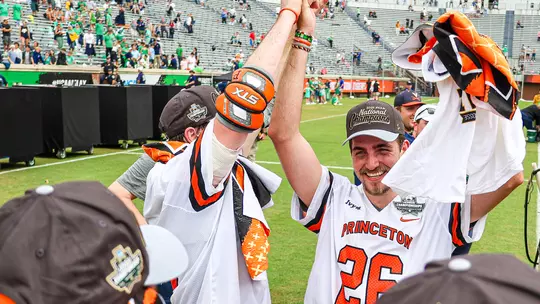
THE ENTIRE NCAA men’s lacrosse tournament is televised by ESPN. The crew for each game will schedule a Zoom with the head coaches and some of the key players, and that was the case prior to the Princeton-Penn State game. Dana Boyle was to be the sideline reporter, and she noticed that it said “F ALS” on tape on Ryan Croddick’s wrist.
“You see his left wrist taped, not due to injury but instead as a reset, a reminder for Ryan to keep it all in perspective,” Boyle says. “Written on that tape are his sentiments towards ALS.”
“She asked me about it,” Croddick says. “So I told her. It literally means what it says. ‘F ALS.’ When people ask me about it, there’s nothing that holds me back from sharing it. My friends all have known about it. In my senior speech to the team, I mentioned it. I think it gave the guys a glimpse into my life.”
The entire conversation with Croddick lasts way longer than it takes to eat a cheeseburger. In the hour-plus of talking, what he said next was probably the biggest takeaway:
“That’s my motivation for why I play.
Question: What do you want your children to learn from your experience and how you’ve faced this illness?
Answer: I try to put a smile on my face every day. I didn't know this, but Ryan used it as motivation this season.
Despite the fact that it was more than 90 degrees in the stands and more than 100 degrees on the Delaware Stadium turf, John Croddick was in attendance that day. It was only the third time all season he would see a game in person.
The Princeton-Penn State rematch was played exactly one year to the day of the Princeton-Syracuse heartbreaker of 2025. This game showed all the signs of being an excruciating repeat of that one. Penn State went up 2-0. Princeton led 6-4. It was 6-6 at the half; 9-9 after three; 10-9 Nittany Lions with 14 minutes to go.
“It was so hot on the turf,” Ryan says. “I was wiping my eyes every timeout. I couldn’t see. There was sweat and eyeblack in my eyes. Penn State was tough, athletic. I honestly think they were the best team we played all year. We were just holding on until we made that run.”
Ah yes. “That run.” It became the signature of the 2026 Tigers in the postseason. Between the Ivy League tournament and the NCAA championship, a total of six games, Princeton had a “that run” in every one of them, blowing open close games that turned into six wins by an average of 6.5 goals. “That run” against Penn State came despite the heat and despite the stakes. Princeton would score the final five goals of the game, flipping a loss to a win for the second time in 2026. Final score: Princeton 14, Penn State 10.
Next up would be the NCAA semifinals in Charlottesville and a Duke team that was questionable for the tournament itself all season. Given a second chance, Duke defeated No. 4 seed Richmond 14-12 before destroying Georgetown in the second quarterfinal at Delaware 16-6. The Blue Devils were on a roll, confident and high-scoring — until they ran into Ryan Croddick.
“Once he made that first save,” his mother says, “I said ‘he’s got this.’”
Yes, he did. Croddick made 20 saves, of which 12 came in the first half and eight in the second. What had been a 4-3 Duke lead early in the second quarter became a 14-7 Princeton win. The 20 saves tied the program record for a single NCAA game, something Croddick now shares with Hall-of-Famer Scott Bacigalupo, who made his 20 saves in the 1991 NCAA quarterfinals.
Question: What is like being the father of the goalie?
Answer: It's Nerve wracking every goal he lets in I second guess I say to myself OH RYAN LOL but in the semifinal game he made so many great saves I said to myself RYAN IS ON LOL
As the tournament’s top seed, Princeton was assigned the nicest hotel among the teams in Charlottesville. It was a resort, a sprawling one at that.
“It scared me,” Madalon says, mostly, but not completely, kidding. “Frightened. A resort? Great. Now we’re going to lose because we got soft.”
“It was just fun being with the whole team,” Croddick says. “School was finished. We didn’t have a care in the world. At dinner Sunday night everyone was just laughing, smiling, enjoying each other’s company. I knew then we were going to win.”
There were fireworks at the resort Sunday night, regularly scheduled Memorial Day Weekend ones. The fireworks Monday didn’t start until after Notre Dame had scored the first three goals and Madalon called a quick timeout.
“It was a very important timeout,” Croddick says. “We felt their athleticism right off the bat. Coach Hirsch [defensive coordinator Jeremy Hirsch] said that we were going to run zone to see how it worked out. Turns out it worked tremendously.”
The fireworks came in the form of the best “that run” Princeton men’s lacrosse has ever had, anywhere, anytime, any game, any year. It would be 3-3 by the end of the first quarter. It would be 11-3 at halftime, as in Princeton scored 11 straight goals to end the first half.
“I didn’t have to do much,” Croddick says. “The ball was never in our end. I kept talking to myself. C’mon Meeks [face-off man Andrew McMeekin]. Keep winning draws. Keep scoring goals. It started creeping in that we were going to do this.”
Running off the field with that eight-goal lead, the soon-to-be champs ran past the members of the previous Princeton NCAA title team, the 2001 Tigers, who by a great coincidence of timing were being honored on the field on their 25th anniversary.
“The 2001 team was coming onto the field all hooting and hollering and fist -bumping,” Croddick says. “I tried not to smile, but hey, it was impossible not to.”
Notre Dame tried to answer, but the hole was just too deep. The exclamation point came with Princeton up 14-8 midway through the fourth quarter. Cooper Kistler came away from a wild scramble that lasted nearly 30 seconds with the ball and fed it back to Croddick, who passed it from behind the goal all the way past midfield, perfectly leading Cooper Mueller, who rifled one in to set off yet another wild celebration.
“It was surreal,” Rachel Croddick says. “I was standing with all the moms. We were like ‘wait, are they really going to win this?’ They’d talked about it for so long, and it takes so many pieces to win. It was, yeah, just surreal.”
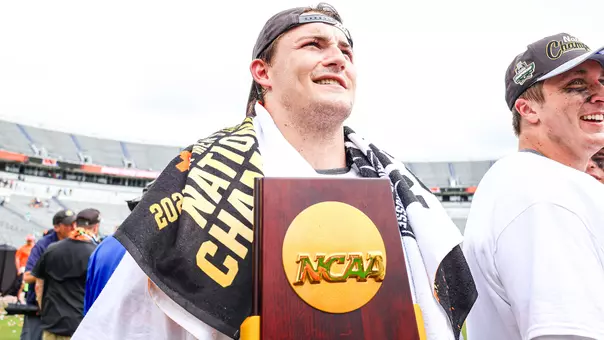
The final was 16-9. Croddick had made 13 more saves, giving him 33 in two Final Four games and a ridiculous .673 save percentage for Memorial Day Weekend. The choice for Most Outstanding Player was obvious.
“It’s easy to give it to the goalie,” Croddick says. “It’s really a team award.”
“It was so much fun to watch his game evolve and mature, from his freshman year through his first start junior year to winning the national championship his senior year,” says Gianforcaro, one of the many Princeton alums in the Scott Stadium stands at UVa. “He’s a natural goalie who brings an athletic element to the game that so many lack. He’s also an intense competitor who has unshakable confidence and channels that into making the next save.”
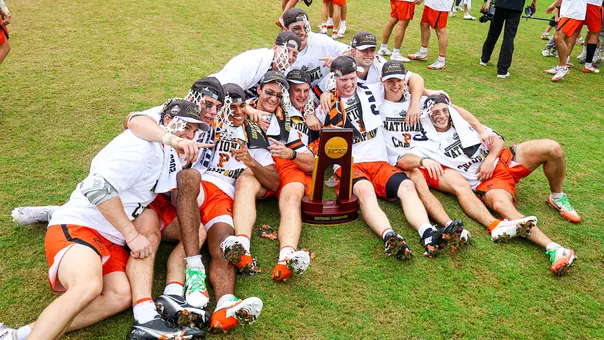
The very next day after the final was graduation at Princeton, and the 13 seniors on the team brought the NCAA trophy with them to the ceremony.
“When you ask his teammates, they’ll tell you that Ryan is not only the backbone of the team but also its calming force,” Boyle says. “Ryan’s ‘why’ is his father John. I first met Ryan on Zoom prior to the quarterfinal game and got to the follow Ryan and his team to its eventual championship. His calm, humble demeanor stood out to me. He’s a great teammate. I’m now covering Ryan in the PLL, and it’s evident what a great person he is on and off the field. Lacrosse is lucky to have people like Ryan playing the game we all love.”
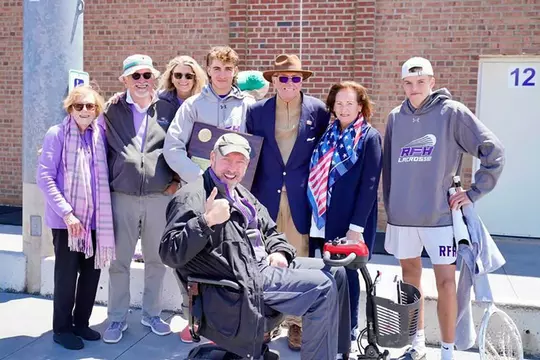
JOHN CRODDICK watched his son win the NCAA title at home. Afterwards, he went to a local restaurant where the game had been shown.
“If you want a snapshot into Ryan and the Croddicks, look no further than the video shared on social media of Mr. Croddick as he enters the restaurant,” Palumbo says. “You see an entire community that is celebrating Ryan’s accomplishment by applauding his father and their family. That’s how you know that the Croddicks are a family people want to be around and want to root for. In that video you see a community rallying around a family they love, and you see a father so proud of his son. Having spent a ton of time with Ryan, I can attest to the amount of love he has for his dad. In the moments Ryan has shared about his dad it’s easy to see how much he cherishes the memories they share and the time they spend together.”
Palumbo is a bigger part of this story than just as one of Croddick’s best friends. Palumbo was diagnosed with a rare form of cancer prior to his senior year of high school and fought all the way back through that to become one of the best players on the NCAA championship team. The joy he plays with continues now as one of the top rookies in the PLL, reflected in the “Summer of Chad” storyline.
“Chad shows so much exuberance and happiness,” Rachel Croddick says. “It just spills out of him.”
She appears to be the same. When you are faced with something like she is, like they all are, you either give up or you fall back into each other and stay who you have always been.
“You see their family, and they’re so used to dealing with this,” Faulstich says. “Coming from an outside position, you’re like “wow.” They’re so amazing. If you take a step back, it’s an insane situation to be in. And yet they’re just so much fun to be with, anytime you’re around them.”
“I think I have a unique perspective that many people don’t have given the circumstances of my dad’s illness,” Ryan says. “At the same time, it’s super motivating for me being in the situation I am in and the opportunities I’ve had to make the most of them. You never know when time is up. You have to cherish every moment. You never know when you’re not going to be able to talk to your dad anymore.”
Think about that as you figure out the theme of this story. It’s back where it all started, more than 7,000 words ago. It’s back before the cheeseburger ever arrived.
The theme is, in a word, time. Rachel Croddick is right about what she says about Palumbo. And, unspoken in those words is this: There are no guarantees. There is no telling what will happen next.
Let the happiness spill out while you can.
— by Jerry Price