


Princeton University Athletics
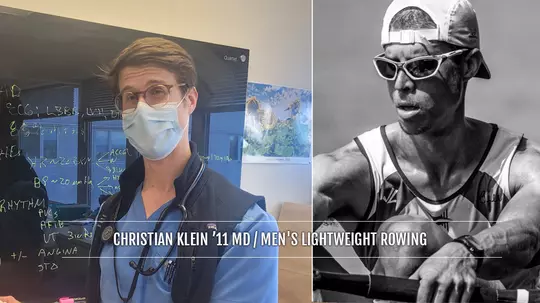
Christian Klein '11 MD / Men's Lightweight Rowing
City, State / Workplace / Title
Seattle, WA / University of Washington / MD (Resident)
Medical Specialty / Other Degrees (MBA/MPH, etc.)
Internal Medicine
What made you choose a career in healthcare?
First, I really enjoyed the science - I had been a Molecular Biology major at Princeton, but ultimately found bench research didn't really fulfill me. Medicine had that scientific foundation but with more focus on human interaction, which appealed a lot. The other draw was that Medicine is a field where you know you will make a difference in somebody's life every day - to give help and healing to people who wouldn't be able to get it otherwise. I wanted to make sure that whatever career I chose was one which would leave some kind of lasting impact, so Medicine was an obvious choice.
What is the focus of your work today?
I'm in my first year of residency, which means my work right now is primarily clinical and focused on patient care. (Specifically, a Hematology/Oncology rotation at the moment; I'm also able to spend more time at my primary care clinic nearby.) I've been able to work on a bit of research in Cardiology, and am working on scheduling time for further research.
How has your work changed in the face of COVID-19?
Words are honestly failing me right now to describe what it felt like to be on the phone with the loved ones of people who were critically ill or dying, other than to say that they were some of the most challenging things I've done as a physician.Christian Klein
Medicine during COVID is all I've really known. It's impossible not to see how different things are now than they would have been two years ago- masks are now ubiquitous rather than limited to the OR, and there's a much heavier emphasis on remote work, stricter, standardized use of PPE including specific use of trained observers to make sure we "don and doff" appropriately; and, until more recently, the unshakeable fear that any interaction with a known COVID-positive patient could be the act that led to us, or by extension our friends and loved ones, becoming critically ill or dying. (That, thankfully, has largely abated with the vaccine. The biggest impact for me, is the restrictions it places on how we interact with our patients and, more importantly, how they are able to interact with their own families and loved ones. Visitation is tightly regulated, with limitations typically being eased only when patients are clearly at end of life. I've had conversations with patients dying of metastatic cancer and their families that could only be done over the phone because the patient happened to also have COVID - something that would be unthinkable in other circumstances. Words are honestly failing me to describe what it felt like to be on the phone during those calls, other than to say that they were some of the most challenging things I've done as a physician, and ones that I will carry with me for a long time to come.
How did being a Princeton student-athlete prepare you for the challenges you’ve faced?
The two things that have best served me in residency are also the two biggest things I learned from being a rower at Princeton - perseverance and hard work, and teamwork and loyalty. Being able to put our heads down and just do the work was necessary in the sport of rowing - if you couldn't do that then you wouldn't even make the boat. The long winter hours spent indoors on rowing machines were rarely glamorous, but they were necessary, and developing the ability to survive (and even thrive) through that slog is one of the best things that happened to me. Residency is less physically taxing, but the mental and emotional challenges are similar, and learning how to shoulder that load from rowing has been a huge boon. The ability to work with and rely on others is essential to succeed. People like to refer to rowing as the "ultimate team sport" because of the physics of having nine bodies in a single boat who have to work together. The more important part of rowing is teammates having your back, pushing you to try harder, picking you up when you fall down. I still give huge credit to Greg Hughes and Marty Crotty for instilling in us that those values. Knowing how to integrate into that environment and contribute to it is something that I learned from my years in the boathouse and on the water.
What keeps you inspired as you look ahead?
First, the work my colleagues and I do is incredibly important and really does do a lot of good for our community and the people in it. Medicine is arguably more crucial now than ever - not just for the pandemic, but also for all the downstream effects like people forgoing access to preventive care, loss of employment and financial security, worsening mental health nationwide, increasing numbers of substance use disorder... the list goes on. Getting to be a doctor against that backdrop is both a privilege and a responsibility. I'm grateful to be here and motivated not to let down the people who need our help. I am part of something incredible, and historic, just by being a doctor in Seattle in the year 2021. The first COVID deaths in the state of Washington, some of the earliest rumblings of this thing that would change our society, were patients of our residency program - patients who were taken care of by the people who would become my colleagues, my friends, my mentors. The first alarms raised about the potential scope of this virus came from researchers at this institution. The knowledge that I am now a part of this is... humbling and inspiring, and still drives me on in the hopes I can one day live up to it.
Medical School / Other Affiliations
Eastern Virginia Medical School


Tiger Heroes
In partnership with RWJBarnabas Health, the official health care system of Princeton Athletics, “Tiger Heroes” honors front line workers and health care leaders from our alumni community. This digital and social series highlights alumni from all 37 varsity sports programs who have risen to the challenge since the onset of COVID-19. We also recognize special Princeton friends and family. Nominations may be sent to Jess Deutsch, Princeton's Associate Director, Student-Athlete Services: jdeutsch@princeton.edu