


Princeton University Athletics
Doug Davis And The Pause Wall
It’s tough to talk to Doug Davis for too long without getting around to asking him about, well, if you’re a Princeton fan, you already know what.
And so it was this time as well.
“I’m a teacher now,” says Davis, a Class of 2012 graduate who is now a U.S. history and AP geography teacher and the head basketball coach at Princeton Day School. “Every now and then, my students will AirPlay it to the big screen and I’ll hear ‘Davis for the win …’ “
Hey, that’s how it is when you’re singularly responsible for one of the most iconic moments in the history of Princeton Athletics. And Doug Davis is.
Back in 2011, Princeton and Harvard tied for the Ivy League championship in men’s basketball, forcing a one-game playoff for the NCAA tournament bid. Princeton trailed by one with 2.8 seconds to go when Davis took the inbounds pass, made one head fake and swished in the game-winner, sending the orange half of Yale’s neutral site of Payne Whitney Gymnasium into a frenzy and the Tigers to the NCAA tournament.
“Hey, it’s a great way to connect with the kids,” he says.
It’s a light moment in a conversation that has focused on a pretty serious topic, one that Davis experienced first-hand and that he now has been instrumental in trying to attack for the current generation of Princeton athletes.
If you walk into Caldwell Field House now, you’ll notice the “Pause Wall,” which sits alongside the upper hallway, just inside the door on the side between Jadwin Gym and Weaver Track.
“As a student, I don’t think you realize the stress you’re under,” he says. “You’re too focused on what you have to do next. As a teacher, I see it from the other side.”
And that perspective has given him a chance to take a second look at his own experiences.
“When I think back on my time at Princeton,” he says, “I realize that I never really took any time to reflect on the fact that I was going through the same things that someone on the swim team was, or the field hockey team, or any team. We call Princeton the ‘Orange Bubble,’ but too often everyone is in their own individual orange bubbles, bouncing off one another. You say ‘hi,’ and ‘how are you’ and keep going, from class to class, paper to paper, lift to lift, practice to practice, game to game.”
The “Pause Wall” grew out of an initiative and a grant coordinated by Associate Director of Athletics for Student Services Jess Deutsch. Davis worked with Deutsch and several students in the planning of the wall.
“Jess told me about the project when it was really just an idea,” Davis said. “She really put it into practice and made it come to fruition. I just tried to give her a little of my experience as a student athlete at Princeton. When you’re a player and a student, it can be tough to figure things out.”
The wall is designed to help combat that. The wall itself offers students a chance to leave messages or support, or to take messages of support. It also offers services and resources available to help if necessary.
“The Pause Wall is about creating what is needed, in the time and space available – an opportunity, even a momentary one, to slow down, gather resources, and realize that as a student-athlete here, you are not alone,” Deutsch says. “It’s about breaking down the stigma around struggling, or asking for help, and recognizing that outward, public success does not inoculate anyone against more inward, private struggle. All of this – the wins and the losses – can be a part of Education Through Athletics. No Tiger needs to be too tough to get support, from a teammate, a coach, a professor or an advisor.”
The wall was unveiled on Nov. 11, with a gathering of students and administrators. Davis, too, was in attendance.
Davis, originally from Philadelphia, played basketball at the Hun School before coming to Princeton. He made an immediate impact, with 25 points in his first game in the 2008-09 season. Davis would finish with 1,550, which at the time was the second-best in program history and today is third, behind only Bill Bradley and Ian Hummer.
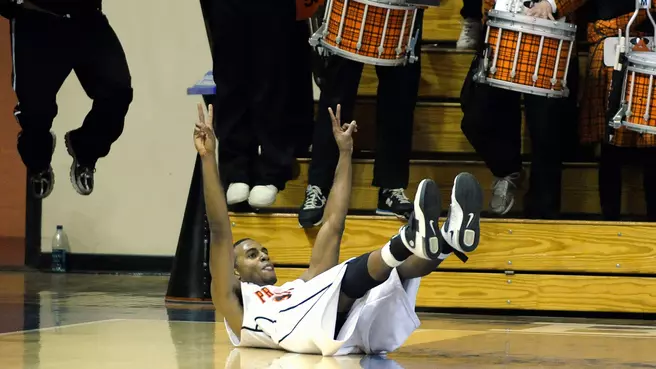
Of those 1,550, the two biggest were obviously the two that took down Harvard in the playoff game. Davis just snuck his shot in before the buzzer and fell to the ground, as his momentum took him back towards the Princeton fans. The iconic moment was captured in an iconic picture, with Davis, on his back, his arms extended up, just before he disappeared under the throng of his teammates and Princeton students who were there.
It’s hard to believe that was nine years ago.
“I just turned 30,” he said, laughing. “I woke up and all of the sudden I was slower.”
Since graduation Davis has played professional basketball in Germany, worked for the Philadelphia 76ers, gone through his own start-up and then gotten into his real passion, education, first at the Berkshire School in Massachusetts and now for the last two years at PDS.
“I love it,” he says. “I love the balance of teaching and coaching. I went to Berkshire thinking it would be a one-year thing and fell in love with it.”
Davis is married to Narissa Williams, a Princeton alum and third-year medical student. When she graduates and starts her residency, Davis may look to make the next step in his career, which would possibly be coaching on the college level.
In the meantime, he continues to share his perspective with his students. And that perspective is personified by the Pause Wall.
“Grace Baylis [the field hockey goalie and one of the driving forces behind the wall] said that for each person and each team it’ll be something different,” Davis said. “So many kids think their stories are so unique and personal. In some ways they are, but also they connect. I know I felt that my struggles were mine and mine alone. That’s the attitude you don’t want people to have. The Pause Wall is a way for a lot of our student athletes to connect about more than what sport do you play or what is your major. It’s a way to talk about what we don’t want to talk about.”
That’s his message. It’s the point of the Pause Wall.
And Doug Davis is way more than just one made basket, no matter how big a basket it was.
And so it was this time as well.
“I’m a teacher now,” says Davis, a Class of 2012 graduate who is now a U.S. history and AP geography teacher and the head basketball coach at Princeton Day School. “Every now and then, my students will AirPlay it to the big screen and I’ll hear ‘Davis for the win …’ “
Hey, that’s how it is when you’re singularly responsible for one of the most iconic moments in the history of Princeton Athletics. And Doug Davis is.
Back in 2011, Princeton and Harvard tied for the Ivy League championship in men’s basketball, forcing a one-game playoff for the NCAA tournament bid. Princeton trailed by one with 2.8 seconds to go when Davis took the inbounds pass, made one head fake and swished in the game-winner, sending the orange half of Yale’s neutral site of Payne Whitney Gymnasium into a frenzy and the Tigers to the NCAA tournament.
“Hey, it’s a great way to connect with the kids,” he says.
It’s a light moment in a conversation that has focused on a pretty serious topic, one that Davis experienced first-hand and that he now has been instrumental in trying to attack for the current generation of Princeton athletes.
If you walk into Caldwell Field House now, you’ll notice the “Pause Wall,” which sits alongside the upper hallway, just inside the door on the side between Jadwin Gym and Weaver Track.
“As a student, I don’t think you realize the stress you’re under,” he says. “You’re too focused on what you have to do next. As a teacher, I see it from the other side.”
And that perspective has given him a chance to take a second look at his own experiences.
“When I think back on my time at Princeton,” he says, “I realize that I never really took any time to reflect on the fact that I was going through the same things that someone on the swim team was, or the field hockey team, or any team. We call Princeton the ‘Orange Bubble,’ but too often everyone is in their own individual orange bubbles, bouncing off one another. You say ‘hi,’ and ‘how are you’ and keep going, from class to class, paper to paper, lift to lift, practice to practice, game to game.”
The “Pause Wall” grew out of an initiative and a grant coordinated by Associate Director of Athletics for Student Services Jess Deutsch. Davis worked with Deutsch and several students in the planning of the wall.
“Jess told me about the project when it was really just an idea,” Davis said. “She really put it into practice and made it come to fruition. I just tried to give her a little of my experience as a student athlete at Princeton. When you’re a player and a student, it can be tough to figure things out.”
The wall is designed to help combat that. The wall itself offers students a chance to leave messages or support, or to take messages of support. It also offers services and resources available to help if necessary.
“The Pause Wall is about creating what is needed, in the time and space available – an opportunity, even a momentary one, to slow down, gather resources, and realize that as a student-athlete here, you are not alone,” Deutsch says. “It’s about breaking down the stigma around struggling, or asking for help, and recognizing that outward, public success does not inoculate anyone against more inward, private struggle. All of this – the wins and the losses – can be a part of Education Through Athletics. No Tiger needs to be too tough to get support, from a teammate, a coach, a professor or an advisor.”
The wall was unveiled on Nov. 11, with a gathering of students and administrators. Davis, too, was in attendance.
Davis, originally from Philadelphia, played basketball at the Hun School before coming to Princeton. He made an immediate impact, with 25 points in his first game in the 2008-09 season. Davis would finish with 1,550, which at the time was the second-best in program history and today is third, behind only Bill Bradley and Ian Hummer.
Of those 1,550, the two biggest were obviously the two that took down Harvard in the playoff game. Davis just snuck his shot in before the buzzer and fell to the ground, as his momentum took him back towards the Princeton fans. The iconic moment was captured in an iconic picture, with Davis, on his back, his arms extended up, just before he disappeared under the throng of his teammates and Princeton students who were there.
It’s hard to believe that was nine years ago.
“I just turned 30,” he said, laughing. “I woke up and all of the sudden I was slower.”
Since graduation Davis has played professional basketball in Germany, worked for the Philadelphia 76ers, gone through his own start-up and then gotten into his real passion, education, first at the Berkshire School in Massachusetts and now for the last two years at PDS.
“I love it,” he says. “I love the balance of teaching and coaching. I went to Berkshire thinking it would be a one-year thing and fell in love with it.”
Davis is married to Narissa Williams, a Princeton alum and third-year medical student. When she graduates and starts her residency, Davis may look to make the next step in his career, which would possibly be coaching on the college level.
In the meantime, he continues to share his perspective with his students. And that perspective is personified by the Pause Wall.
“Grace Baylis [the field hockey goalie and one of the driving forces behind the wall] said that for each person and each team it’ll be something different,” Davis said. “So many kids think their stories are so unique and personal. In some ways they are, but also they connect. I know I felt that my struggles were mine and mine alone. That’s the attitude you don’t want people to have. The Pause Wall is a way for a lot of our student athletes to connect about more than what sport do you play or what is your major. It’s a way to talk about what we don’t want to talk about.”
That’s his message. It’s the point of the Pause Wall.
And Doug Davis is way more than just one made basket, no matter how big a basket it was.