


.png&width=24&type=webp)


Princeton University Athletics
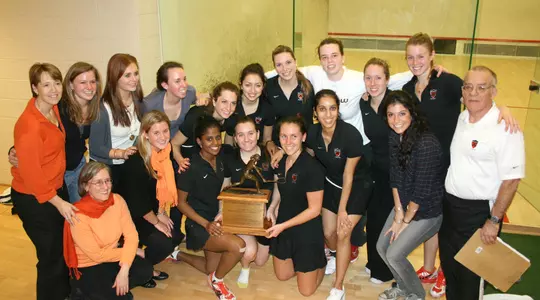
Senior Standouts Look To Cap Careers With Fourth Women's Squash National Title
November 20, 2009 | Women's Squash
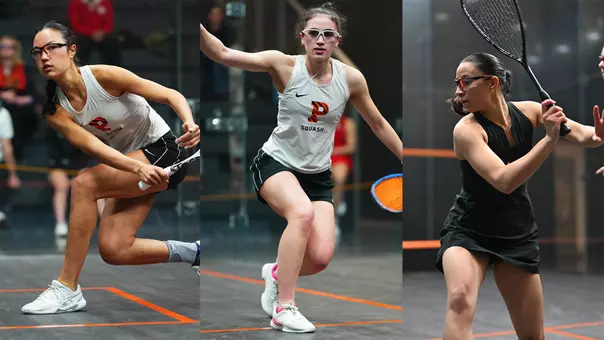
Before Amanda Siebert, Kaitlin Sennatt and the rest of their Class of 2010 teammates took their first class at Princeton, the Tiger women's squash team hadn't won an Ivy League title or a national title since the previous century.
Regardless of what happens this season, they will leave with no fewer than two league titles and three Howe Cup national championships.
So you would think the pressure is off a senior class that includes four players (Siebert, Sennatt, Emery Maine and Neha Kumar) who have played prominent roles and won decisive matches in Princeton's championship efforts. But the truth is this; teams don't become the best without setting the highest of expectations for itself.
Nothing has changed for the 2009-10 Princeton women's squash team, which brings unmatched experience and confidence into a new year. After surviving a pair of 5-4 thrillers against Harvard and another against Trinity, each with one major title hanging in the balance, this is a team that knows how to handle the big moment.
Siebert, one of three tri-captains this season, has played No. 1 for the last two years. A three-time All-America and All-Ivy honoree, Siebert pulled out the biggest win of her career in the 2009 Howe Cup final. Down 2-1 in games and 5-2 in the fourth, Siebert won 16 of 17 points to win the match and clinch the national title. A former Constable Open champion, Siebert has ended the last two regular seasons ranked among the top six in the nation.
Sennatt, a tri-captain, went 9-3 last season playing in the top half of the lineup. She is a fierce competitor who went undefeated in dual matches as a freshman and is 8-1 all-time in the Howe Cup. Like Siebert, she had a match-clinching win en route to the national team title last season; she fought off a match ball against Trinity's JoAnn Jee in the semifinal and claimed the fifth 10-9 to send Princeton back to the championship match.
The third captain, Maine joined the team as a sophomore and was an All-Ivy and All-America player by the end of her junior year. A dependable point in the lineup, she was one of four players to compete in all 13 of Princeton's team matches, and she went 12-1 in the process. She won the clinching match in the 2008 Howe Cup championship final, and she had more success against 2009 individual champion Nour Baghat (Trinity) than almost anybody in the nation when the two met in the CSA championship.
The wild card for the season will be Kumar, who has battled constant injury issues over the last two seasons and is already dealing with them again. She proved last season that she doesn't need a full year of competition to make a major impact; she won six of seven matches in 2009, including all three in the Howe Cup, and she earned All-America honors by reaching the national individual quarterfinals. When she is healthy, she can compete with and defeat the best in the nation, and head coach Gail Ramsay is hopeful she'll be ready when it matters most.
A pair of juniors are also likely to play important roles this season. Jackie Moss has played around the top or middle of the lineup since her career began, and she has an impressive 17-5 career record. She went 8-2 last season and nearly shocked Harvard's Nirasha Guruge in the first round of the national individual championships.
Moss has more experience than classmate Nikki Sequeira, but that didn't stop Sequeira from a strong first showing in the varsity lineup last season. Playing mostly at the No. 7 and 8 positions, she won 11 of her 13 matches. Her biggest win came in the Howe Cup national final, when she rallied from an 0-2 deficit to defeat Harvard's Cecelia Cortes; Princeton needed every win in an eventual 5-4 team victory.
Of the sophomores, only Katie Giovinazzo saw consistent varsity action in her rookie year. Giovinazzo made the most of it, winning all 13 of her matches to become the premier No. 9 player in the nation. Her 3-0 record in the Howe Cup showed her ability to deal with pressure, a responsibility that will likely come more often over the next few years.
Classmates Clare Kuensell, Eliza Kontulis and Daphne Rein-Weston were all promising recruits who showed improvement throughout last season. Each will battle for spots around the bottom of the lineup this season. Two seniors from last year's Howe Cup lineup have graduated, so there are openings to fill.
Of course, one of those spots is likely to go to freshman Julie Cerullo, who should find herself at or near the top of the Tiger lineup throughout the next four years. The top-ranked American recruit in the Class of 2013, Cerullo is coming off a summer where she competed for U.S. Team in 2009 World Junior Women's Championships in Chennai, India. She has been a top-ranked American throughout her career and has both the talent and drive to be a top collegiate player for the next four years.
Another freshman to watch is Casey Cortes, the younger sister of Harvard's Cecelia Cortes. Casey has been a top-10 ranked player throughout her age group since she began playing and was the Team MVP for the Milton Academy after the 2008-09 season.
College squash scores will have a new look this season; the C.S.A. has adopted the professional tour rules, so each game will be played to 11 (instead of 9) with rally scoring rules. Thus, instead of only scoring points on your own serve, you score on every point. All games must be won by two points, and there is no ceiling; in previous years, when games went to nine, you could win a game 10-9. One-point victories will no longer happen in college squash. Matches are likely to be shorter and should provide more exciting finishes in several individual games and matches.
Regardless of what happens this season, they will leave with no fewer than two league titles and three Howe Cup national championships.
So you would think the pressure is off a senior class that includes four players (Siebert, Sennatt, Emery Maine and Neha Kumar) who have played prominent roles and won decisive matches in Princeton's championship efforts. But the truth is this; teams don't become the best without setting the highest of expectations for itself.
Nothing has changed for the 2009-10 Princeton women's squash team, which brings unmatched experience and confidence into a new year. After surviving a pair of 5-4 thrillers against Harvard and another against Trinity, each with one major title hanging in the balance, this is a team that knows how to handle the big moment.
Siebert, one of three tri-captains this season, has played No. 1 for the last two years. A three-time All-America and All-Ivy honoree, Siebert pulled out the biggest win of her career in the 2009 Howe Cup final. Down 2-1 in games and 5-2 in the fourth, Siebert won 16 of 17 points to win the match and clinch the national title. A former Constable Open champion, Siebert has ended the last two regular seasons ranked among the top six in the nation.
Sennatt, a tri-captain, went 9-3 last season playing in the top half of the lineup. She is a fierce competitor who went undefeated in dual matches as a freshman and is 8-1 all-time in the Howe Cup. Like Siebert, she had a match-clinching win en route to the national team title last season; she fought off a match ball against Trinity's JoAnn Jee in the semifinal and claimed the fifth 10-9 to send Princeton back to the championship match.
The third captain, Maine joined the team as a sophomore and was an All-Ivy and All-America player by the end of her junior year. A dependable point in the lineup, she was one of four players to compete in all 13 of Princeton's team matches, and she went 12-1 in the process. She won the clinching match in the 2008 Howe Cup championship final, and she had more success against 2009 individual champion Nour Baghat (Trinity) than almost anybody in the nation when the two met in the CSA championship.
The wild card for the season will be Kumar, who has battled constant injury issues over the last two seasons and is already dealing with them again. She proved last season that she doesn't need a full year of competition to make a major impact; she won six of seven matches in 2009, including all three in the Howe Cup, and she earned All-America honors by reaching the national individual quarterfinals. When she is healthy, she can compete with and defeat the best in the nation, and head coach Gail Ramsay is hopeful she'll be ready when it matters most.
A pair of juniors are also likely to play important roles this season. Jackie Moss has played around the top or middle of the lineup since her career began, and she has an impressive 17-5 career record. She went 8-2 last season and nearly shocked Harvard's Nirasha Guruge in the first round of the national individual championships.
Moss has more experience than classmate Nikki Sequeira, but that didn't stop Sequeira from a strong first showing in the varsity lineup last season. Playing mostly at the No. 7 and 8 positions, she won 11 of her 13 matches. Her biggest win came in the Howe Cup national final, when she rallied from an 0-2 deficit to defeat Harvard's Cecelia Cortes; Princeton needed every win in an eventual 5-4 team victory.
Of the sophomores, only Katie Giovinazzo saw consistent varsity action in her rookie year. Giovinazzo made the most of it, winning all 13 of her matches to become the premier No. 9 player in the nation. Her 3-0 record in the Howe Cup showed her ability to deal with pressure, a responsibility that will likely come more often over the next few years.
Classmates Clare Kuensell, Eliza Kontulis and Daphne Rein-Weston were all promising recruits who showed improvement throughout last season. Each will battle for spots around the bottom of the lineup this season. Two seniors from last year's Howe Cup lineup have graduated, so there are openings to fill.
Of course, one of those spots is likely to go to freshman Julie Cerullo, who should find herself at or near the top of the Tiger lineup throughout the next four years. The top-ranked American recruit in the Class of 2013, Cerullo is coming off a summer where she competed for U.S. Team in 2009 World Junior Women's Championships in Chennai, India. She has been a top-ranked American throughout her career and has both the talent and drive to be a top collegiate player for the next four years.
Another freshman to watch is Casey Cortes, the younger sister of Harvard's Cecelia Cortes. Casey has been a top-10 ranked player throughout her age group since she began playing and was the Team MVP for the Milton Academy after the 2008-09 season.
College squash scores will have a new look this season; the C.S.A. has adopted the professional tour rules, so each game will be played to 11 (instead of 9) with rally scoring rules. Thus, instead of only scoring points on your own serve, you score on every point. All games must be won by two points, and there is no ceiling; in previous years, when games went to nine, you could win a game 10-9. One-point victories will no longer happen in college squash. Matches are likely to be shorter and should provide more exciting finishes in several individual games and matches.
Players Mentioned

/ Women's Squash

/ Women's Squash

/ Women's Squash

/ Women's Squash
/ Women's Squash

/ Women's Squash

/ Women's Squash

/ Women's Squash

/ Women's Squash

/ Women's Squash

/ Women's Squash
Tuesday, June 04
Wednesday, June 22
Monday, June 06
Tuesday, March 01