


Princeton University Athletics
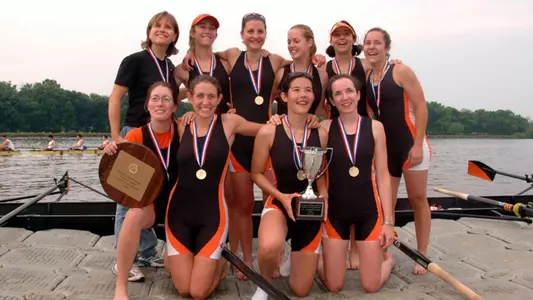
The 2003 Women's Lightweight National Champion
Photo by: Beverly Schaefer
Five: From Start Up Team To National Champions
June 03, 2021 | Women's Rowing - Lightweight
It was 1997.
The boathouse was currently in stretch of four straight years with one of its teams collecting a national championship.
There were only three rowing teams at Princeton.
Until it was announced that the women's lightweight program would start in the spring of 1998.
In the spring of 1997, Heather Smith was hired to start the brand-new program.
"Going from no team to competitions and working towards success at a place like Princeton with its long history of rowing is a different thing then being popped down in the middle of Kansas," said Smith about the program's start.
The team raced for the first time at the Head of Charles in Philadelphia in the fall of 1998.
The roster construction was a little different than what you would see out of a roster now. Most of the athletes had been with the open rowing squad as freshmen and sophomores but moved to this team.
"It was exciting and scary," stated Lisa Cakmak '00, as the team was put together for the first time. "For me at first it felt a little bit like "oh is this just a group of misfits who couldn't cut it on the open women's program?"
They proved to be anything but misfits. The Tigers dropped the first race of the 1998 season but went out to San Diego and placed second. The squad won each of its matches the rest of the season except for an invitational on Cooper River.
Princeton's first postseason was fantastic as it won the Eastern Sprints and placed third at the IRA Championships.
"I wasn't that surprised because we had all been part of a really strong women's program and so the mindset of hard work and competition were just naturally there," remembered Cakmak. "The open weight program pushed us -- we did speed orders against them, and they were really fast so we had a really competitive and fast team to spar with on the lake. "
The women's lightweight program showed very early that it could be successful and maintaining that culture after the first season was part of being the coach.
"Some of that (culture) is easy when you're in a boathouse with trophies from decades ago and you're on a campus that naturally attracts students that are competitive," specified Smith. "I didn't want to take a job that was killing time and helping someone in the athletic department check a Title IX box. If I'm a coach, I want to do something where athletes are working hard and having success."
It wasn't always easy for the program. The Tigers ran into adversity in the first event of the 1999 season. In its qualifying heat at the San Diego Classic, Cakmak forgot to carry her extra weight and the boat was disqualified from the final despite winning its heat. The coaches allowed the varsity eight to race with exhibition status anyway and they won by 1.4 seconds.
The Tigers rebounded with an impressive victory at the Camden Invitational along with wins over Wisconsin, Radcliffe, Virginia and Georgetown to finish the regular season.
Princeton shined in the postseason, securing the Eastern Sprints title for the second straight year before a four-second win at the IRA Championships.
It was time to add a women's lightweights national championship trophy to the boathouse.
"The other thing I remember from the awards dock is as we were pulling away the rest of the Princeton team at IRAs did a cheer for us and I still remember tearing up and thinking we were an equal part of the boathouse and not just an upstart team," uttered Cakmak.
"I remember being relieved and happy for the kids," stated Smith. "Relieved because we were going to be able to stay and we were not the unwanted step-child in the boathouse."
Things were different now.
There were more aspirations as a national champion.
More recruited student-athletes.
"We maintained expectations by working hard," revealed Cakmak. "We just worked all the time and put in the effort just like everyone else in the boathouse. And we never assumed we would win."
Princeton only had three dates of competition during the regular season in 2000. The Tigers won the San Diego Classic by almost 15 seconds over Wisconsin.
The Badgers got one back as they defeated the Tigers two weeks later by 1.98 seconds.
Princeton got the two that mattered the most.
At the Eastern Sprints, Princeton won by 1.1 seconds with Wisconsin crossing the finish line second. At the IRA Championships, the Tigers posted almost a four-second decision as the Badgers were third.
Cakmak had graduated as a senior captain who was now a two-time national champion.
"I think when we started, we were all a little uncertain, like this is an experiment and someone could decide that it's not working," reflected Cakmak. "By the time I graduated we were a full-fledged part of the boathouse with our own traditions and our own recruits."
The 2001 season began much like the previous year, Princeton and Wisconsin exchanging victories. Princeton finished the year with three wins before the Eastern Sprints. The Badgers took a thriller at the Eastern Sprints by five-tenths of a second, but the Tigers won its third straight national crown by over five seconds.
Princeton began the 2002 campaign falling to Wisconsin at the San Diego Classic before placing third at the Knecht Cup. The Tigers' only win of the regular season came over Radcliffe. Once again, Smith's unit shined the brightest in the postseason, collecting the Eastern Sprints and IRA Championships.
Who was the second- place team in both of those events?
Wisconsin, of course.
The 2003 season was perfect.
No, really, it was.
The Tigers won the Windamere Classic to start. They took home the Knecht Cup by four-tenths of a second over Radcliffe before defeating its Ivy rival again on Lake Carnegie.
Princeton, again, took down second-place Radcliffe in the Eastern Sprints and IRA Championships.
Five straight national championships.
"We had more depth by the time I left," said Smith. "We went from trying to get one healthy boat to two eights and a freshman boat. The fact that it worked is a credit to a student-athletes."
Safe to say, it more than worked.
The boathouse was currently in stretch of four straight years with one of its teams collecting a national championship.
There were only three rowing teams at Princeton.
Until it was announced that the women's lightweight program would start in the spring of 1998.
In the spring of 1997, Heather Smith was hired to start the brand-new program.
"Going from no team to competitions and working towards success at a place like Princeton with its long history of rowing is a different thing then being popped down in the middle of Kansas," said Smith about the program's start.
The team raced for the first time at the Head of Charles in Philadelphia in the fall of 1998.
The roster construction was a little different than what you would see out of a roster now. Most of the athletes had been with the open rowing squad as freshmen and sophomores but moved to this team.
"It was exciting and scary," stated Lisa Cakmak '00, as the team was put together for the first time. "For me at first it felt a little bit like "oh is this just a group of misfits who couldn't cut it on the open women's program?"
They proved to be anything but misfits. The Tigers dropped the first race of the 1998 season but went out to San Diego and placed second. The squad won each of its matches the rest of the season except for an invitational on Cooper River.
Princeton's first postseason was fantastic as it won the Eastern Sprints and placed third at the IRA Championships.
"I wasn't that surprised because we had all been part of a really strong women's program and so the mindset of hard work and competition were just naturally there," remembered Cakmak. "The open weight program pushed us -- we did speed orders against them, and they were really fast so we had a really competitive and fast team to spar with on the lake. "
The women's lightweight program showed very early that it could be successful and maintaining that culture after the first season was part of being the coach.
"Some of that (culture) is easy when you're in a boathouse with trophies from decades ago and you're on a campus that naturally attracts students that are competitive," specified Smith. "I didn't want to take a job that was killing time and helping someone in the athletic department check a Title IX box. If I'm a coach, I want to do something where athletes are working hard and having success."
It wasn't always easy for the program. The Tigers ran into adversity in the first event of the 1999 season. In its qualifying heat at the San Diego Classic, Cakmak forgot to carry her extra weight and the boat was disqualified from the final despite winning its heat. The coaches allowed the varsity eight to race with exhibition status anyway and they won by 1.4 seconds.
The Tigers rebounded with an impressive victory at the Camden Invitational along with wins over Wisconsin, Radcliffe, Virginia and Georgetown to finish the regular season.
Princeton shined in the postseason, securing the Eastern Sprints title for the second straight year before a four-second win at the IRA Championships.
It was time to add a women's lightweights national championship trophy to the boathouse.
"The other thing I remember from the awards dock is as we were pulling away the rest of the Princeton team at IRAs did a cheer for us and I still remember tearing up and thinking we were an equal part of the boathouse and not just an upstart team," uttered Cakmak.
"I remember being relieved and happy for the kids," stated Smith. "Relieved because we were going to be able to stay and we were not the unwanted step-child in the boathouse."
Things were different now.
There were more aspirations as a national champion.
More recruited student-athletes.
"We maintained expectations by working hard," revealed Cakmak. "We just worked all the time and put in the effort just like everyone else in the boathouse. And we never assumed we would win."
Princeton only had three dates of competition during the regular season in 2000. The Tigers won the San Diego Classic by almost 15 seconds over Wisconsin.
The Badgers got one back as they defeated the Tigers two weeks later by 1.98 seconds.
Princeton got the two that mattered the most.
At the Eastern Sprints, Princeton won by 1.1 seconds with Wisconsin crossing the finish line second. At the IRA Championships, the Tigers posted almost a four-second decision as the Badgers were third.
Cakmak had graduated as a senior captain who was now a two-time national champion.
"I think when we started, we were all a little uncertain, like this is an experiment and someone could decide that it's not working," reflected Cakmak. "By the time I graduated we were a full-fledged part of the boathouse with our own traditions and our own recruits."
The 2001 season began much like the previous year, Princeton and Wisconsin exchanging victories. Princeton finished the year with three wins before the Eastern Sprints. The Badgers took a thriller at the Eastern Sprints by five-tenths of a second, but the Tigers won its third straight national crown by over five seconds.
Princeton began the 2002 campaign falling to Wisconsin at the San Diego Classic before placing third at the Knecht Cup. The Tigers' only win of the regular season came over Radcliffe. Once again, Smith's unit shined the brightest in the postseason, collecting the Eastern Sprints and IRA Championships.
Who was the second- place team in both of those events?
Wisconsin, of course.
The 2003 season was perfect.
No, really, it was.
The Tigers won the Windamere Classic to start. They took home the Knecht Cup by four-tenths of a second over Radcliffe before defeating its Ivy rival again on Lake Carnegie.
Princeton, again, took down second-place Radcliffe in the Eastern Sprints and IRA Championships.
Five straight national championships.
"We had more depth by the time I left," said Smith. "We went from trying to get one healthy boat to two eights and a freshman boat. The fact that it worked is a credit to a student-athletes."
Safe to say, it more than worked.


Tuesday, June 04
Wednesday, June 22
Tuesday, June 07
Monday, June 06