


.png&width=24&type=webp)
Princeton University Athletics

Right On Q
April 24, 2002 | Baseball
April 24, 2002
On a lazy Friday afternoon in early March, the Tiger baseball team is playing a preseason intrasquad scrimmage at Princeton's Clarke Field. Along the first base line a lone photographer leans against a fence and gazes out on the diamond, temporarily forgetting his responsibilities. Fifteen feet behind him, two loyal fans hold a pleasant monopoly on all four sections of green seats. They watch intently, saying nothing, respecting the serenity of the afternoon.
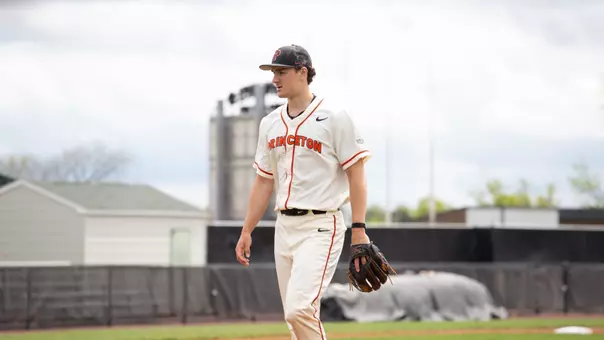
Behind a batting practice screen located twenty or thirty feet behind home plate, coach Scott Bradley holds a radar gun in the direction of the mound. From his familiar vantage point behind home, the 42-year-old former catcher, a veteran of nine major league seasons, eyes his latest ace - this year, it's 2001 Ivy League Pitcher of the Year Ryan Quillian. Chances are Bradley won't be the last to take aim at the junior righthander this season. At six-foot-three and 210 pounds, the former high school tight end is a big target. He easily fills out his black long-sleeve practice jersey and gray baseball pants. The pants stretch just below the knees, revealing high black socks worn in the "throwback" style, which is perhaps fitting. Quillian's composed yet startlingly intense demeanor on the mound is a reminder of the way the game used to be played. In an age when players from both sides chat and laugh together between pitches as though they're all part of one big baseball fraternity, you'll be hard-pressed to find Quillian talking even to his own teammates on the day of a start. And in the golden era of showboating and self-expression, Quillian is relaxed rather than animated on the mound - he seems as effortlessly calm as his surroundings.
Don't be fooled by appearances. His team isn't. Catcher Tim Lahey calls him "a bulldog" on the mound, and shortstop Pat Boran flatly states that Quillian is "one of the most competitive people I know."
"He's all business when he takes the baseball," says his coach.
As a sophomore last year in a league headlined by more experienced, highly-touted pitchers such as Harvard junior Ben Crockett and Yale junior Jon Steitz, Quillian surprised many observers by becoming the league's top starter. The surprise was not simply that Princeton had the best ace in the league, it was that the Tigers had a staff ace at all. Following rising junior Chris Young's signing with the Pittsburgh Pirates, Princeton entered the 2001 campaign desperately needing to answer questions about its starting rotation. "Going into the league last year I think people looked at us and said, 'Boy, Chris Young isn't here, what's going to happen?'" Bradley says. "I don't think people expected Ryan Quillian to be a first-team All-Ivy League performer, that's for sure."
Quillian's response to the challenge was emphatic. Quickly assuming Young's role, he became the starter that could last into the late innings of every game, keeping his team close and giving it a chance to prevail. At times he seemed to win games single-handedly, like when he threw back-to-back 1-0 shutouts against Dartmouth and Columbia. Commanding three solid pitches with exceptional accuracy around the strike zone, Quillian finished with a league-best 1.30 ERA and a 4-1 record. League coaches recognized Quillian's accomplishments by voting him Princeton's first-ever Ivy League Pitcher of the Year.
"He carries himself well, he's real confident, and he's aggressive on the mound," says Bob Whalen, now in his 13th year as the Dartmouth coach. "He would be in the upper echelon of kids that I've seen in the time I've been in the league."
Quillian rocks and releases, continuing a rhythmic game of toss with his catcher that has lasted for several innings now. Keeping the glove close to his face, he kicks his left leg back below his right elbow, then brings it down again for the last big push forward. He seamlessly rotates his torso and upper body through the motion as his legs provide a base of power. It's only March, but he looks as though he's been doing this for months.
This time, though, the ball rockets off the bat, the collegiate aluminum supplying a familiar "ping" sound. The ball bounds deep into left field - an extra-base hit - as Quillian runs to back up a potential throw to third base. Within moments the Tiger defense has relayed the ball to Quillian. He looks at it in disgust for an instant, then tosses it up in the air and catches it while at the same time smacking it down with his glove. He fires the ball into his glove a few more times for good measure, making sure the culprit has been sufficiently punished. The whole scene lasts about ten seconds, but it's one of the few chances you'll have to glimpse the fierce intensity peeking out from behind Quillian's relaxed fa?ade.
"In our intrasquad games he doesn't even want to give up hits," Boran says.
"He's an outstanding competitor," adds Lahey. "He hates to lose as much as anybody I've ever played with. He's talented but there are a lot of guys who are talented out there. What makes him a different kind of guy is he can flip a switch. Once he's off [the field] he's one of the nicest, most easygoing guys you'd ever want to meet."
Teammates and friends say Quillian is loyal, personable, easygoing, even reserved at times. He knows how to have a good time, and he is not easily fazed. "Off the field he's just fun and smiles, kind of a happy-go-lucky guy," says fellow righthander David Boehle.
In the locker room, he good-naturedly absorbs teammates' verbal jousting, which usually includes a variety of cracks about his over-healthy head of hair. Quillian has taken to growing out his hair from December until his first loss of the season, when he promptly shaves it off. In the weeks leading up to that first loss last year, his locks grew long and unruly in the back while remaining relatively short in front. The appearance earned him the nickname "Mullethead" from teammates. Quillian has repeatedly denied all mullet-related allegations, but to no avail. "His hairstyles - and you can definitely quote me on this - are highly suspect," Lahey says with a laugh.
While his body language remains unperturbed on the mound, Quillian's friendly, carefree attitude gives way to a distant, competitive persona. "He probably changes between those two personalities more than anybody on our team," says Boehle.
The transformation begins the night before a start, when Quillian places himself in the proper frame of mind by eliminating distractions and shutting himself off from the outside world. Typically he does this by enjoying a quiet night in his room watching a DVD or two, sometimes with a few friends. The day of the game, Quillian is confident and focused. Boran, who lived with Quillian last summer when the two played for the Harwich Mariners of the Cape Cod Baseball League, became accustomed to this game-day transformation. "There's a little different air to him, maybe a little bit more confidence on those days, maybe borderline cockiness. He'll put his headphones on and go off into his own world."
During the game, Quillian goes about his business with a quiet intensity, mostly keeping to himself. "Yeah, if things aren't going well on the field, you don't want to talk to me," he confesses with a smile that makes you wonder whether he's pulling your leg. Though Quillian and those around him believe this intensity is his best asset, at times it has also been his Achilles' heel. In high school and during his freshman year at Princeton, the normally calm Quillian was susceptible to on-field outbursts when the reserved fa?ade could no longer hide the emotional turmoil within. By tossing gloves and balls and losing control of his temper, Quillian believes he failed to respect the game. "I'm a pretty competitive person I think, and that's maybe upset Coach a little bit," Quillian admits. "Sometimes I get a little too into the game."
With greater maturity and the help of Bradley, Quillian has toned down that aspect of his on-field personality. At the same time, he has always maintained his competitive fire. "I think it's different for individual people," he says. "There are some guys on our team that can go out there and then come into the dugout and just be joking around all the time. I don't do that."
Before coming under Bradley's tutelage, Quillian honed his skills from an early age under the watchful eyes of a close, sports-minded family. "We rolled balls to him as soon as we could prop him up with pillows. He has loved baseball since he could sit up," says Quillian's mother, Buff. As Ryan steadily progressed from plastic toy bats to racquetball racquets to real baseball bats, his parents continued to encourage him, sometimes even taking on the duties of training partners. By the time Ryan was in little league, his father, Kirk, was throwing to him and taking him to batting practice, and Buff was donning catcher's gear and providing a target during pitching lessons.
Meanwhile, the Quillians brought their son to Atlanta Braves games as soon as he was able to walk. With the stadium relatively empty thanks to the Braves' modest success in the late 1980s, the family would move from one area of the stadium to another so Ryan could get up-close views of the opposing team's best player. At one game Ryan even met his baseball hero, Atlanta outfielder Dale Murphy.
These days, the Quillians travel a little bit farther to the park, making the journey from Atlanta to Princeton for almost every home series. Fortunately there is no longer much need to meander through the stands in search of star power, now their son is often the best player on the field. For Kirk and Buff, the trips are well worth the mileage. "We're not there only for the wins," Kirk says. "We're there to watch him play because that's a main part of his life."
The Quillians come because athletics are an integral part of their lives as well. Ryan's younger sister, Lauren, a freshman at the University of Virginia, lettered in soccer and basketball in high school, Buff is an avid tennis player who participates in United States Tennis Association (USTA) tournaments, and Kirk once entertained offers to play fullback for the University of Florida football team before finally choosing to attend Emory University.
If something else was needed to supplement the sport-friendly environment in which Quillian was raised, holiday gatherings of the extended family often proved highly educational for an aspiring collegiate athlete. Seated around the dinner table would be Ryan's uncle, Dave Sime, a silver medalist in the 100 meters at the 1960 Olympics, cousin Scott, a former Duke football player, cousin Sherrie, who lettered in tennis for Virginia, cousin Lisa, who played soccer at Stanford, and Lisa's husband, Denver Broncos Pro Bowl receiver Ed McCaffrey. "There's always been athletics in our family, so it's always been a thing that he's had a lot of people to talk to about," says Kirk, who is quick to add that Ryan's success can still be attributed to his work ethic more than anything else.
In some ways, though, Ryan can credit his family even for this defining characteristic. "My dad gave me a lot of motivation," he says. "I could look at him and see how he works. Even just at his job, he does a lot of work for his law firm that he doesn't have to do, but he does it because he thinks it's the right thing to do. He helped me set goals as a younger kid, and he helped me achieve them."
With his dad either coaching or looking on from the sidelines, Ryan's work ethic was evident from an early age. He was always a good player, but he was never the biggest star or the most skilled player in the league. "Every year he got better and every year he liked baseball as much or more," Kirk says. "There were other kids that I could tell clearly had more athletic ability, and he would outperform them on what I think was just his desire and smartness and hard work."
Even at Westminster School in Atlanta, Ryan didn't become a dominant pitcher until late in his high school career. His athletic success was often overshadowed by his classmates' exploits. Much of the attention went to classmate Tyler Crain, a teammate on the baseball squad and the quarterback of the football team, who joined Quillian at Princeton.
"For those of us who didn't play summer baseball with him before senior year, it was like he was really coming out of nowhere," Crain says of the tremendous jump Quillian made between junior and senior year. "If you go back to sophomore or junior year of high school, I never would have seen it coming. We all knew he was working really, really hard."
Three years later Quillian has taken his game to new heights on a greater stage, but still the doubters persist. There are those who think he doesn't throw hard enough, or that he will have a hard time repeating last year's performance. Many observers, though more than willing to give him credit for an outstanding 2001 season, still rank him behind other top-tier starters in the league. "As good as Ryan is, [Harvard's Ben Crockett] should be the dominator in our league," says Penn head coach Bob Seddon of this year's Ivy arms race.
Intent on proving the doubters wrong, winning another Ivy title, and making his professional dreams a reality, Quillian redoubled his efforts during the offseason. He sharpened his mental game and his competitive focus against some of the best amateur players in the nation while pitching in the Cape Cod Baseball League. He has hit the weight room with his characteristic intensity, adding ten pounds since last season. He has built up his throwing arm by performing various arm strength exercises. Twice a week during the winter, Quillian and teammate Thomas Pauly met for sessions of long toss on the football field, routinely launching the ball as far as 80 yards. "I've added two or three miles per hour so far," Quillian says. "I've had to really work to get that up if I want to keep playing."
"It seems like he's actually worked harder in the offseason," says Boehle, the junior righthander who combines with Quillian to form an impressive one-two punch for the Tigers. "There are four guys on the team that throw over 90 miles per hour, and the fact that none of those guys is our ace says a lot about Quillian and his ability."
Quillian believes the hard work of the past year will keep him a step ahead of the Ivy League competition in 2002. "I think people still think I'm very hittable," he says. "I pitched well last season, but I've improved a lot on how I pitched last year. And even though guys will be more ready for me, I don't think they'll be able to hit me any better." Quillian will need to be even better - given the target he's become, last year's pitcher of the year won't be sneaking up on the Ivy League's big guns this time.
- By Dana Pasternak