


.png&width=24&type=webp)


Princeton University Athletics
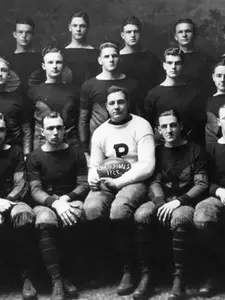
"Team Of Destiny" Claimed Last Midseason Unbeaten Showdown With Harvard
October 20, 2006 | Football
The taxi arrived on campus from New York City in the spring following that most glorious of all Princeton football autumns, the 1922 season. The car parked, and out stepped the most unlikely of passengers — a live tiger cub, just in from India.
This tiger, as one might expect, quickly bolted, setting off an actual tiger hunt in town. Finally retrieved, the tiger hung out on campus until commencement, when it marched with the Class of 1923 in the P-rade before settling into his new, permanent home at the Philadelphia Zoo.
Albert Howard, the right guard on the undefeated Princeton team the previous fall, had been promised the tiger by his father, who had been on a trip to India, if the Princeton Tigers could sweep Harvard and Yale.
In the fall of 1922, Princeton was the wrong team to bet against.
Grantland Rice, who managed to become quite possibly the greatest sportswriter of all time without ever once hosting a show on ESPN, picked Princeton to lose week after week during the 1922 season. Rice, writing in the Nashville Tennessean, said of the Tigers: “All they have going for them is destiny.” From that point on, the 1922 Princeton team became known as the “Team of Destiny,” and its destiny would be a most unexpected national championship, for as Rice further wrote: “a team that won't be beaten can't be beaten.”
The most famous game of that season was a 21-18 win over Amos Alonzo Stagg's University of Chicago team in, among other things, the first game ever broadcast on radio. Even after that last-second win, preserved by a goal line stand in the final seconds, Princeton still wasn't considered the top team in the country.
All that changed on Nov. 11, 1922, when undefeated Princeton traveled to Cambridge to take on undefeated Harvard. Except for the 1946 season, when Princeton was 1-0 and Harvard was 2-0, it was the last time until today that Princeton and Harvard have met when both were undefeated.
Harvard Stadium today is the very same Soldier's Field that hosted the game in 1922, when 52,000 filled what was then a young building. In some ways, it probably didn't look too much different to when Princeton travels to Harvard these days – minus, of course, women students and athletes – as the football game that year was preceded by a soccer game on a field to the west of the stadium, possibly near where Harvard's baseball field or the parking lot between the stadium and the indoor track and hockey rink are today. For the record, Princeton won the soccer game 8-0.
The New York Times speaks of “thousands after thousand, the throng pressed its way across the Larz Anderson Bridge to deploy through the gates into Soldier's Field … in a riot of color such as never is seen, except at big gridiron encounters.”
The game would account for no fewer than four stories on the front page of the Times' Nov. 12 sports section. There were also three charts on the front page, one featuring the year-by-year results of a series that began in 1877; one featuring the starters, substitutes and officials from the game; and one featuring the final and quarter-by-quarter stats from the game. There was also a separate, front-page story on Harvard's win in the freshman game in Princeton.
Harvard would score first in the varsity game on a drop-kick field goal that made it 3-0 after the first quarter. The key play of the game came in the second quarter, when Princeton made full use of head coach Bill Roper's key slogan for the year: “follow the ball.”
In this case, following the ball led Princeton to recover a fumble on the Harvard 18 in the second quarter, a play described by the Times in this manner:
“When the referee untangled Pink Baker from the hostile pile of Harvard men sitting astride his figure, the ball was securely buried in the capacious anatomy of Princeton's right tackle.”
From there, it took Princeton three plays to get in the end zone, the touchdown coming on a two-yard run from Harry Crum. The drop-kicked extra point made it 7-3 Princeton in the second quarter, and Princeton's first lead, according to the Daily Princetonian, “made the outcome by all rights concluded.”
During halftime, there was a ceremony to honor the 224 Harvard students who had been killed during World War I, as the game was played on the fourth anniversary of the armistice.
Princeton's defense, the strength of the team all season, kept Harvard from getting anywhere near scoring in the second half. Among the strategies of the time was to punt on first or second down and hope for a turnover, and the teams would combine for 26 punts in the game. The only second-half points would come from Baker's drop-kick in the third quarter, which made the final score 10-3. Princeton held Harvard to 94 yards rushing and 77 yards passing; among the leaders of the defense was Charlie Caldwell, who would go on to coach the Tigers through another legendary era in school history, including Dick Kazmaier's 1951 Heisman Trophy-winning season.
Princeton then came back a week later to finish its perfect season with a 3-0 win over Yale at Palmer Stadium.
Five months later, the tiger cub made his brief run for freedom before being caught on William Street in short order. In those days, it was easier to stop a real tiger than it was the Princeton Tigers.
by Jerry Price (research assistance provided by Liz Stevens '10)