


.png&width=24&type=webp)


Princeton University Athletics
Players Mentioned

The Closer: Rob Toresco
October 11, 2007 | Football
It was 3rd-and-7, but it was really 3rd-and-history. Princeton had lost nine straight games to Harvard coming into that chilly October afternoon in Cambridge, but the Tigers held a tenuous three-point lead in the final minutes.
When you've done nothing but beat an opponent since President Bill Clinton's first administration, you tend to have a certain confidence. Members of the Crimson offense were chomping at the bit, waiting for that one chance to send the Tigers home with another nightmare to relive.
It was 3rd-and-7, and everybody knew what was coming. The sophomore fullback, playing in his first Harvard-Princeton game, was going to get the ball.
It was 3rd-and-7, and nine yards later, it was 1st-and-10. Three rushes later, all by the same player, it was over. The Crimson never got the ball back, and the streak had finally ?? mercifully ? ended.
Most remember the game for Jay McCareins' 93-yard kickoff return for a touchdown. Many point out another strong effort from quarterback Jeff Terrell, who would win the Bushnell Cup one year later.
But if you follow Princeton, if you really care about this football program, you can never forget this. With the game, and all that it meant for the present and future of the program, on the line, head coach Roger Hughes gave the ball to one person, and one person only.
He knew Rob Toresco would get it done.
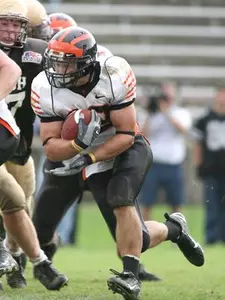
Winning programs need players like Toresco, both for his on-the-field skills and his off-the-field attitude. On the field, Toresco gives the Princeton offense countless options. He is listed as a fullback, but he can be used as a tailback one play and a wideout the next. He led Princeton in rushing yards as a sophomore and finished third on the team in receiving yards as a junior. He can block on the option or burn you on a screen pass.
“He is absolutely one of the main cogs in our success,” Hughes said. “Three things about him are his versatility, his toughness and his leadership. I feel bad because he does so many things for us that he doesn't generate the stats in a single category that you usually need to be all-league. But I think he would start for almost any team in the league.”
Off the field, Toresco brings a confidence that is unshakable. It isn't an arrogance (well, it might toe that line now and then), but it's a belief that he will get the job done in any situation. It is borne from a competitive fire that was borne from, well, birth.
And the birth that happened one minute earlier.
“There was always a constant competition,” Rob said of his relationship with twin brother Matt. “School, grades, sports, you name it. There is always somebody comparing you to your brother. It comes at a cost sometimes. There was some tension growing up.”
“It would even be for the attention of our parents,” Matt said. “We would fight a lot. I was a lineman and he was the back, so it was tough for me to outshine him. Once, when we were seven playing flag football, I wanted to run the ball. My dad coached us and put me in for one play. I gained about three yards and my dad put Rob back in.”
As much as Matt helped build Rob's competitive fire, his father Bob helped direct his son to Princeton. The older Toresco was a two-year starter on the offensive line at Delaware in the late 1970s. His roommate, and his close friend for the nearly three decades since, was current Princeton defensive coordinator Steve Verbit.
“I've known those boys since they were young,” Verbit said. “I have so many pictures with my kids and Rob and Matt when they were kids. Bob was tough in the trenches, and Rob has the same kind of toughness.”
Verbit paused, smiled and added, “But Rob was far more skilled than his dad could ever be.”
Knowing that his father was close friends with Verbit was about all Toresco ever thought about Princeton football. A big-time player at Hunterdon Central, Toresco gained more than 1,200 yards and scored at least 12 touchdowns every season in high school. That includes his junior year, when he played most of the season on a torn ACL.
“I had to keep playing,” Toresco said. “I wasn't going to hurt it worse. I just had to deal with the pain. The team depended on me.”
He gained 1,700 yards, scored 18 touchdowns and led his team to a state semifinal that season. He also lost the interest of several big-time schools that had been recruiting him. His lifelong dream of playing in front of 80,000 fans ?? which once seemed a day away, when he thought West Virginia was close to offering him a scholarship ? was fading into a bitter process. He was suggested to come out as a “preferred walk-on,” and see what happened.
Meanwhile, Verbit came to the house one day and suggested Princeton as a possible destination. It forced Toresco to view college a different way. There wouldn't one hundred thousand fans screaming in unison as his team took the field.
But there would be the No. 1 school in the nation, and there would still be Division I college football. When he saw it that way, and when he met the Princeton coaching staff, he didn't need much more incentive.
His final high school performance came in an all-star game after his senior year. He was already committed to Princeton, but this gave him a final chance to compete with the guys he played against for four years. It would prove to be a short competition.
Toresco already knew what an ACL tear felt like, so when he cut on a kickoff return and started hobbling, he knew what happened.
“I just thought that this can't be happening again,” Toresco said. “It's such a long process, constantly pushing yourself. The first time I did it, I came back stronger and faster, so I knew I could do it. They say things happen for a reason, but I didn't see the reason for it to happen again.”
Where some players would not have overcome a second major knee injury, the competitive fire in Toresco burned. He took a year off from school, found a job and began his journey back. The next year told a lot about the player that would someday clinch Princeton's first Ivy League championship in 11 years.
“I never saw anybody work harder than Rob did that year,” Matt said. “He was determined to get himself back on the field.”
Toresco would wake early to work out. He then went to work at a hardware store. He would run and lift again after work. Nine months ? no glory, no games, no nothing but work, work and work.
His reward as a Princeton freshman. No glory. No games. Just work, work, work.
Toresco was behind senior fullback Joel Mancl on the depth chart that season. Mancl was injured and didn't practice consistently, so Toresco was often running with the first team. He was Princeton varsity Monday through Friday, and he was a Princeton fan on Saturdays.
It would all change his sophomore season, when Toresco made an immediate name for himself. Projected to finish sixth after losing several key players on both sides of the ball, the 2005 Tiger squad was a complete unknown. Toresco was the starting fullback in the opener during a hot Saturday afternoon in Easton, Pa. Princeton grabbed an early lead on Lafayette and then held on for dear life. Starting tailback Cleo Kirkland suffered leg cramps midway through, so the majority of the fourth quarter belonged to Toresco.
Seven of the final eight offensive plays went his way, and Lafayette could do nothing about it. That started to earn a trust in Toresco that the coaching staff turned to in many fourth quarters.
“We don't purposely hold off giving him touches until the end of the game,” running backs coach and offensive coordinator Dave Rackovan said. “He is a major part of our gameplan, but at the end of the game, we have a high level of trust in him. He's a guy who has done it before.”
Despite the fact that he doesn't get 25-30 touches per game (and if you don't think he wants them, just ask him), Toresco's impact in the offense is immense.
“With him in the game, defenses don't know specifically what we will do,” Rackovan said. “They'll look at what package is in the game, but with Rob, we can run him like a tailback, send him out, have him block. His biggest strengths are his versatility and athleticism.”
His competitive drive only makes both physical strengths more apparent. He didn't forget what it took to win a fight with his twin brother for playing time, friends' attention or, well, anything else. On the 3rd-and-7, his athleticism alone could get him five yards. His drive and passion was what got him the other four and sent Princeton to its biggest win of the season.
The fighter in Toresco has that never-say-die mentality that any champion needs. He is the player who never gives up until he hears the whistle.
Check that. He gave up once.
And he was on SportsCenter for it.
It was 4th-and-goal at the 1-yard-line this time, and everybody knew what was coming. Or so they thought.
The Penn defense was lined up for one last push in double overtime. On the snap, they stuffed the right side of the line. The hole opened to the left, but Toresco didn't see it. He barrelled into the line and went nowhere. He tried again. Nothing. He knew he wasn't getting in. He turned, tossed the ball to Jeff Terrell and got drilled. Seconds later, Princeton Stadium erupted as Terrell scored the winning touchdown in a 31-30 overtime win.
That night, Toresco and his teammates got to relive the moment with an entire nation.
“We were all sitting there when we saw the recap, and we thought it was awesome,” Toresco said the week after the play. “Then we sat there and watched the Top 10 Plays. We saw pretty amazing catches by some wide receivers, and a great run by a BYU running back, then we saw No. 3 was a horse race and No. 2 was a hockey clip. So we figured it wouldn't be on. Then it came on at No. 1 and we flipped. It was so surreal ... we watch SportsCenter every day and it is a dream to be on the Top 10, let alone No. 1. I got tons of text messages and phone calls from friends and family. It was awesome.”
It got even better in the next two weeks, as Princeton rallied from 14 points down to defeat Yale and then held off a game Dartmouth team to clinch the Ivy League title with a 27-17 win. Toresco, who barely missed out on state titles as a high school junior and senior and then suffered through the 2005 Yale lost that knocked the Tigers out of Ivy championship contention, was again asked to finish the job. On 3rd-and-goal, ahead by only three points, Terrell and Toresco hooked up one more time. This time, it was an option that saw Terrell take the hit and Toresco score the points. When he crossed the line, he knew his championship dreams had finally come true.
The competitive fire still burns for Toresco, who joins his teammates today in search of another Ivy title. You can rest assured that maybe his biggest supporter will be just as worked up as anybody beforehand.
“I get more nervous for his games than anything I ever competed in,” said brother Matt, who played lacrosse at Ohio State before a neck injury ended his career prematurely. “I'd miss the games here just so I could watch his games on the internet. I can't sit still during the games. It's great to be able to watch his hard work get paid off.”
That hard work started as a young boy. Matt got him ready. Rob got himself ready. The battles fought by the younger Toresco twin are now waged 10 weekends in the fall. Since he entered the starting lineup, he has been on the winning side in 17 times in 22 games.
And when he closes a game, it's closed. Whether it's to end a streak or to bring home a league title, Toresco finishes the job.
He has to. It's what he knows. It's how he grew up.