Gabrielle Cole was unimpressed as she watched the final of the 2008 Olympic men's eights.
Cole, who ran track and played basketball in high school, didn't know anything about rowing at the time.
"I thought I should try to do that, but I didn't really know how, and I didn't know anyone who rowed," mentioned Cole. "I didn't even know how to get into it, it seemed like an inaccessible sport."
That changed when she got to Princeton. She understood that she probably wouldn't be able to run track or play basketball, so she did some research and found out the school had rowing.
"I didn't know how to hold an oar, didn't know what starboard or portside was, I was a complete novice," said Cole.
Cole decided to walk on to the team and was going to the season-opening barbeque down at the boathouse. She started the trot there and got the perch where she could see the dock where people were milling around.
Everyone was white.
"I thought it was a very homogenous population," Cole remembered. "I felt self-conscious and out of place. I didn't really know anyone, and I was young. I wasn't going to go down there so I started to turn around and go back up the hill."
By chance, she ran into another Black student, Sara Grey, who asked her if she was going to the boathouse. The two eventually agreed that they would go eat and leave.
They stayed and joined the team.
A month later, the two eventually had a class together and conspired to quit on the same day.
"Rowing was harder than it looked on television," Cole explained.
Sara followed through with her promise. Cole stuck it out for the entire year.
What made Cole keep going with a sport that she had no knowledge before going to Princeton?
"The element of the sport itself," Cole specified. "It's addictive in a bit of psychological and physical way. I really enjoyed seeing myself improve and the culture of dealing with pain in a cerebral way. It gives you euphoria to have a simplistic goal and to be able to obtain it. It serves as a proxy for more complicated challenges in our lives."
It wasn't easy for Cole despite the positive feedback from coaches in the early going.
"Gabrielle was a gift, she walked on to the team with no experience and proceeded to crush it," said coach Lori Dauphiny. "The novice coach Kristin Haraldsdottir '08 recognized her potential early on and encouraged her to keep at it. She persevered through the challenges of learning a new sport. She was a star; athletic, determined and tough."
Cole's class had a few talented walk-ons competing for seats in the top boat. "The tension between the walk-ons and recruited athletes was very prominent in my class," mentioned Cole. "The attitude towards me was weariness, like who are you, what do you see your position on this team and how is going to impact my position on the team? Another element was it's hard to not be the token (Black girl) if you're the only one."
Cole didn't let out of the water problems affect her performance. She competed in England at the Henley Women's Regatta and earned time at the United States U-23 selection camp.
Rowing at a U.S. national camp after having just learned the sport seemed impossible in that short of a time frame.
"Everything happened so fast that I didn't process the magnitude of it," stated Cole. "It didn't register with me. I didn't really stop and say 'wow, this is extraordinary.' I was on this path and just kept trying to run on it."
Now though, looking back, Cole feels an immense amount of gratitude.
"It just so happened that I went to Princeton and it just so happened that there was an incredible coaching staff and the U.S. national team there," Cole reflected upon. "All of these stars kind of aligned for me to have an incredible experience. Some days were challenging, but I went to Amsterdam, Netherlands, flew all around Europe and went to Henley. I've had incredible opportunities to row."
Cole had put a lot of time into her three years rowing at Princeton. Her senior year wasn't always a joyous celebration. At one point in the preseason, she took a leave from absence from the team. As she described, a break was needed.
Why did she eventually make her way back down the hill to the boathouse?
"I wanted to finish placing all the blocks on this tower," explained Cole. "It became imperative not to quit."
Safe to say, she made the right decision.
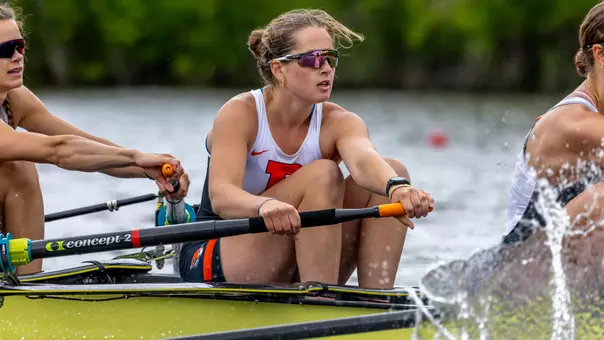
Cole raced in the varsity eight all year, helping the Tigers to second place at the NCAA Grand Final. The squad went undefeated against the Ivy League in regular season and retained the Class of 1987 Trophy, Class of 1975 Cup, Eisenberg Cup and Class of 1984 Plaque. She also earned All-American honors.
2013 Ivy League Champions
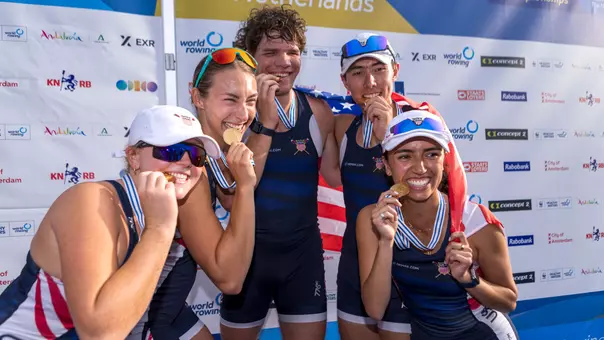
"Gabrielle has had a significant impact in our program, and I am grateful she decided to row," stated Dauphiny reflecting back on Cole's career. She made our team better and she made boats fast while also pushing and encouraging her teammates. Gabrielle is not only an inspiration to her teammates but also to future generations. There are very few athletes of color in the sport of rowing something we feel committed to change. She demonstrated great courage, strength and dedication in the sport and in the Princeton community at large. She broke down many of the barriers that exist and achieved greatness as a rower. She won the Championship eight at the Charles early on in her career at Princeton, to competing in the 2012 U23 World Championship and winning a gold medal in the USA eight, to rowing in the second fastest collegiate eight in the country her senior year!
Four years prior, she almost skipped out on trying out for the team because she felt out of place. She also had no idea how to hold an oar.
Now she was the one of the best at her sport.
Those things didn't really resonate with her though.
"I got more pride that I made it through the day-to-day operation," the All-American revealed. "The getting up early, coming back early from breaks, the fact I stayed on the day I intended to quit are all parts of the body of work I'm proud of."
Currently, Cole is a system engineer at Northrop Grumman and a pilot in the Illinois National Guard. She was also recently accepted into Northwestern's PhD program in electric and computer engineering.
How does rowing help now as she balances all of those things?
"There are a few features of rowing that are timeless," Cole discussed. "It teaches you a deep appreciation for patience when things are uncomfortable. There's also a quote from a teammate that I'll never forget, "Whether you go fast or slow, it's going to hurt the same, the only difference is you're going to feel different after it's done."