.png&width=24&type=webp)
Princeton University Athletics
Book Excerpt - The First 50 Years Of Women's Athletics: Podie Lynch
April 12, 2021 | General, Women's Tennis
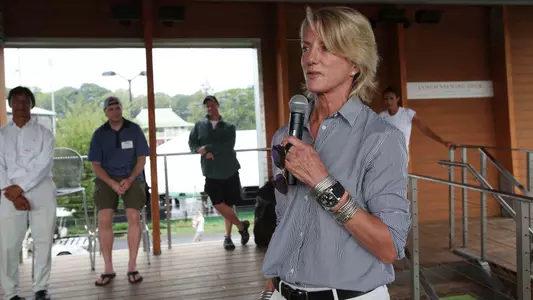
The “first” lady of Princeton women’s athletics comes from a family of Yalies. Being a trendsetter, though, has never been an obstacle for Podie Lynch, Class of 1971.
She was, after all, a member of the first group of women at Princeton, back in the 1969-70 academic year. She was the first woman at Princeton to major in art history. She went on to be the first woman to be a member of the Princeton Club of New York. She was the first woman to be president of the class of ’71. She has been the first woman on several corporate boards.
Hey, she was even the first (well, one of the first) women cheerleaders at Princeton.
Of course, being the first doesn’t usually mean things are easy. Take the Princeton Club for instance. Before she was able to become the first female member of the Club, there were all kinds of complexities to work through, negotiations to be had, places that would be off-limits and others that she could access. It took in all six months of back and forth.
Ultimately, when she wanted to play squash, she had to call a week in advance to schedule it. Then she had to change in a bathroom on the sixth floor before wearing a robe to keep her knees covered – lest she offend the sensibilities of some of the older alums there – to get to the courts in the basement.
She laughs about it now, but dealing with something like that in the moment takes a special kind of determination and, more than that, grit.
“The bottom line,” she says, “is that from the time I got to Princeton, I was the usually the ‘first’ or ‘only’ in many of the things I did.”
She wasn’t the first woman to compete for Princeton, so it’s not exactly right to say she was the first letterwinner. What she was, though, was the only woman in the first class of women at Princeton to win a varsity letter.
Whatever that makes her, “oldest” and “Podie Lynch” don’t really belong in the same sentence. She’s more accurately described with words like “confident” and “driven” and “accomplished” and “pioneering” and, most obvious from talking to her, “youthful.”
Lynch was one of 39 women in the Class of 1970, along with the 840 men in her class. That made the women less than five percent of the class.
She had the right preparation for that, though. In her family, she was a little more than 12 percent of the female siblings.
“I am the oldest,” she says. “I have five younger brothers. I grew up with boys who roughhoused and farted all the time. Can I say that? Well, to me, none of that stuff was a big deal when I got to Princeton. It didn’t faze me at all. It was nothing I hadn’t seen a million times before.”
Podie Lynch was born in Texas, and the Lynch family moved to Concord, Mass., when she was eight. She was a self-described “tomboy jock” who played every sport she could find.
“I spent my whole childhood outside,” she says. “Sun. Rain. Wind. Snow. It didn’t matter. We threw footballs and rode bikes. In the winter, we lived next to the Sudbury River, and there was a wetland between us and the river that would freeze in the winter. We’d play hockey all winter long on ice with grass sticking up. We were outside all winter long. These days, it seems like kids don’t go outside and just play. Me? That was in my DNA.”

Her introduction to competitive athletics came in seventh grade, when she played field hockey. At Concord Academy she would play five different sports: field hockey, lacrosse, basketball, tennis and softball.
When it came time to choose a college in the spring of 1971, neither Princeton nor Yale was accepting women. The Rhode Island School of Design was.
“They had no sports,” she says. “Nothing. No extra-curriculars. It was all about being an artist. I asked the admissions person what else I could do there, and he said I could sing in the choir. My brother was with me, and he just laughed and said ‘you haven’t heard her sing.’”
Instead of going there, she instead went a two-year school in Milbrook, N.Y., named Bennett College. She thrived there, playing field hockey, basketball and tennis and serving as captain for field hockey and tennis. She also was the president of the student government, not to mention the top student in her class.
“Going there was the best thing I ever did,” she says of Bennett, which would eventually close and see some of its personnel folded into SUNY-New Paltz.
When it came time to choose her next stop, much had changed in the higher education landscape.
As far back as Lynch’s senior spring of high school in 1967, then-University president Robert Goheen was quoted in the Daily Princetonian as saying that “it is inevitable that, at some point in the future, Princeton is going to move into the education of women. The only questions now are those of strategy, priority and timing.”
A year later, the famed “Patterson Report” was issued by economic professor Gardner Patterson, who was part of a faculty committee on the subject of coeducation. Yale then preempted Princeton’s announcement by saying it would go co-ed in the 1969-70 school year, which led to a decision by Princeton to do the same.
Suddenly the young woman at Bennett College had two incredible new options. There was the school in New Haven, where so many of the Lynch’s had gone before her, and there was the school in New Jersey, where her brother Vinnie had gone to play soccer and hockey.
It was Vinnie who would send her a Princeton application. It was her father who would say “over his dead body” would she go to Yale.
“He really said that,” Lynch says. “Vinnie was a freshman at the time. He said I had to go to Princeton. When I got in, I told myself I had to do it. I had no idea what it would be like.”
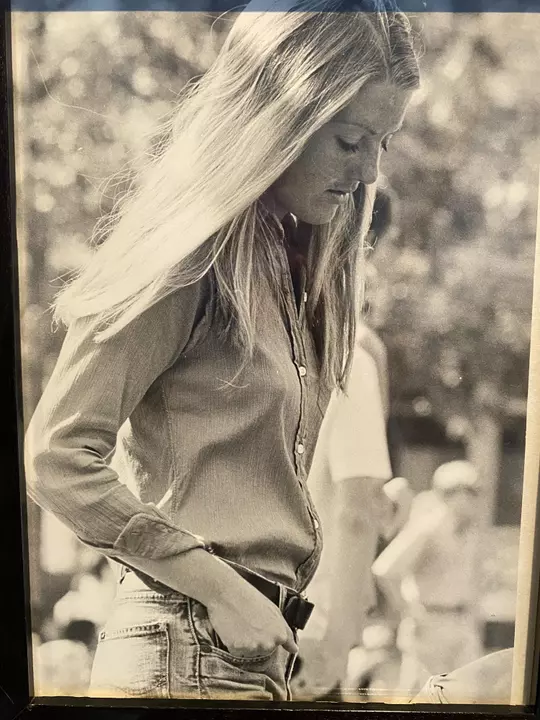
Beyond the 39 in her class, there were roughly 150 women in all on campus for the 1969-70 academic year. There was no plan at all at the time for any sort of women’s athletics.
In fact, the first effort to put together a women’s team came in the fall of 1969, when Betty Constable, who would become the first squash coach two years later, tried to create a field hockey club. Fewer then 10 women expressed any interest, and so the team never got off the ground. For her part, Lynch and Constable played together on a local Mercer County club team.
This didn’t stop Lynch from becoming more directly involved with Princeton sports, though. In fact, she and three others became Princeton’s first female cheerleaders at football games, joining the ranks of a men’s cheerleading unit that dated to 1897 and had included at one point future actor James Stewart.
The four women split the games, with two of them at each home game. Lynch’s partner for those three games was another Concord Academy grad, a woman named Lisa Halaby, who is known more these days for having been Queen Noor of Jordan.
The following August, in 1970, Princeton hired Merrily Dean Baker as its first administrator for women’s athletics. Had it not been for Baker’s insistence on ignoring the University’s original five-year plan for women’s athletics and expediting the process into a matter of weeks, Lynch – and for that matter none of the women who were in the early years of coeducation – would ever have been on a team.
Instead, Princeton was represented by two women’s tennis players at the Eastern Championships in October of 1970 and then by a swimmer and diver at those Eastern Championships in March of 1971. An attempt at a field hockey team in the fall of 1970 failed again, and so the first varsity team would be the 1971 women’s tennis team, which played its first match against Penn on April 12, 1971. It would be the first head-to-head varsity intercollegiate women’s competition in school history.
“I’m not sure where I found out about it,” Lynch says. “I think it was a piece of paper on a tree that mentioned there was going to be a tennis team. I thought this was great. I was really excited.”
She tried out and made the team, which was coached by Eve Kraft, a local woman Baker talked into volunteering. That first match was against Penn, which came off the bus with Penn sweatsuits and Penn tennis bags. Princeton had nothing. Lynch, for that matter, was wearing a hand-me-down tennis dress from Margie Gengler Smith, one of the first two women who had competed. There were four singles matches and two doubles matches, and Princeton won 5-1. Lynch and Sally Fields won their doubles match 6-2, 7-6.
There was a crowd of 250 in attendance, according to Debbie Goldstein’s story in the Daily Princetonian: “The boys gathered on the hills to watch the girls behind the fences and Princeton’s first women’s varsity athletic team – tennis – opened with a 5-1 win over Penn.”
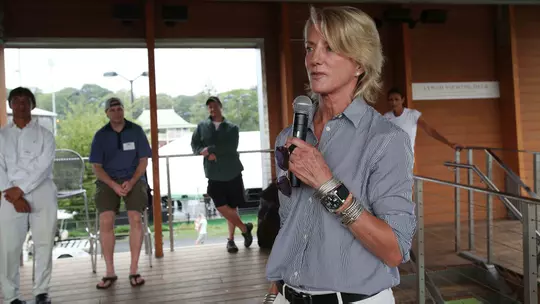
Princeton went on to go 8-0 that season and then won the Middle States tournament championship. The 1971 schedule featured five Ivy League opponents, every school except Brown and Cornell. Their only road trip was on a bus to Yale.
Kraft was a local woman who was sort of drafted by Baker to coach the first tennis team. In a world with no budget at all, Kraft coached the team for free, giving up her time for months before there was an actual competition. When it came time to for the season, there were no uniforms and no budget to buy them, so Kraft helped the team improvise.
“I had the best time playing tennis,” she says. “That first match with Penn, they had all their matching stuff, and we just wore whatever we had. Eve Kraft gave us all orange and black pompom socks. We all had brightly colored pigtails too.”
As the first women’s team, the members of the 1971 tennis team had to fight to be given varsity letter-sweaters, including a white letter-sweater for captain Helena Novakova, as the team had been undefeated.
It was all part of what it was like to be a woman at Princeton in those earliest years. It wasn’t easy on any level, anywhere across the board. Having her brother there helped Lynch considerably.
“I had it so much easier than so many other people,” Lynch says. “Vinnie had six Canadian hockey teammates as roommates. I spent a lot of time with them. Hey, we were social outcasts in a lot of ways. I think the guys were afraid of us. There were all these articles about how smart we were, how capable we were. In my class, I was probably the only one who ever saw the inside of Jadwin Gym or Dillon Gym. The other women in my class couldn’t have been nicer, but it was hard to get to know them because we were so scattered around the campus. The only women I really got to know at Princeton were the tennis players. I had a lot of male friends. I didn’t have a lot of women friends.”
She considered going into a Ph.D. program in architecture after graduation, until she worked at an architecture firm for a short time. She would become a personal assistant to a fashion designer named Roy Frowick, who was known professionally by simply his middle name of “Halston.” Yes, that Halston.
From there her career took her to Revlon, then to Harvard Business School, then into the cosmetics field before becoming the president of Danskin, one of the first athletic activewear companies. Her next stop was running a small children’s hosiery company and then Victoria’s Secret Fragrance. In all, her 30-year business career saw her become one of the top names in her industry.
She has also stayed very loyal to where she came from, including serving as a trustee at Concord Academy and, among other capacities, as one of the first women to serve on the Board of Directors for the Princeton Varsity Club. She’s also been the president of the Class of 1971 for the last decade.
“It wasn’t an easy time to be a woman at Princeton,” she says. “My son [Gates Torrey, who would be a member of the Princeton Class of 2013] went to prep school in Connecticut and I met the mother of one of his classmates there. She was in the Class of 1981, and I told her she was so lucky to be 10 years behind me. And she said ‘it wasn’t easy then either.’ We had this conversation around where coeducation had evolved, and it felt to me that she didn’t feel that much different than I had felt. The main point of the conversation is how long it really took for coeducation at Princeton to become a more normal feature of the University. It took a long time.”
Of course, it’s not easy to be the first. It never is when you have to kick open doors, especially ones that had been shut for more than two centuries. Still, she wouldn’t trade her experience at Princeton for anything, and no matter what she carries with her the legacy of having been the only member of the first class to earn a varsity letter.
“That’s very special to me,” she says. “It’s weird to be the oldest female athlete. I don’t know if I like that term. I just feel really lucky. I felt this walking out of Princeton. Even though it was hard, and even though it was lonely at times, I feel so privileged to have had the chance I did.”