Princeton University Athletics
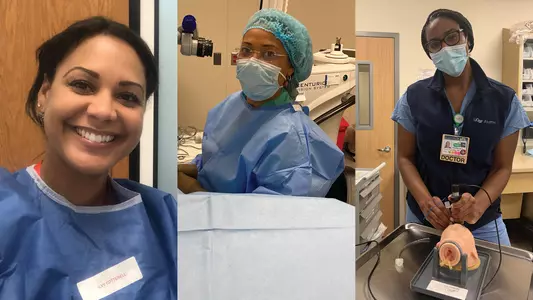
Black History Month Feature: Doctor, Doctor, Doctor
February 03, 2022 | Field Hockey, Women's Track and Field, Women's Volleyball, Diversity, Equity & Inclusion
As part of the Princeton Athletics celebration of Black History Month, there will be a different feature story each Thursday in February. The first in this series will focus on three former Tiger women athletes who became doctors, and it is an excerpt from the book “I Can Do Anything … Stories From The First 50 Years Of Women's Athletics At Princeton," which can be ordered HERE.
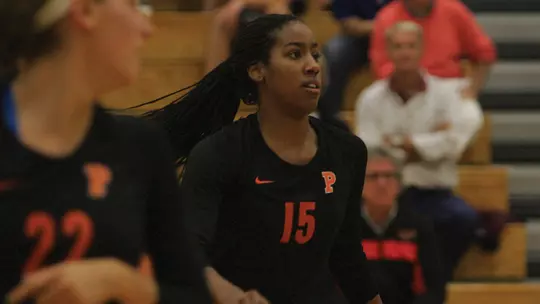
Preseason practice was about to begin and Tiana Woolridge was one plant of her foot away from finishing the preseason conditioning test. Her senior volleyball season at Princeton beckoned. It was her chance to be an All-Ivy League selection for the third time.Then she planted her foot, and something immediately went wrong. She fell to the ground in Jadwin Gym. It turned out to be a torn Achilles tendon, which meant the end of her college athletic career. It was disappointing. It was painful. It was sad. It was brutal.
“It was all of those things,” she says. “In a strange way, it was something else though. While I was on the ground, they were doing things to check to see if the tendon was in place. They were squeezing my calf, and it was supposed to get my foot to flex in a certain direction. When it didn’t, they knew the tendon wasn’t in place. I found it …”
Then she paused, searching for the right word.
“… fascinating.”
That injury happened in August of 2014. Fast-forward more than six years, and she was Dr. Tiana Woolridge, a pediatric resident at the University of California at San Francisco Medical Center.
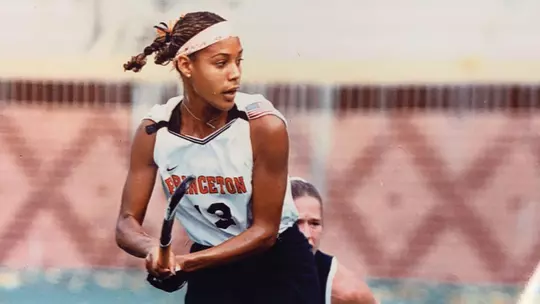
When she graduated, Ilvy Friebe was as good a field hockey player as Princeton had ever seen.
She came to Princeton from her home in Germany, and when she left she was the program’s all-time leading scorer, a two-time Ivy League Player of the Year, and a two-time first-team All-American. She went to medical school at the University of Minnesota. Today she’s an orthopedic surgeon.
“Orthopedic surgery is the only specialty that hasn’t seen a growth with women and minorities,” she says. “Only 12 percent of orthopedic surgeons in this country are women. And a lot of us are former athletes.”
Princeton’s women’s athletic alumnae have succeeded in pretty much every occupation, in a wide variety of different areas. There have been a great number, more than 300 exactly, who have become medical doctors.
Nicole Harrison is another athlete-turned-doctor.
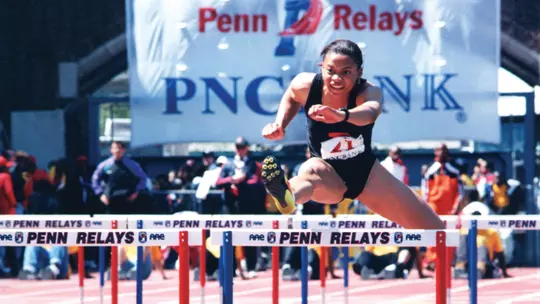
The greatest sprinter that Princeton track and field produced in the first fifty years of women’s athletics, a fifteen-time individual Heptagonal Ivy League champion, Harrison became an eye surgeon.
“I was always interested in surgery,” Harrison says. “I thought about orthopedic surgery. I was always good with my hands. There was a real appeal to eye surgery, though. The surgeries are very short and sweet. It’s very technologically savvy, with the latest in lasers and such. It’s also not as bloody and gory. It’s not putting together knees and hips. There’s also a lot of continuity with patients. I’ve had a lot of my patients for years.”
Harrison graduated in 1998. Friebe graduated in 2003. Woolridge graduated in 2015. Pick a decade. Pick a sport. You’ll find athletes turned doctors.
What is the connection between athletics and medicine, if there is one?
“There are a few things that come to my head,” Woolridge says. “First, medicine is very much a team sport. As doctors we are often leading a team of nurses, respiratory therapists, other hospital members. We’re teaching parents and family about what to do in terms of care and what’s going on in the hospital. There is a lot of communicating with other people and working together toward one major goal. It draws people who are coming from a team sports background. Another thing is that we deal with injury, except for a lucky few. Most NCAA Division I athletes have had an injury, and there’s so much exposure to medicine that you get. The rehab process. Knowledge about the muscular skeletal system. How bones and joints form. How they break. What surgery is like. Working with a trainer and doing physical therapy, it piques an interest in your mind. For a lot of athletes, one of the biggest things that impacts them is the injury that ended their season.”
In her case, that came just before her senior season began.
Woolridge wanted to be a doctor from the time she was little.
She was always drawn to science in school, and she always wanted to help people. Medicine
combined both. She grew up in California. Her father was basketball player Orlando Woolridge, who went from leading Notre Dame to the Final Four to averaging sixteen points per game during his fourteen-year NBA career.
He would also go on to coach, among other teams, the Los Angeles Sparks of the WNBA.
His daughter Tiana also played basketball when she was young, in addition to volleyball. She went from Harvard-Westlake School to Princeton after applying as a non-recruited player, and women’s volleyball coach Sabrina King took her as part of her first team. She ended up being
All-Ivy League as a sophomore and junior before the Achilles injury her senior year.
She went directly from Princeton to UCSF for medical school, pausing for one year to get a master’s in public policy at Harvard. She was in her residency at UCSF during the Covid pandemic.
“We were spared a bit in pediatrics by the virus,” she says. “There weren’t too many kids hospitalized with Covid. There’s been a lot of fear from parents and what it means, what the long-term effects could be. There’s been a lot of uncertainty. We’ve dealt with the struggles of remote learning, the economic impact. It’s been a huge challenge for families in general. And the mental health impact has been huge. We haven’t had to deal with a lot of intubating kids. We’ve seen a lot of increases in self-harm and suicides, way more than in prior years. With school closures and sport closures, there was a lot of isolation, and that was affecting kids.”
Friebe grew up in Germany, the daughter of a German father and American mother.
Her father brought her to a sports club that had both tennis and field hockey for little kids. Tennis “didn’t stick.” But field hockey did. She came to Princeton for a summer camp after her junior year of high school, and Princeton would be the only school to which she would apply. She’d score 71 goals at Princeton, which, at the time, tied her with Kirsty Hale for the program’s all-time record. (Kat Sharkey has since broken that record with 107). Friebe also had 30 assists, giving her 172 points, third all-time with the Tigers. She was also a first-team All-American as a junior and senior, and she won the Ivy League Player of the Year award both years as well.
“I don’t look back at the records and honors,” she says. “It’s the camaraderie. I can’t imagine having gone through Princeton and not having had my team to make it so special. I also learned a lot about multitasking. It definitely helped prepare me for medical school. It was actually easier, I think. I didn’t have to get up early and juggle practices and lifts and do homework on the bus to games. Being an athlete at Princeton taught me a lot about what I could do.”
She would do her residency as a hand surgeon at Virginia Commonwealth, and she went on to teach in the medical school at VCU while also being the chief of orthopedics at the VA hospital in Richmond. This was in addition to seeing patients and performing surgeries.
Nicole Harrison grew up in Houston. Her mother and several aunts were nurses, and she had an
interest in a medical career from an early age.
She also came to sports at an early age. All kinds of sports.
“I played tons of team sports,” she says. “Volleyball. Soccer. Softball. You name it; I played it.”
She attended Kincaid High School in Houston, where her guidance counselor was a woman named Judy Muir, whose son Chad was a member of the first Princeton men’s lacrosse team to win an NCAA championship his senior year of 1992. It was Judy who first told Harrison about Princeton, where Harrison and Judy’s daughter Laura would end up classmates.
Harrison won seven indoor Heps individual titles and eight outdoor individual Heps titles in track and field, both of which remained Princeton records more than two decades after she graduated. So too did her 110 hurdles record.
“I hated training,” she says. “Hated it with a passion. But I loved winning. There was nothing like
it. One thing I really liked about track was that it was a team atmosphere and a team sport but you still had your individual race. Nobody could run it for you. If you crossed the finish line first, you won. I loved that. I was so competitive. Even now, I still am. If I’m playing something with my kids, I never let them win. I’m a true competitor.”
Harrison would attend medical school at St. Louis University. She took with her lessons she learned both at home as a child and while a Princeton athlete.
“I was taught at an early age to help people,” she says. “It was ingrained in me. My athletic career gave me a background in dedication and perseverance, and that helped me tremendously in medical school.”