Princeton University Athletics
Feature Story: The Energy And Depth Of Pia Beaulieu
May 15, 2026 | Women's Track and Field
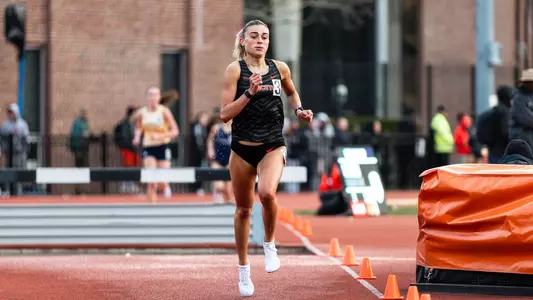
Pia Beaulieu is talking. I am listening. It isn’t long before it dawns on me that I can’t keep up with her in this conversation any more than I could on the track that sits in front of us.
As she speaks, I try to think of how best to describe her. Words like “whirlwind” and “explosion” and perhaps even “cyclone” come to mind.
A few days later, I am talking to Princeton head women’s soccer coach Sean Driscoll, who has coached her for the last four seasons. He goes back to his first experience of conversing with her.
“I had one conversation with her, on the phone, in the hallway of a hotel,” he says. “The thing that struck me was her larger-than-life personality. She’s one of those kids where you definitely remember the first impression. I liked her personality so much that I just prayed the soccer player matched the personality.”
There was some validation in his words, validation that I wasn’t wrong about Beaulieu. On the other hand, did I really need validation?
She and I spoke on a drizzly midweek day. We were sitting in the stands at Weaver Track and Field Stadium — the same facility where she will run the 3,000-meter steeplechase Sunday at 11 am at the Ivy League Heptagonal Championships, with the fastest time by an Ivy League athlete this season by more than two seconds. We were under the giant concrete overhangs that keep spectators dry on days like this. Perhaps instead of the overhangs, there might be a way to harness her energy to simply push the rain away?
Here’s a sample of some of the things she says during our short time together:
“I’m a black belt in karate. I mean, how random is that?”
“What was my major? SPIA. It was a layup opportunity. I mean, it’s the School of PIA. It’s literally named after me.”
“When people say ‘what do you like to do besides sports and school,’ what am I supposed to say? I read books and crochet? I mean, I don’t really do either of those. I just like to be outside.”
“I’m not one of these people who started running in the womb.”
And then there was my personal favorite:
“Coach [Brad] Hunt suggested the steeplechase for me. He saw my traits, knew I liked a little more of the distance side. He thought with my soccer background that I could be athletic across different landscapes. He said ‘you could be pretty good if we threw some obstacles at you.’ For me? I like it because it keeps me entertained.”
Usually, conversations like this one lead to a back-and-forth of questions and answers. This one is more of a forth and forth. Ultimately, I didn’t so much ask questions as I presented my own hurdles for her to clear and then ramp back up to full speed. Eventually, I just said this:
“You’re not shy, are you?”
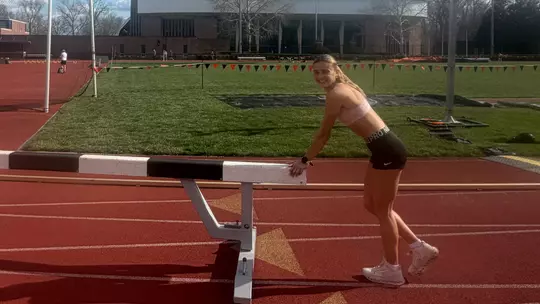
The 3,000-meter steeplechase is unlike any other event in track and — and, in the interest of full disclosure, my favorite event by far. Each lap consists of five barriers that need to be cleared, four of which are basically hurdles, only each individual runner does not have a separate one to clear. Instead, every runner goes over the same barrier, which, unlike in regular hurdles races, is bolted to the track so it doesn’t fall over.
And then there is what you think of first when you think of the steeplechase — the water jump. It is 12 feet from the front of the barrier to the end of the water pit, which slopes downward from the front edge, going from 28 inches deep at the barrier back to ground level 12 feet later.
From the far end of the jump looking back to the barrier, it looks so easy, peaceful almost. In fact, in the stillness of this day at Weaver Stadium, the water acts as a mirror, reflecting the barrier and the trees outside of neighboring Jadwin Gym. It’s almost like hopping over a puddle after a rainstorm.
Only it isn’t. You have to clear this beast seven times, with competitors all around you. Each time around your spikes will get wet. Your face will get splashed. You have to make sure you stay upright — and you have to do all of this as quickly as possible. This is what keeps Pia Beaulieu entertained.
Princeton has a great tradition in the event, especially this century, when Donn Cabral won an NCAA championship and reached two Olympic finals, Lizzie Bird reached the 2024 final in Paris and Ashley Higginson won gold at the Pan Am Games and twice qualified for the World Championships.
Can Pia Beaulieu be the next great Princeton steeplechaser? That wasn’t even a remote thought on anyone’s mind her first three years at Princeton, when she wasn’t even on the track and field team. Or when her senior year was about to begin, this past August. Back then, she was dealing with a much tougher barrier than anything found on this track: She found out in August, two days before preseason soccer was to begin, that she had one stress fracture in her left shin and a double stress fracture in her right.
Fast-forwarding to the present, this whole conversation with Beaulieu began when Hunt and Driscoll reached out to me about Beaulieu and her unique and, to use Hunt’s word, “meteoric” rise in the event.
“Her evolution is absolutely remarkable,” Hunt said to me in an email. “One kid. Two sports. Two Ivy League championship programs and a meteoric rise unmatched in Princeton Women’s Athletics in the last two decades.”
My response was five words: “You had me at steeplechase.”
Pia Beaulieu (pronounced “BOWL-ee-uhr”) grew up in Boca Raton, Fla., the daughter of Claudia and Bruce Beaulieu, with an older brother who is also named Bruce (and who is currently in medical school).
“They are my biggest support team ever,” she says. “I owe a lot to them. Even now I remind myself that I do this for myself but also for them. It’s not that I don’t want to disappoint them. It’s that their belief in me makes me go.”
Given her natural ability and the weather, it’s not shocking to learn that she played pretty much every sport she could growing up. By high school she was excelling at soccer and as a middle distance runner in track and field, so much so that she was recruited by SEC schools for the latter.
She first came onto Driscoll’s radar from a coaching colleague, and that led to that original conversation. She quickly committed to Princeton to be part of the women’s soccer program. Track wasn’t part of the occasion.
“I learned very quickly that her competitive drive and determination was really, really high,” Driscoll says.
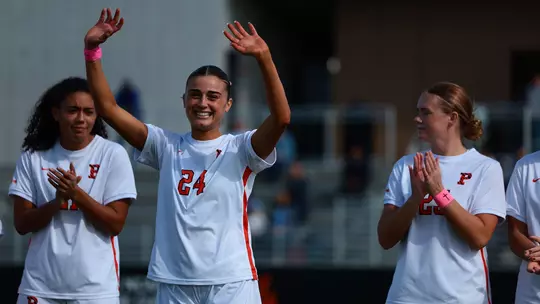
Her first three seasons at Princeton saw her play a supporting role on teams that reached two NCAA tournaments and won the 2024 Ivy League title on the final day of the regular season. She scored her first two collegiate goals as a junior, against William & Mary and UMBC.
Her track and field experience to that point consisted of saying hello to Hunt when they’d walk past each other. It wasn’t until a year ago that she began to briefly train with the track team, and she even ran in two meets as an independent.
Her senior year got off to a really rocky start with the shin splints, which she tried to train through so she wouldn’t fall behind in soccer. Instead, she would miss the first four games of the year, though she did push herself in her rehab to get back in time for a date she had circled on the schedule: a Sept. 4 game at Miami, not far from her home. How’d that turn out?
“I scored off a corner kick,” she says of the goal with eight minutes to go that gave Princeton a 2-2 tie. “I remember saying ‘this is awesome!!!!’”
I’m not really sure how many exclamation points would be the correct amount for that sentence, so I just estimated.
Princeton lost its first two Ivy League games and then won five straight to win the championship, something unprecedented in Ivy women’s soccer. By season’s end, she was playing all 90 minutes on multiple occasions and ultimately earned second-team All-Ivy honors.
“We had a slow start to our season,” Driscoll says. “I told her ‘listen, you communicate well. You’re not afraid to project your voice. We’re going to use your skillset to organize the people in front of you. That’ll make us a better team. That’s when we started to make our run in the league, and she was a huge part of that. She played a ton of minutes. As a track athlete, she could run forever. She was relentless in her approach. She gave us everything she had, and she ended on an ultimate high — leading a team to an Ivy championship.
Her soccer career at Princeton was over. Her Ivy championship career was not.
With no spring soccer in front of her, Beaulieu walked (ran?) onto the track team at season’s end. By indoor Heps, she was the 21st ranked miler in the Ivy League. Then she gave an indication of what was to come, reaching the final.
“When track season started, every time I’d check in with Brad, he was like ‘Sean, you have to see this kid.’ I watched the Heps race. I was actually in my car but I pulled over to watch. I clicked on it and she was behind. From there it was like watching the Derby or something.”
She’d improve her seed by a ridiculous 12 spots in the prelims to qualify ninth and then three more spots in the final, finishing sixth in 4:47, nine seconds better than her first time a month earlier — and earning a point for her team. To go from soccer player, and one only a few months removed from shin splits at that, to a point-scorer at Heps is crazy. The point she earned helped Princeton win the team championship. That was another Ivy title in her column.
“It was one point, but it meant the world to me,” she says. “I contributed to the team, helped them get the trophy. It was way better than I expected to do. My mindset is always that the job isn’t done. Prelims to finals. That’s like first half to second half. You have to put the whole puzzle together.”
Next up was the outdoor season and with it her introduction to the new event. Only two Princeton women have ever run a sub-10-minute steeplechase. Not shockingly, those two are Higginson and Bird. Beaulieu is third all-time at Princeton, with a career best of 10:02.39 at the Penn Relays last month (last year’s winning time at Heps was 10:05.51). With the storied history of Princeton women’s track and field, no one ever besides those two is within four seconds of Beaulieu.
To be behind only Bird and Higginson is impressive enough. It becomes even more impressive when you are told the number of times she’s run the event. The answer to that would be: Three. That’s ever, as in all time. Three.
“We discussed the steeple as a great potential event for her during the outdoor season,” Hunt says. “I have a video of one of her first water jumps in practice. I actually laughed out loud.”
Laughed out loud because of how she fell over the barrier and splashed face-first into the pit?
“It appeared like she’d done that difficult motion hundreds of times before.”
Her first race came at Princeton, in the Sam Howell Invitational on April 4. Think about that. April 4 of this year was her first time to run the event. On top of that, she was only supposed to get a feel for what the event was like and not go all 3,000 meters.
“The first meet I ran this spring, actually the first time I ran it, I figured I might as well finish it,” she says. “I knew I could do it. I was uncomfortable because I’d never done it before and I wanted to see how I could do.”
She won, easily, in a time of 10:30.86. Race No. 2 was two weeks later, at Wake Forest. Her time there was 10:20.79. That’s more than 10 seconds. Next up was the Penn Relays, and this time, she improved by nearly nine more seconds. Her performance earned her Ivy League Athlete of the Week honors.
“The race at Wake, the first water jump felt uncomfortable,” she says. “There were 25 people there, and I’d never felt the splash from anyone else before. It was different. I felt like I chased that race. That race forcefully came to me. At Penn, the field opened up. I had more space. I told Coach Hunt that it just opened up for me.”
Three races. A 29-second improvement? Her best time ranks her 13th in the NCAA’s East Region and 21st overall in Division I heading into Heps.
“Pia has ignited our team with her fierce competitive spirit and the pure joy she brings to the training and racing,” Hunt says. “I have enjoyed every second of working with Pia and I am so appreciative of the opportunity to connect with the outstanding women’s soccer staff throughout the sport crossover. Princeton University provides a platform for discovery and growth throughout the greatest undergraduate experience in the country. Pia has erupted in her senior year and Princeton Athletics continues to celebrate her evolution with every step on the pitch and every step around the oval.”
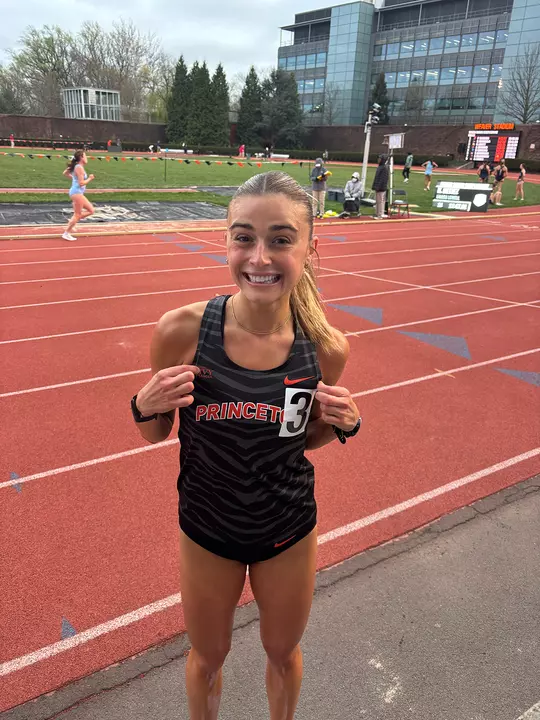
Throughout our whole conversation her energy and the speed with which she speaks never wane. Every now and then she’ll be distracted by something and switch up her focus, briefly. For instance, there was the time that one of Princeton’s athletes was practicing the discus.
“That’s crazy,” says Beaulieu, who will be running next year at Duke after graduating from Princeton in two weeks. “I could never do that.”
She probably could if she put her mind to it. Who would think any differently?
She talks about how she started out by watching her brother’s games when she was little and how restless she would get. Her parents would be watching too, only little Pia wouldn’t let them. Finally, they’d tell her something like “how about you go run to that pole and back and see how fast you can do it.” And off she’d go.
“I’d run all around the field,” she says. “I couldn’t sit still.”
She’ll say things like that, and she’ll say things like “I love the water jump; it’s so much fun when you’re approaching it.” Do not for a moment think she’s flighty or anything like that. She may be a fast thinker, but she’s also a very deep thinker.
Like this:
“Do I have internal goals? Absolutely. What I want to present externally is to do as well as I can for the greater good of the team. Coming from a team sport like soccer, I understand that. I want to score the best I can. I’m having so much fun doing what I’m doing. The times? They’ll take care of themselves.”
And this:
“I love running because it has instilled in me a lot of discipline. A lot of those characteristics are from the mental challenge it gives me. In the moment of the race, I’m so focused on the track. I can’t see or hear anything or anyone else.”
And this:
“As a freshman and sophomore, I played outside back. That was a very difficult transition for me. It was a completely new aspect of the game that I hadn’t unlocked, and that was definitely a fun learning experience. I think I got better every year with soccer. With age comes experience. This season was so much fun and so freeing. I just played with a lot of joy, and I think you could see that in the way I played.”
And this:
“I have this thing where I want the person I’m talking to to feel comfortable.”
As she says that, I can’t help but think of how innate that ability is for her. Then I looked out, across the track and to the left, where the water barrier sits. From that distance, it hardly looked menacing at all. At that moment, I couldn’t help but laugh a little.
Our 20 minutes or so together are ending. I’ve learned a lot about her in that time — most notably that including “barrier” in a sentence with “Pia Beaulieu” seems somewhat silly.
— by Jerry Price