


.png&width=24&type=webp)


Princeton University Athletics
Tiger Football 2000 ...
April 03, 2000 | Football
April 3, 2000
Princeton At A Glance ...
Location Princeton, NJ 08544
Founded 1746
Enrollment 4,600 undergraduates
Nickname Tigers
Colors Orange and Black
Home Field Princeton Stadium (natural grass--27,800 capacity)
Affiliations Ivy League, ECAC, NCAA Division I-AA
1999 Record (Ivy) 3-7 (1-6, tie/seventh)
Letterwinners Returning 36 (18 offense/17 defense/one specialist)
Letterwinners Lost 23 (10 offense/10 defense/three specialist)
Starters Returning 13 (7 offense/5 defense/1 specialist)
Starters Lost 10 (4 offense/6 defense)
1999 First-Team All-Ivy Players one returning (OT Dennis Norman), one graduated (DE David Ferrara)
2000 Captain Michael Higgins '01
President Harold T. Shapiro *64
Director of Athletics Gary D. Walters '67 Head Coach Roger Hughes (Doane College '82)
Hughes at Princeton/Overall First Season: 0-0
Hughes vs. Ivy League 0-0
Assistant Coaches Dave Rackovan (Millersville '73), Offensive Coordinator & Running Backs, Steve Verbit (Delaware '77), Defensive Coordinator & Line, Stanley Clayton (Penn State '88), Offensive Line, Don Dobes (Illinois Wesleyan '79), Linebackers, Eric Jackson (Eastern Michigan '87), Defensive Backs, Meade Clendaniel (West Chester '97), Assistant Secondary, Chris Griswold (Hobart '98), Assistant Defensive Line, Brett Sawyer (Muhlenberg '98), Tight Ends, Adam Scheier (Dartmouth '95), Wide Receivers & Special Teams Coordinator, Matt Fleming (Rutgers '97), Strength and Conditioning
All-Time Football Record 738-316-50 (.691) 130 seasons
Ivy League Championships 8 (1957, '64 and '95 outright, 1963, '66, '69, '89 and '92 shared)
2000 Princeton Schedule Sept. 16 at Lafayette 1:30 23 LEHIGH 7:00 30 at Columbia 1:30 Oct. 7 at Colgate 1:00 14 BROWN 1:00 21 HARVARD 1:00 28 at Cornell 1:00 Nov. 4 PENNSYLVANIA 1:00 11 at Yale 12:30 18 DARTMOUTH 1:00
So what's new? Not to answer a question with a question, but what isn't new? Princeton football in the 2000 season bears no resemblance to the product on the field even five years ago, and more has changed than just the players. It started with a new stadium and new uniforms in 1998, and it took more than just a cosmetic feel after the 1999 season, when Steve Tosches resigned after 13 years as head coach of the Tigers. In his place steps Roger Hughes, a dynamic young coach who helped develop some of the top Ivy League attacks in recent memory as the offensive coordinator at Dartmouth. Hughes is making his head coaching debut, and he brings with him nearly a decade's worth of experience in the league, not to mention a Ph.D. he earned while serving as a graduate assistant at Nebraska.
What else is new? For the first time since 1975, Princeton opens its season against a team other than Dartmouth or Cornell. More importantly, also for the first time since 1975, Princeton does not open with an Ivy League game. In fact, Princeton's first two games are non-league games, at Lafayette and home against Lehigh. It isn't until a game at Columbia in Week 3 that Princeton plays within the league, and that is followed by a game at Colgate in Week 4 before six Ivy games in the final six weeks. The new schedule will give the Tigers a chance to get acclimated with the new coaching philosophy before heading into the meat of the schedule.
What can we expect from Hughes' guys? Roger Hughes will put his own stamp on Princeton's offense, but he has spoken about running a balanced attack. Hughes has a tremendous track record of developing quarterbacks, something he did with great success at Dartmouth, where 14 of the top 15 single-game total offense performances in school history came under his watch. At Princeton, Hughes finds himself with an army of young skill players with whom to work, including the two returning quarterbacks, the top two rushers from last year and a deep corps of receivers.
What other new faces will be in the coaches' picture? Roger Hughes brought Dave Rackovan with him from Dartmouth to be the offensive coordinator. Rackovan worked with the offensive backs and special teams at Dartmouth, he will also work with the running backs at Princeton. Stanley Clayton, a member of Penn State's 1986 national champion who went on to play for three NFL teams, will coach the offensive line. Eric Jackson, who was on the staff for two Ivy League championship teams at Cornell, will coach the defensive backs. Steve Verbit stays as defensive coordinator, but he will work with the defensive line after more than a decade with the secondary. Don Dobes stays on as linebackers coach.
Who is the captain? Linebacker Michael Higgins is Princeton's lone captain this season. The last time Princeton had a linebacker as its sole captain was 1995, when Dave Patterson captained the Tigers to their only outright league title in the last 36 years.
What figures to be the strength of this team? For the first time in almost a decade, Princeton has stability at the quarterback position heading into a new season. Five of the six linebackers from the two-deep return, including four who were starters at some point of last season. The kicking game should also be very solid.
Where are the question marks? Princeton returns a host of young wide receivers, but graduation took both starters at the position, including one who was among the best wide receivers in the program's history. Two four-year starters graduated from the offensive line, and one of the three returning starters is coming off a major late-season knee injury. The defensive line loses two starters, including the school's career leader in sacks, and the secondary needs some stability.
Where do we start on offense? For the first time in a long time, you start at quarterback. Princeton has had seven different starting quarterbacks in the last eight years, but the Tigers head into 2000 with something they haven't had in 16 years. Not since Doug Butler in 1984 has Princeton had a junior quarterback who was a returning starter. This year, however, Princeton has Tommy Crenshaw, who completed 157 of 281 passes for 1,662 yards and seven touchdowns as a sophomore last year. Crenshaw, also a pitcher on the baseball team, has good size, a strong arm and good mobility. Jon Blevins, a senior, also returns after seeing considerable playing time a year ago, when he was 37 for 61 for 448 yards and three touchdowns.
Is the backfield still in motion? Princeton used a rotation of four tailbacks in 1998 and three in 1999. The only current running back to be part of both rotations is Kyle Brandt, who has had an interesting career to say the least. Brandt gained more than 100 yards in his first career start, which just happened to be the first game ever played in Princeton Stadium. He has had other big days as a running back as well, though there was that little detour to defensive back in the middle of last season that saw him spend four weeks on the other side of the ball. Despite that, Brandt led Princeton with 466 yards and a 5.4 yards per carry average. A strong and durable runner, Brandt is back for his senior year. Cameron Atkinson is back for his sophomore year after spending much of his freshman season as the featured tailback. Atkinson led Princeton with 102 carries a year ago and four rushing touchdowns, and he gained 348 yards with two 100-yard games. Atkinson is also a sprinter on the track team, and he showed glimpses last year of what his speed can mean in the fall. Behind these two, Princeton also has Andy Bryant, who carried 11 times for 37 yards as a freshman, and sophomore Ismael El-Amin. Princeton also returns H-back Marty Cheatham, who did not carry the ball once but who did catch 20 passes a year ago. What happens to Cheatham this year, and the H-back position under the new system for that matter, remains to be seen.
Will Princeton be able to `Phil' the void at wide receiver? Phil Wendler had a remarkable season last year as Princeton's top wide receiver. Wendler caught at least six passes in every game and finished the season with 74, more than the next four players combined. His 822 yards were more than the next three players combined. Danny Brian was second on the team with 33 receptions and 441 yards, Brian and Wendler were handed diplomas last spring. There is no shortage of candidates to step in at the receiver spots, as Princeton ran wave after wave out there last year. The leading returner is sophomore Chisom Opara, who caught 10 passes for 156 yards a year ago. Opara and classmates Patrick Schottel and Nathan Lindell all saw considerable playing time as rookies. Tim Ligue caught seven passes as a junior last year, and his classmate Stephen Pierce is also back. Replacing Wendler and Brian may be the biggest need for this year's Tigers.
Which end will be up? It has been nearly 10 years since Princeton has had a tight end catch at least 10 passes in a season. George Citovic, the incumbent at the position, has shown the potential to be a big-play man, but his junior year last year consisted of six catches for 71 yards and a considerable amount of time blocking. Princeton's old use of the tight end can be summed up this way: John Amburgy, an offensive guard, was moved to tight end in midseason a year ago. It remains to be seen how much the tight end gets used in the new system, Hughes coached All-Ivy quarterbacks, running backs and wide receivers at Dartmouth but no All-Ivy tight ends.
How do they line up? Princeton graduated Hamin Abdullah and Bernie Marczyk, who started side-by-side for four years on the offensive line. Marczyk started the final 35 games of his career at center, while Abdullah started 34 at guard. They are the two most experienced offensive linemen in Princeton football history, and they must be replaced. Ross Tucker started his entire sophomore year and the first nine games of his junior year at one guard spot before suffering a major knee ligament injury against Yale last year, he will be back for his senior year this year, but the injury puts a question mark next to his name. Tucker is one of the three returning starters, and there is a host of young offensive linemen in the program. The key man up front is senior Dennis Norman, the only returning first-team All-Ivy League selection on the team. Norman has been first-team All-Ivy the last two years, he has a chance to join Derek Graham '86, Damani Leech '98 and Matt Evans '99 as the only three-time first-team All-Ivy players in Princeton history. Norman is one tackle, John Raveche started all 10 games last year as the other tackle. Like Norman, Raveche will be a senior. Another senior, Brian Wilson, filled in for Tucker last year after his injury, and he has played guard and center in his career. Junior Matt Peluse filled in for Norman when he was injured for the Penn game, and junior David Czehut and sophomores Chris Havener and John Holownia lead the group competing for playing time.
Without Ferrara, will Nathan have to be Ol' Reliable? Defensive end David Ferrara graduated, taking his two first-team All-Ivy League selections and school record 28.5 career sacks with him. Still, fellow end Nathan Podsakoff is back for his senior year after quietly having an outstanding 1999 season of his own. Podsakoff made 49 tackles, 28 unassisted, and had three sacks on a season that ended with honorable mention All-Ivy honors. He will be counted on to anchor the defensive line with Ferrara gone.
What else does Princeton have to be up front about? Nick Freitag split one tackle position with Doug Silverman last year, with Silverman's graduation, Freitag may have to play full-time. Jason Rotman was the other tackle last year, he has played tackle and end. Michael Long, healed from a major knee injury freshman year, had a good sophomore year as a backup, and he may be headed for more playing time. Aron Tremble and Brian Foley also figure in the mix.
If you graduated one linebacker, how can you have four returning starters? Chuck Hastings graduated last year after a second-team All-Ivy selection, but Princeton is very deep at linebacker. It starts with Michael Higgins, this year's captain who led the Tigers with 85 tackles last year. Higgins started every game last year, he is joined by three players who were starters at various times. Steven Koopman, Drew Babinecz and Bob Farrell are all veterans, and they ranked 3-5-8 in tackles last year for the Tigers. Chris Roser-Jones, who is also a valuable special teams man, is another returning linebacker after a sophomore year that saw him intercept two passes and make 30 tackles, Rob Currey contributed as a freshman. This group is the strength of the defense.
What's next for the secondary? The last two years have seen Princeton's defensive backs racked by injuries. The 1998 season saw two starters go out with season-ending injuries, and last year was more of the same. Taylor Smith and Clark Webb missed the entire season after getting hurt in training camp, and promising freshman Shane Stevenson tore his knee after becoming a starter early in the season. Princeton also lost three key veterans to graduation in safety Ryan Demler (three-year starter), safety Dave Richie (two-year starter) and cornerback Gerry Wilson (three-year starter). Obviously, this area is of great concern. Still, there are all sorts of directions in which Princeton can go. Junior Brian Beem has started parts of each of the last two years as a corner. Paul Simbi started much of last year as a freshman cornerback. The three returning from injuries will be key, as will sophomore Kevin Kongslie, who was as good as any Tiger defensive back by season's end last year.
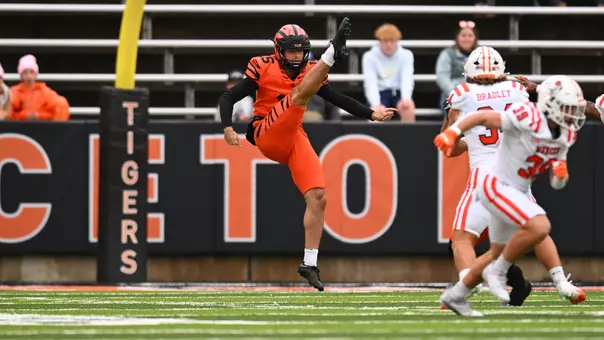
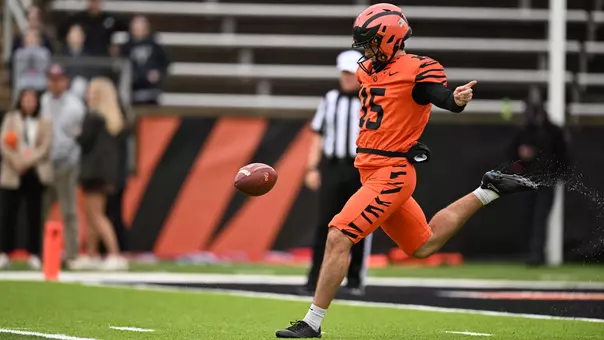
Will Taylor be getting his kicks again? Junior Taylor Northrop was Princeton's placekicker and punter last year, and he showed flashes of brilliance at both. He also was stronger in the beginning of the season than at the end, and it's possible that the double-duty took its toll. Northrop has a tremendous leg, and his 52-yard field goal that momentarily tied the Harvard game at 6-6 with three minutes to play was the second-longest in school history. He showed great distance all season, and he actually had a higher percentage on field goals of more than 40 yards than he did on extra points. In addition to his placekicking, Northrop also kicked off and punted, and he averaged 38.1 yards on his 49 punts. He was twice named Ivy League Special Teams Player of the Week.
What else is special about this team? Danny Brian graduated after spending most of his career as the top punt returner. Sophomores Cameron Atkinson and Andy Bryant were the two leading kickoff returners last year, and Kyle Brandt is also an experienced kick returner. Brian was also the holder, though Jon Blevins filled in when Brian was hurt. Princeton needs to replace four-year longsnapper Todd Helfrich, who gave the Tigers stability at an important spot. Garrett Fittizzi graduated, meaning the last of the kick-blocking Fittizzi brothers is gone. The Tigers' coverage teams were very young last year, and six freshmen were used on the kickoff coverage team at times.
How did recruiting go? "Recruiting went remarkably well considering the staff changes that occurred," Princeton head coach Roger Hughes says. "While we did not matriculate as many student-athletes as we would have liked, we are very excited about their quality. We have commitments from numerous players who were offered scholarships by Division I-A and I-AA institutions. We look forward to the contribution they will make. Our ability to attract these high quality student-athletes attests to the efforts of our assistant coaches, the reputation of Princeton, its football tradition, and the admissions department's commitment to excellence. After looking at our depth charts, many of the recruits will have a realistic opportunity to contribute, especially in the secondary, offensive and defensive lines, and on special teams."
What else does Coach Hughes have to say? "I'm excited about the opportunity to coach at Princeton. We have made a lot of changes and the players have responded well. I have assembled an outstanding staff, retaining two assistants, Don Dobes and Steve Verbit, and hiring four new faces in Dave Rackovan, Stanley Clayton, Eric Jackson and Adam Scheier. Schematically, we are looking to retain a similar philosophy on the defensive side as in previous years, but the biggest change will come on the offense where we will look to incorporate a more balanced run/pass ratio. Look for us to run a lot of formations, motions and shifts as well as a few gadget plays. "Overall, I think we have a pretty athletic team Defensively, most of our linebackers return, led by captain Mike Higgins. While none are overpowering, all of them can shed blocks well and are great playmakers. We are excited about the quality of our defensive line, but we are concerned about our depth. For us to have success, we will have to remain healthy. Last year we were young in the secondary, so we are trying to capitalize on their playing experience by being more multiple in our coverage checks and also using more disguise packages. "Offensively we look to be strong on the line, but again depth is a problem. All-Ivy Dennis Norman will anchor the line, and we need to fine a reliable center. We lost some major playmakers at the wide receiver position so spring practice will have to help us determine who will replace Wendler. Currently, Chisom Opara, Nate Lindell and Pat Schottel are all vying for the starting role. We should be experienced at both running back and quarterback, but we must find a consistent fullback within the program. We are currently looking at the H-backs to fill this void. We are also looking for some depth at tight end, especially since our offensive scheme often uses two tight ends. Our kicking game should be solid with Taylor Northrop returning. "I'm also excited about the change in the scheduling format. The good news is we will open up with two non-Ivy opponents this year. This will be crucial because it will give our team time to grow into the new systems without hurting our chances for an Ivy title. The bad news is that three of the first four games are away and two of the non-league opponents are Lehigh and Colgate, who were both in the playoffs last year. It is important that our kids remain focused on our long term goals and fight through our growing pains. "I'm very pleased and thankful for how readily the administration, coaches, faculty, alumni and players have accepted me into the Princeton family. It has been a whirlwind experience since I was named the head coach back in January. Between recruiting, assembling a staff and finishing the weight room and locker room projects, most of my time has been spent with the administrative duties of my job. I'm anxious to proceed with the actual coaching portion as we prepare for spring football and fall camp. Our coaching staff is very excited about the opportunity to work with some of the best athletes in the Ivy League and our players have demonstrated a renewed commitment through their work ethic during the winter conditioning program. They are anxious and enthused about learning a new system, working with new coaches, and are dedicated to putting Princeton football back among the Ivy League's elite."
1999 RESULTS (3-7 overall, 1-6 Ivy League)
Sept. 18 Cornell 20, Princeton 3 25 Lehigh 31, Princeton 0 Oct. 2 Princeton 27, Fordham 0 9 Brown 53, Princeton 30 16 Princeton 22, Lafayette 10 23 Harvard 13, Princeton 6 30 Princeton 44, Columbia 15 Nov. 6 Penn 41, Princeton 13 13 Yale 23, Princeton 21 20 Dartmouth 19, Princeton 18
1999 IVY LEAGUE STANDINGS Ivy Overall Brown 6-1 9-1 Yale 6-1 9-1 Cornell 5-2 7-3 Pennsylvania 4-3 5-5 Harvard 3-4 5-5 Dartmouth 2-5 2-8 Princeton 1-6 3-7 Columbia 1-6 3-7