


.png&width=24&type=webp)


Princeton University Athletics
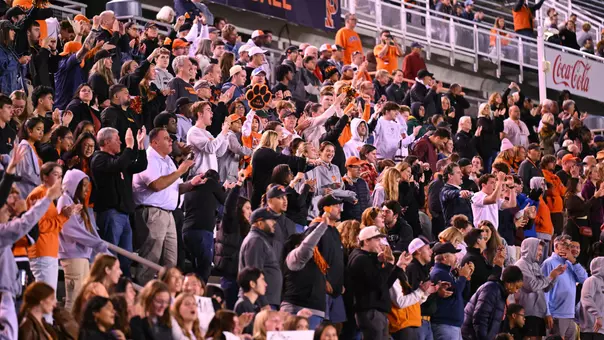
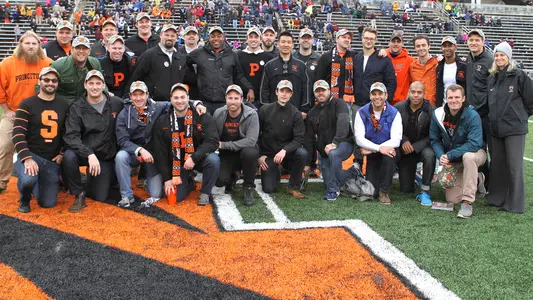
Photo by: Beverly Schaefer
A Decade Later, The 2006 Tiger Football Championship Ride Still Feels Like A Tale Of Fiction
October 26, 2016 | Football
There is a panoramic photo outside the Princeton football office of a Tiger touchdown celebration in front of a packed, enthusiastic Princeton Stadium. Two fans in one corner are high-fiving as the Tigers celebrate a touchdown against their most historic rival.
It's a great picture. It also captures the final moment of joy in the most torturous game ever played at Princeton Stadium.
And it was the prologue to one of this century's most memorable — and incredible — Orange and Black championship stories.
The 2006 Princeton Tiger football team was honored last weekend on the 10th anniversary of its Ivy League title season, a year when the Tigers rallied from four fourth-quarter deficits, won twice in overtime, and otherwise tugged on every heartstring en route to its first title in more than a decade.
If it sounds like a storybook season, it was — but it probably belonged in the fiction section. There was no way that really happened, did it?
Let's relive the epic.
PROLOGUE
Nov. 12, 2005 • Yale 21, PRINCETON 14
The photo inside Jadwin captures the moment after Brian Brigham's 32-yard touchdown reception, a score that opened a 14-0 lead for a Princeton team in control of its own destiny in the Ivy League race.
This came four weeks after a wild comeback win at Harvard, the Tigers' first over the Crimson since 1995. For the first time in a decade, Princeton fans were at a Yale game that had both championship and bonfire implications. The 14-0 lead ignited a celebration like few before it at the still-newish home for Tiger football.
The party ended, stunningly, in a sea of turnovers, penalties and a devastating final 74 seconds. Trailing 14-7, Yale converted a 4th-and-10 into a 14-yard TD to even the score with 1:14 to go. Princeton's first offensive play after that was a crossing route from quarterback Jeff Terrell — who went from unknown to leading man in the blink of an eye — to Brian Shields, but a collision on the catch left the ball floating to a Yale defender, who returned it inside the 10. A score, another interception on a desperation pass, and … heartbreak.
Understand that the 2005 Tigers went 7-3, the best record in a decade of Princeton football, and yet nobody could fully enjoy it afterwards.
"I'm thinking about five interceptions," Terrell said. "I think we saw we had a lot more potential. It left such a bad taste in my mouth. I was far from satisfied with just a winning record."
"I think it was one of the most deflating moments of my life," said cornerback JJ Artis, another junior on that team and a 40-game Princeton starter. "I remember how quiet the locker room was. Nobody said a word to each other. I remember wanting to get out as quickly as possible."
It was a crossroads moment for a program. Its leader, Roger Hughes, was the embodiment of hope and optimism — it's why Stetson recently called upon him to resurrect its football program. But Hughes wasn't the one who was going to play those games the following season.
His players were, and they were determined to rewrite the ending if given another chance.
"Anytime you have a close loss like that, it's so devastating because you feel like you turned a corner," Terrell said. "Not only are we trying to win that game, but we're trying to get rid of this underlying skepticism or doubt that people had about our program, that we weren't winners, and we couldn't win a game like that. To lose like that, it was so devastating, but also motivating to say that I had another year to come back and turn the program around and have an expectation to go into every game and expect to win."
They proved that expectation nine times the following fall.
And they did in incredible ways.
CHAPTER ONE
Weeks 1-5
The first five games of the season included:
• three second-half comebacks
• an overtime win on a failed two-point conversion
• a near shutout of Brown in Princeton's first-ever Friday night game
And those games comprised the more normal half of that season.
Princeton played one of its worst halves of football all season to open the season, but it escaped Lehigh with a 14-10 win to ignite a 5-0 start. That run concluded with a 17-3 home win over Brown on ESPNU, a game that will always be associated with a diving interception by JJ Artis in one of the season's most remarkable plays. He remembered a similar play by Harvard the previous season, when he missed an assignment and was beaten deep.
It would not happen again. He made the play, kept Brown out of the end zone and sent the Tigers into an all-ranked, all-undefeated home showdown with Harvard.

CHAPTER TWO
Oct. 21, 2006: PRINCETON 31, Harvard 28
A 10-yard touchdown run on a counter by R.C. Lagomarsino gave Princeton a 24-14 lead going into halftime, but the explosive Crimson offense scored twice in the third quarter to grab a 28-24 lead entering the fourth.
The Crimson had the ball and the lead with eight minutes to go, when senior co-captain Luke Steckel picked off a pass in Tiger territory to give his offense the opportunity it needed.
A 19-yard completion to Brigham on 3rd and 14 got the drive rolling, and a fumble recovery by junior Rob Toresco on the Harvard 20 kept it alive. One play later, with the clock ticking below the 5:00 mark, it was time to strike.
It was Sooner time — a route that Terrell and wide receiver Brendan Circle perfected in practice during a 2004 season when neither was listed on the Princeton depth chart.
"I remember looking the safety off and just knowing it was going to be there," Terrell said of the 20-yard strike to Circle, his top receiver that season. "It wasn't the prettiest ball coming off my hand, but he made an incredible catch and finish. The beautiful thing is that was the play we practiced more than any other over our years."
While Terrell credited his receiver, Circle credited everybody else on the field.
"I remember going towards the goal line, and I remember Adam Berry and Brian Brigham being on the field and commanding a lot of respect from the safety, which opened a lot of room for me," Circle said. "I remember each of the defensive backs, including the one trying to line me up for a big hit, but not wrapping me up, and I remember being able to gather myself and score. Ultimately, the way I get to the end zone is Adam Berry taking care of his brother (Andrew, an All-Ivy defensive back).
"I vividly remember seeing Harvard players on the ground from all the blocks," he added. "It was nice seeing all the work everybody had to do to make that play happen."
That connection made it 31-28, but Harvard would get two more opportunities to steal the win. That put the onus on the defense, which was more than happy to accept the responsibility. The group got overlooked at times due to the standout play by Terrell, the eventual Bushnell Cup winner, and the offensive comebacks over the season, but it was the defense that consistently kept Princeton in games.
"I remember thinking, let's get back on the field, get the job done, and get this victory," said Artis, a four-year starter at cornerback and All-Ivy League honoree. "By that point, we had played so many close games during the season, there was no way we weren't going to come out with the W there. Kevin Kelleher made two huge plays down the stretch."
Kelleher, a junior safety, ended both Harvard drives with interceptions, sending Princeton to 6-0.

CHAPTER THREE
Oct. 28, 2006: CORNELL 14, Princeton 7
If you wondered about Tuesday's GoPrincetonTigers.com headline about Schoellkopf Field being a 'House of Horrors' for the Tigers, look no further than this game. Ranked 15th nationally, Princeton couldn't muster enough points to keep its perfect season intact.
"I've thought about that game, because something that stands in your way of a perfect season, you think about it a lot," Circle said. "The reality was, we just didn't put a game together that was worth a win that day, and Cornell outplayed us. When you only get 10 games a year, it's hard to say we weren't ready to play. For whatever reason, we didn't click."
Princeton outgained the Big Red 328-274 that day, but a Cornell interception set up a 1-yard touchdown drive that gave the Big Red a lead it wouldn't relinquish.
You already know that this story ends with a championship, but it wasn't an unblemished ride. And if you think this wasn't a team full of perfectionists, well …
"That is the game that still gives me nightmares, because that was the opportunity to make an undefeated season," Terrell said. "But I guess it's a reminder that life isn't perfect."
Life? No.
The upcoming November? Yes, that was perfect.
CHAPTER FOUR
Nov. 4, 2006: PRINCETON 31, Penn 30 (2 OT)
Circle caught a five-yard TD pass on the first play of the fourth quarter, and a traditional football game was in perilous danger of breaking out. After all, this defense spent nine weeks that season throttling its opponents in the fourth quarter.
Naturally, this would be the other week. Why do it the easy way?
Penn scored twice, including a 16-yard pass with 39 seconds remaining, to force overtime and leave a Princeton team stunned that this win wasn't already in the bag.
"I was shocked when they came back the way they did," Terrell said. "The defense had been so solid. But it was so different than two years prior. Before, we would have felt like we lost that game. That day, even when that game went into overtime, we felt like we would figure it out."
Princeton stuffed Penn on its first overtime drive, but Penn followed with a field goal block to force a second session. The Tigers started on offense and drove 24 yards on five plays to set up 4th and goal at the 1. Hughes kept the offense on the field and trusted Toresco, his hard-nosed running back, to get the yard.
Toresco got plenty of yards in his career. That wasn't one of them. Instead, he was hit by a swarm of Penn defenders at the line. He pushed, and they pushed back. He pushed again, and they pushed back again.
But he didn't go down.
"I just remember locking eyes with him," Terrell said of the play that will forever be remembered first and foremost from that season. "I don't think he could have heard me. He dove, dove again. His back is to the goal line. It's just chemistry, the chemistry of that team. He realized that the whole defense was on him, and if we were going to get in, he needed to get rid of the ball. It was unbelievable, the ultimate backyard play with the buddy you've played with for years. You just trust each other, you know where one another would be."
Toresco flipped the ball to Terrell, who ran untouched into the right corner of the end zone to open a 31-24 lead. Afterwards, Hughes said he was already thinking about the defense when Toresco was hit at the line, so he was stunned as anybody by the play's outcome.
End of story? Of course not.
Penn needed one play to score a touchdown on its turn, making a third overtime seem inevitable. Then came a low snap. Holder Matt Reinert picked it up and started to roll to the left. For a moment, nobody seemed to be joining him on the journey.
"I absolutely [thought he would score]," Terrell said. "That's the worst as a quarterback. You play the position to have control, and there is nothing you can do in that moment."
"We didn't make winning look easy," Circle added.
Ultimately, junior defensive lineman Pat McGrath sprinted to the open field and forced Reinert out of bounds a yard short of the end zone, a yard short of Tiger misery. It was arguably the most incredible three minutes of football ever played at Princeton Stadium, and it would have been the Game of the Year in almost any other year.
It wasn't even the Game of the Month.
CHAPTER FIVE
Nov. 11, 2006: Princeton 34, YALE 31
Yale tailback Mike McLeod was considered one of the best players long before his six-yard scamper 66 seconds before halftime of a rematch Princeton players thought about for 52 weeks.
But this was ridiculous. McLeod had capped off each of Yale's last four drives with touchdown runs, and that dream of rewriting the script was being mercilessly stomped on by the league's best running back.
More than 43,000 people filled into the Yale Bowl that day to watch a pair of 7-1 battle for first place in the league. While the home team had its fair share, there was an incredible contingent of Orange-and-Black-clad Princeton fans behind the visiting sideline, doing all they could do to will an Ivy title and bonfire back to Princeton.
It looked bad to them.
For whatever reason, it just didn't look as bad to the players.
"It was the best I thought our offense felt all year," Terrell recalled thinking at halftime. "The offense was clicking, we just didn't have the points to show for it. We had a penalty that called back a big Adam Berry play, we had a tipped pass that was intercepted. I wasn't afraid of being down, because I felt we had the ability to score, and score a lot.
"I've never had more fun in my life than I did playing in that second half."
Touchdown passes of 15 and eight yards to Circle bookended a Yale field goal, and Princeton found itself with the ball, down 5, with just under eight minutes to go. It was an opportunity for another one of those time-consuming, defense-breaking, go-ahead scoring drives, right?
Or not.
Brigham ran a double move on the first play, the Yale cornerback bit, and Terrell launched a perfect strike for a stunning 57-yard score that ignited one side of the Yale Bowl. Princeton led.
Terrell threw for 445 yards that day, the fourth-most in program history, but he is quick to point out that none of those yards would matter if his defense didn't shut down Yale for the final 30 minutes.
"The defense was the epitome of our team all year," he said. "They were a bend, not break, stand up when it matters, unit. The defense deserved way more credit than they ever get. The real star in the league that year was their running back, and to hold him and that offense to three points in the second half is just as big a reason we won as anything the offense did. That's what made it such a beautiful win. It was a full team refusing to lose, and putting the best performance of the season when it mattered most."
"What happened in the first half was mental lapses," Artis recalls. "It was uncharacteristic of us to allow those kinds of runs. We knew if we just did our jobs, we'd get back into it. There was no yelling, no big motivational speeches, it was just about correcting mistakes and taking care of our roles. We trusted the offense, so we didn't step outside our responsibilities. Series by series, we were able to do that."
The defense stopped Yale at midfield, and the Bulldogs punted with hopes of getting one more chance. They put Princeton in a 3rd-and-8 spot and prepared for a run, a timeout, and then a chance to cause one more heartbreak.
3rd and 8.
"That's the play I remember more than any play in my career," Circle said. "The play call is Spread Right Trojan. I'm in the slot, and I ran a crossing route, a 10-yard in. As Jeff rolled to his left, I stayed with him, knowing he would have the option to run or pass. I just remember staying in phase with him, and him trusting me to throw the ball. I remember thinking I had to get down inbounds to keep the clock rolling, then catching it, going down and seeing the referee wind his arm to continue the clock running.
"I stood up at the feet of Yale coach Jack Siedlecki, turned to our sideline to saw the coaches indicate the victory formation, and then this sea or Orange behind our sideline. They were so excited to see it, and to know the bonfire was coming to Princeton. I see that whole play in slo-mo in my mind."
Minutes later, the field belonged to the victorious Tigers and an impassioned road crowd like none other Princeton has seen in decades. Strickland was lifted to the skies by classmates who would enjoy the first bonfire on Cannon-Green in more than a decade.
"I didn't accept it until it was done," Artis said. "But then I screamed louder than I ever did before. Pure happiness. My family was there, people are rushing the field, they're carrying Strickland off the field. Wow. It makes all the hard work, all the sweat, makes it worth it. To share that moment with your friends, your family, the school, there's nothing like it."

CHAPTER SIX
Nov. 18, 2006: PRINCETON 27, Dartmouth 17
If the last two games were works by Picasso and Rembrandt, the finale was Color By Numbers. A two-win Dartmouth team came to Princeton Stadium and made the Tigers sweat more than anybody expected.
"We just wanted the ring so badly, we were a little nervous and didn't play as loose as we usually did," Terrell said.
With the game tied at 17-17 early in the fourth quarter, Hughes — who correctly played his gut plenty with this squad — sent in Matt Lichtenstein to attempt a 25-yard field goal. It was the first field goal attempt of his career, and it was for the lead in the final quarter of a title-clinching game.
No pressure, kid.
Lichtenstein drilled it, Toresco converted an option into a touchdown with 1:03 left, and the celebration was on. This Tiger team, on the brink time and again (and again and again) was Ivy League champion.
Every championship team has its story.
Few will stand the test of time like this one.
Fewer belong in the fiction section as much as nonfiction.
Maybe none will match the drama of those final five weeks.

It's a great picture. It also captures the final moment of joy in the most torturous game ever played at Princeton Stadium.
And it was the prologue to one of this century's most memorable — and incredible — Orange and Black championship stories.
The 2006 Princeton Tiger football team was honored last weekend on the 10th anniversary of its Ivy League title season, a year when the Tigers rallied from four fourth-quarter deficits, won twice in overtime, and otherwise tugged on every heartstring en route to its first title in more than a decade.
If it sounds like a storybook season, it was — but it probably belonged in the fiction section. There was no way that really happened, did it?
Let's relive the epic.
PROLOGUE
Nov. 12, 2005 • Yale 21, PRINCETON 14
The photo inside Jadwin captures the moment after Brian Brigham's 32-yard touchdown reception, a score that opened a 14-0 lead for a Princeton team in control of its own destiny in the Ivy League race.
This came four weeks after a wild comeback win at Harvard, the Tigers' first over the Crimson since 1995. For the first time in a decade, Princeton fans were at a Yale game that had both championship and bonfire implications. The 14-0 lead ignited a celebration like few before it at the still-newish home for Tiger football.
The party ended, stunningly, in a sea of turnovers, penalties and a devastating final 74 seconds. Trailing 14-7, Yale converted a 4th-and-10 into a 14-yard TD to even the score with 1:14 to go. Princeton's first offensive play after that was a crossing route from quarterback Jeff Terrell — who went from unknown to leading man in the blink of an eye — to Brian Shields, but a collision on the catch left the ball floating to a Yale defender, who returned it inside the 10. A score, another interception on a desperation pass, and … heartbreak.
Understand that the 2005 Tigers went 7-3, the best record in a decade of Princeton football, and yet nobody could fully enjoy it afterwards.
"I'm thinking about five interceptions," Terrell said. "I think we saw we had a lot more potential. It left such a bad taste in my mouth. I was far from satisfied with just a winning record."
"I think it was one of the most deflating moments of my life," said cornerback JJ Artis, another junior on that team and a 40-game Princeton starter. "I remember how quiet the locker room was. Nobody said a word to each other. I remember wanting to get out as quickly as possible."
It was a crossroads moment for a program. Its leader, Roger Hughes, was the embodiment of hope and optimism — it's why Stetson recently called upon him to resurrect its football program. But Hughes wasn't the one who was going to play those games the following season.
His players were, and they were determined to rewrite the ending if given another chance.
"Anytime you have a close loss like that, it's so devastating because you feel like you turned a corner," Terrell said. "Not only are we trying to win that game, but we're trying to get rid of this underlying skepticism or doubt that people had about our program, that we weren't winners, and we couldn't win a game like that. To lose like that, it was so devastating, but also motivating to say that I had another year to come back and turn the program around and have an expectation to go into every game and expect to win."
They proved that expectation nine times the following fall.
And they did in incredible ways.
CHAPTER ONE
Weeks 1-5
The first five games of the season included:
• three second-half comebacks
• an overtime win on a failed two-point conversion
• a near shutout of Brown in Princeton's first-ever Friday night game
And those games comprised the more normal half of that season.
Princeton played one of its worst halves of football all season to open the season, but it escaped Lehigh with a 14-10 win to ignite a 5-0 start. That run concluded with a 17-3 home win over Brown on ESPNU, a game that will always be associated with a diving interception by JJ Artis in one of the season's most remarkable plays. He remembered a similar play by Harvard the previous season, when he missed an assignment and was beaten deep.
It would not happen again. He made the play, kept Brown out of the end zone and sent the Tigers into an all-ranked, all-undefeated home showdown with Harvard.
CHAPTER TWO
Oct. 21, 2006: PRINCETON 31, Harvard 28
A 10-yard touchdown run on a counter by R.C. Lagomarsino gave Princeton a 24-14 lead going into halftime, but the explosive Crimson offense scored twice in the third quarter to grab a 28-24 lead entering the fourth.
The Crimson had the ball and the lead with eight minutes to go, when senior co-captain Luke Steckel picked off a pass in Tiger territory to give his offense the opportunity it needed.
A 19-yard completion to Brigham on 3rd and 14 got the drive rolling, and a fumble recovery by junior Rob Toresco on the Harvard 20 kept it alive. One play later, with the clock ticking below the 5:00 mark, it was time to strike.
It was Sooner time — a route that Terrell and wide receiver Brendan Circle perfected in practice during a 2004 season when neither was listed on the Princeton depth chart.
"I remember looking the safety off and just knowing it was going to be there," Terrell said of the 20-yard strike to Circle, his top receiver that season. "It wasn't the prettiest ball coming off my hand, but he made an incredible catch and finish. The beautiful thing is that was the play we practiced more than any other over our years."
While Terrell credited his receiver, Circle credited everybody else on the field.
"I remember going towards the goal line, and I remember Adam Berry and Brian Brigham being on the field and commanding a lot of respect from the safety, which opened a lot of room for me," Circle said. "I remember each of the defensive backs, including the one trying to line me up for a big hit, but not wrapping me up, and I remember being able to gather myself and score. Ultimately, the way I get to the end zone is Adam Berry taking care of his brother (Andrew, an All-Ivy defensive back).
"I vividly remember seeing Harvard players on the ground from all the blocks," he added. "It was nice seeing all the work everybody had to do to make that play happen."
That connection made it 31-28, but Harvard would get two more opportunities to steal the win. That put the onus on the defense, which was more than happy to accept the responsibility. The group got overlooked at times due to the standout play by Terrell, the eventual Bushnell Cup winner, and the offensive comebacks over the season, but it was the defense that consistently kept Princeton in games.
"I remember thinking, let's get back on the field, get the job done, and get this victory," said Artis, a four-year starter at cornerback and All-Ivy League honoree. "By that point, we had played so many close games during the season, there was no way we weren't going to come out with the W there. Kevin Kelleher made two huge plays down the stretch."
Kelleher, a junior safety, ended both Harvard drives with interceptions, sending Princeton to 6-0.
CHAPTER THREE
Oct. 28, 2006: CORNELL 14, Princeton 7
If you wondered about Tuesday's GoPrincetonTigers.com headline about Schoellkopf Field being a 'House of Horrors' for the Tigers, look no further than this game. Ranked 15th nationally, Princeton couldn't muster enough points to keep its perfect season intact.
"I've thought about that game, because something that stands in your way of a perfect season, you think about it a lot," Circle said. "The reality was, we just didn't put a game together that was worth a win that day, and Cornell outplayed us. When you only get 10 games a year, it's hard to say we weren't ready to play. For whatever reason, we didn't click."
Princeton outgained the Big Red 328-274 that day, but a Cornell interception set up a 1-yard touchdown drive that gave the Big Red a lead it wouldn't relinquish.
You already know that this story ends with a championship, but it wasn't an unblemished ride. And if you think this wasn't a team full of perfectionists, well …
"That is the game that still gives me nightmares, because that was the opportunity to make an undefeated season," Terrell said. "But I guess it's a reminder that life isn't perfect."
Life? No.
The upcoming November? Yes, that was perfect.
CHAPTER FOUR
Nov. 4, 2006: PRINCETON 31, Penn 30 (2 OT)
Circle caught a five-yard TD pass on the first play of the fourth quarter, and a traditional football game was in perilous danger of breaking out. After all, this defense spent nine weeks that season throttling its opponents in the fourth quarter.
Naturally, this would be the other week. Why do it the easy way?
Penn scored twice, including a 16-yard pass with 39 seconds remaining, to force overtime and leave a Princeton team stunned that this win wasn't already in the bag.
"I was shocked when they came back the way they did," Terrell said. "The defense had been so solid. But it was so different than two years prior. Before, we would have felt like we lost that game. That day, even when that game went into overtime, we felt like we would figure it out."
Princeton stuffed Penn on its first overtime drive, but Penn followed with a field goal block to force a second session. The Tigers started on offense and drove 24 yards on five plays to set up 4th and goal at the 1. Hughes kept the offense on the field and trusted Toresco, his hard-nosed running back, to get the yard.
Toresco got plenty of yards in his career. That wasn't one of them. Instead, he was hit by a swarm of Penn defenders at the line. He pushed, and they pushed back. He pushed again, and they pushed back again.
But he didn't go down.
"I just remember locking eyes with him," Terrell said of the play that will forever be remembered first and foremost from that season. "I don't think he could have heard me. He dove, dove again. His back is to the goal line. It's just chemistry, the chemistry of that team. He realized that the whole defense was on him, and if we were going to get in, he needed to get rid of the ball. It was unbelievable, the ultimate backyard play with the buddy you've played with for years. You just trust each other, you know where one another would be."
Toresco flipped the ball to Terrell, who ran untouched into the right corner of the end zone to open a 31-24 lead. Afterwards, Hughes said he was already thinking about the defense when Toresco was hit at the line, so he was stunned as anybody by the play's outcome.
End of story? Of course not.
Penn needed one play to score a touchdown on its turn, making a third overtime seem inevitable. Then came a low snap. Holder Matt Reinert picked it up and started to roll to the left. For a moment, nobody seemed to be joining him on the journey.
"I absolutely [thought he would score]," Terrell said. "That's the worst as a quarterback. You play the position to have control, and there is nothing you can do in that moment."
"We didn't make winning look easy," Circle added.
Ultimately, junior defensive lineman Pat McGrath sprinted to the open field and forced Reinert out of bounds a yard short of the end zone, a yard short of Tiger misery. It was arguably the most incredible three minutes of football ever played at Princeton Stadium, and it would have been the Game of the Year in almost any other year.
It wasn't even the Game of the Month.
CHAPTER FIVE
Nov. 11, 2006: Princeton 34, YALE 31
Yale tailback Mike McLeod was considered one of the best players long before his six-yard scamper 66 seconds before halftime of a rematch Princeton players thought about for 52 weeks.
But this was ridiculous. McLeod had capped off each of Yale's last four drives with touchdown runs, and that dream of rewriting the script was being mercilessly stomped on by the league's best running back.
More than 43,000 people filled into the Yale Bowl that day to watch a pair of 7-1 battle for first place in the league. While the home team had its fair share, there was an incredible contingent of Orange-and-Black-clad Princeton fans behind the visiting sideline, doing all they could do to will an Ivy title and bonfire back to Princeton.
It looked bad to them.
For whatever reason, it just didn't look as bad to the players.
"It was the best I thought our offense felt all year," Terrell recalled thinking at halftime. "The offense was clicking, we just didn't have the points to show for it. We had a penalty that called back a big Adam Berry play, we had a tipped pass that was intercepted. I wasn't afraid of being down, because I felt we had the ability to score, and score a lot.
"I've never had more fun in my life than I did playing in that second half."
Touchdown passes of 15 and eight yards to Circle bookended a Yale field goal, and Princeton found itself with the ball, down 5, with just under eight minutes to go. It was an opportunity for another one of those time-consuming, defense-breaking, go-ahead scoring drives, right?
Or not.
Brigham ran a double move on the first play, the Yale cornerback bit, and Terrell launched a perfect strike for a stunning 57-yard score that ignited one side of the Yale Bowl. Princeton led.
Terrell threw for 445 yards that day, the fourth-most in program history, but he is quick to point out that none of those yards would matter if his defense didn't shut down Yale for the final 30 minutes.
"The defense was the epitome of our team all year," he said. "They were a bend, not break, stand up when it matters, unit. The defense deserved way more credit than they ever get. The real star in the league that year was their running back, and to hold him and that offense to three points in the second half is just as big a reason we won as anything the offense did. That's what made it such a beautiful win. It was a full team refusing to lose, and putting the best performance of the season when it mattered most."
"What happened in the first half was mental lapses," Artis recalls. "It was uncharacteristic of us to allow those kinds of runs. We knew if we just did our jobs, we'd get back into it. There was no yelling, no big motivational speeches, it was just about correcting mistakes and taking care of our roles. We trusted the offense, so we didn't step outside our responsibilities. Series by series, we were able to do that."
The defense stopped Yale at midfield, and the Bulldogs punted with hopes of getting one more chance. They put Princeton in a 3rd-and-8 spot and prepared for a run, a timeout, and then a chance to cause one more heartbreak.
3rd and 8.
"That's the play I remember more than any play in my career," Circle said. "The play call is Spread Right Trojan. I'm in the slot, and I ran a crossing route, a 10-yard in. As Jeff rolled to his left, I stayed with him, knowing he would have the option to run or pass. I just remember staying in phase with him, and him trusting me to throw the ball. I remember thinking I had to get down inbounds to keep the clock rolling, then catching it, going down and seeing the referee wind his arm to continue the clock running.
"I stood up at the feet of Yale coach Jack Siedlecki, turned to our sideline to saw the coaches indicate the victory formation, and then this sea or Orange behind our sideline. They were so excited to see it, and to know the bonfire was coming to Princeton. I see that whole play in slo-mo in my mind."
Minutes later, the field belonged to the victorious Tigers and an impassioned road crowd like none other Princeton has seen in decades. Strickland was lifted to the skies by classmates who would enjoy the first bonfire on Cannon-Green in more than a decade.
"I didn't accept it until it was done," Artis said. "But then I screamed louder than I ever did before. Pure happiness. My family was there, people are rushing the field, they're carrying Strickland off the field. Wow. It makes all the hard work, all the sweat, makes it worth it. To share that moment with your friends, your family, the school, there's nothing like it."
CHAPTER SIX
Nov. 18, 2006: PRINCETON 27, Dartmouth 17
If the last two games were works by Picasso and Rembrandt, the finale was Color By Numbers. A two-win Dartmouth team came to Princeton Stadium and made the Tigers sweat more than anybody expected.
"We just wanted the ring so badly, we were a little nervous and didn't play as loose as we usually did," Terrell said.
With the game tied at 17-17 early in the fourth quarter, Hughes — who correctly played his gut plenty with this squad — sent in Matt Lichtenstein to attempt a 25-yard field goal. It was the first field goal attempt of his career, and it was for the lead in the final quarter of a title-clinching game.
No pressure, kid.
Lichtenstein drilled it, Toresco converted an option into a touchdown with 1:03 left, and the celebration was on. This Tiger team, on the brink time and again (and again and again) was Ivy League champion.
Every championship team has its story.
Few will stand the test of time like this one.
Fewer belong in the fiction section as much as nonfiction.
Maybe none will match the drama of those final five weeks.
Tuesday, June 30
Friday, May 22
Thursday, November 20
Wednesday, November 19