


Princeton University Athletics
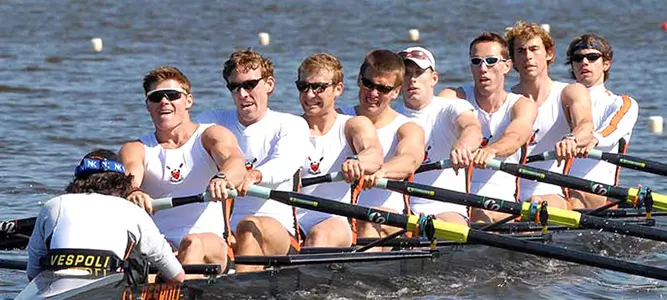
Talent, Chemistry & Respect Brought '06 Tiger Heavies Eastern Sprints Gold
May 12, 2016 | Heavyweight Rowing
GoPrincetonTigers.com will post a preview of the 2016 Eastern Sprints on Friday. This is a look back on one of the great Princeton heavyweight boats in history, the 2006 Eastern Sprints champion on its 10th anniversary.
The 2006 Eastern Sprints champion varsity crew was (c) James Egan, (s) Sam Loch, (7) Steve Coppola, (6) Will England, (5) Alex Hearne, (4) Glenn Ochal, (3) Bill Mongan, (2) Mike Gottlieb, and (b) Pier DeRoo.
They were five seconds of their lives nearly 10 full years ago, and both Steve Coppola and Bill Mongan remember them fondly.
Think about that. There are probably five seconds of your morning you can't fully remember. These were from a decade ago.
But those were the five seconds when their coxswain — their captain, their friend — that they were about to make a four-year dream come true.
“In two minutes,” Coppola remembers Egan saying, “you'll be Eastern Sprints champions.”
He was right. One of the great boats in program history would become the fifth Princeton heavyweight crew to win Sprints. The journey to that finish line — one that lasted far longer than those dominant 2,000 meters — was a testament to talent, togetherness, resilience and dedication.
Most members of that boat started to get a sense of their potential as freshmen. And it wasn't just on Saturdays, when they were beating everybody on their way to a national championship and a Henley Royal Regatta win.
There were the midweek races with the varsity boats, when those freshmen were winning time and again. There was a race on the Schuylkill that fall, when they left Navy so quickly that they didn't see another boat the rest of the race.
Coppola recalled his freshman four winning the Head of the Charles by at least a minute over every other boat. The crew left first, followed by the Gunnery School; by the time Princeton rounded Magazine Beach, the separation was clear and the announcer took notice. The finish line was quiet when Princeton crossed, almost as if they started too soon and nobody was prepared for it.
They just started to figure out that there was something special going on, and their freshman coach did as well.
“They were a very strong freshman crew,” said Greg Hughes, the current head coach of the Tiger heavyweights. “They were undefeated and won the national championship. Not many crews were doing that. It was a remarkable performance and effort from those guys. It was a good beginning, but they had to work hard.”
A handful of those freshmen immediately moved into the varsity boat as sophomores, where they took second at Sprints, though by a healthy margin to Harvard.
One year later, Princeton entered its Compton Cup showdown as the top-ranked boat in the country, but it left with more questions than answers. Princeton made a strong charge the rest of the way and cut heavily into that April margin during Sprints and IRAs, but the Crimson won titles.
Those races may have kept the Tigers motivated over the next eight months, but they didn't haunt them either.
“You look, you analyze, you figure out what you can change and do better,” Coppola said. “We just had to train harder, get faster.”
And so they did.
Coppola, Egan, Mongan, Sam Loch, Alex Hearne, Mike Gottlieb, and Pier DeRoo were the senior members of the 2006 Princeton heavyweights. Over their first three years — not all of which were spent in the same crew — they developed more than just boat chemistry.
“What developed over the years was respect for each person's process,” Coppola said. “There were no judgments. You went about your process and did what you needed to do. What developed over four years was a trust and a respect that everybody else in the boat, especially the seniors, wanted to win as much as you did. You were able to look past people's differences. On race days, there was trust they would go to the well as far you would.”
Several of the guys lived together, but they each had their own individual lives as well. There was friendship — there still is, at Reunions, weddings, races — but that respect meant everything. Sure, maybe most guys couldn't warm up for practice like Mongan, with a few claps of his hands, a couple snaps of the fingers. Everybody didn't need to throw up before racing, but Hearne did. So be it.
When it came time to race, they were of a single mind, a single speed.
And it was fast.

Princeton opened the 2006 season with comfortable wins in the Logg Cup and Childs Cup regatta, and then they packed their bags for a trip to the Charles River, where no Tiger varsity boat had won since the Eisenhower Administration.
It was Harvard who had kept Princeton from a Sprints gold, an Ivy League title, an IRA national championship. It was Harvard that loomed as the last obstacle for this crew. It was Harvard that kept the afore-mentioned seven seniors, as well as junior Will England and sophomore Glenn Ochal, motivated through the darkest, coldest hours of the winter.
“That's your chip from last year,” Coppola said. “That's what lingered. They were the champions from the year before. That was the team we needed to beat.”
Though the biggest race was still to come, the Tigers took a giant step on the Charles River April 14, 2006, when they topped the Crimson by about 3.25 seconds to win the Compton Cup. The win came months after Princeton had become the first collegiate crew to win the Head of the Charles in 23 years, so it had made the Charles River its second home that year.
A month — and four victories — later, they would try to make another Massachusetts course their own.
There were two men who led this talent-loaded boat, a task that can't be overstated. The first was head coach Curtis Jordan, a man who holds the program record with 129 wins and who had led Princeton to each of its prior Sprints titles.
Some of those wins took maximum coaching from the man who currently serves as the USRowing Director of High Performance. In 2006, less was more.
“When we were freshmen, Greg was willing us to go beyond what we thought we were capable of,” Coppola said. “Curtis was there to guide us, but he allowed us to take ownership. You have to decide. If you want to be a champion, here is how you do it. If you just want to be a good boat, this is what you need to do. He put it on our shoulders, and that requires a mature crew.”
Their leader in the boat was Egan, the three-year varsity coxswain whose influence over the team was summed up perfectly in this paragraph from a 2006 piece in the Princeton Alumni Weekly by David Baumgarten '06:
James Egan, the Tigers' coxswain, has long been the class's unquestioned leader, steering the freshman boat and moving into the top varsity boat as a sophomore. His election as the crew's captain this year was the perfect choice, Jordan says with a smile, if for no other reason than his ability to “diffuse the big guys' egos.” The six “big guys” playfully interrupted and ribbed each other when talking to a reporter after their victory over Penn and Columbia, but once Egan arrived, they fell silent and listened as their leader — who resembles the fictional hobbit Frodo Baggins among the trees — did the talking.
Egan was happy to lead, but he didn't consider ego-diffusing a major part of his job.
“It was just a really great group of guys,” he said. “There was never too much ego or second guessing of training or lineup or any of those other things that can distract a crew. We were all great friends and still are. Everyone was just very committed to the goal of being the fastest boat in the country.”
Both would be called on to play their part on May 21, 2006.
Forget those final two minutes on Lake Quinsigamond for just a minute. We'll get there.
Mongan, who sensed a special season was coming and decided to take notes following each race, has distinct memories of his opening heat, when Princeton overcame a very early deficit to grab about a length on both Yale and Syracuse at the 1,000-meter mark. It seemed all clear, as Yale and Syracuse were left to battle for the last spot in the grand final.
That is, until their battle started getting dangerously close to Princeton's boat.
“They moved into our stern, into the middle of our boat,” Mongan remembers. “Those last 10 strokes, it got a little frantic. Another 20 meters, we could have been the first crew to win the petite final by 30 seconds.”
Mongan rowed in the 4 seat, so he had a different view on the proceedings than Coppola, who rowed in the 7. Coppola didn't have any memories of tension in the heat. His tense memories came in the lead-up to the final — at least, in what he thought was the lead-up to the final.
In reality, it was the lead-up to a trip to a local convenience store.

The skies opened up in Worcester that afternoon, which cleared all boats from Lake Quinsigamond. Coppola admitted to feeling some tension before they were called off — and why not, since this was the final shot for he and six classmates to become Eastern champion.
What happened next had no time attached to it, no medal awarded for it, but both Coppola and Mongan remembered it vividly. They went to a convenience store, and the guys laughed about a trip to Redwood Shores, when Jordan also took them to a convenience store and told them that they weren't in Princeton anymore, and they needed to behave like normal people. As the humor came, the tension left.
This was no longer a senior-laden boat with a final shot at a four-year goal.
This was now just a bunch of buddies ready to row fast.
“We were pretty locked in,” Mongan said.
We'll let Mongan take over from here:
When we got on the water, because of the storm, it was dead flat. The race started, and we found our start for the first time that season. Holy (bleep) did we find it. We went off at about a 48. I think Yale was the only crew remotely close to us, and we started taking seats right away.
We made our move at around 1:45 of the race, and we took it on the only two boats we could see, Brown and Harvard. It was a great move, like we had the capability to make. We broke those two crews in the second 500, picked up a couple more seats after the 1000, and I think I was smiling the final 500.
You don't usually get that many strokes where you know, but we had about three minutes to go, we were a length clear, had a ton in the tank, and none of them were catching us. James coxed an amazing piece. He knew what we had, and what speed was left. That last 500 you could start to hear everybody on the beach.
“I remember really clearly, James making the call,” Coppola said. “In two minutes, you'll be Eastern Sprints champions.”
Princeton won its fifth Sprints title, and its first since 2001, in 5:41.59. Harvard finished in 5:44.03, while Brown rounded out the medal stand in 5:46.24. It may have been the expected ending to the season, but it didn't make it any less joyous for that boat.
“They stuck to their plans, kept working hard and they never gave up on it,” Hughes said. “They made it happen. It's a good lesson in the sport of rowing. You can have a strong boat, but that's just one element. Those guys did a great job. It took a couple of years, but they got it done.”
There is just something special about the Princeton 6s. Several members of the Class of 1986 were part of the 1985 crew that became the Tigers' first IRA national champion. The 1996 boat beat Washington by just over a second to win IRAs. The 2006 Tigers won the Head of the Charles, Sprints and, eventually, Henley.
They would love nothing more than to welcome another special group into their Reunions Tour of Champions.
“I would love those guys to have a great performance at Sprints,” Mongan said.
“We were all thrilled to see what the heavyweights have done in the last two years versus Harvard, especially winning again up in Boston,” Egan added.
Whatever happens this Sunday, it will provide this group another opportunity to reminisce on their own journey — one over four years, one over 2,000 meters, both of which ended in gold medals and lifelong friendships.
by Craig Sachson