


Princeton University Athletics
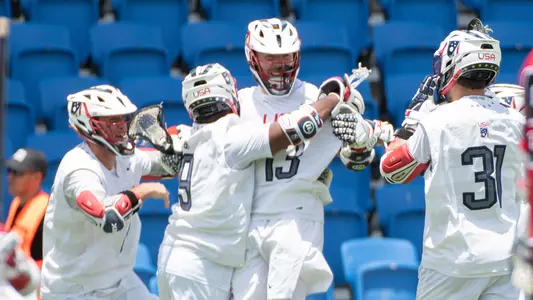
Tom Schreiber celebrates his goal with one second left that gave the US the World Championship in Netanya, Israel (photo by Adam Scott/US Lacrosse).
Photo by: Beverly Schaefer
Schreiber's Goal With One Second Left Gives USA Gold
July 21, 2018 | Men's Lacrosse
In a wildly fierce game that featured most of the top lacrosse players in the world, the one who might be the best of all of them was the one who made the difference.
Tom Schreiber, the 2014 Princeton grad, scored with one second to play to give the United States a 9-8 win over Canada in the gold medal game at the FIL World Championships Saturday morning in Netanya, Israel, in what will be remembered as one of the greatest lacrosse games ever played. Schreiber, who has been called the best player in the world by multiple lacrosse publications, had three goals and an assist in the championship game and was named the outstanding midfielder of the tournament and to the All-World team.
Canada had won the most recent World Championship, four years ago in Denver, and the defending champs would not let their title go easily. The U.S. defeated Canada 11-10 in pool play a week earlier on a goal by Paul Rabil (Johns Hopkins) with 1:10 to go, but this game was somehow even more competitive than that one.
The final was intense throughout and controversial at the end as these two rivals, who are clearly the two best teams in the world, went to the final whistle - or past it, if you asked the Canadians.
The game was tied at 6-6 entering the fourth, and, after Canada's Curtis Dickson scored a minute in, Schreiber retied it at 7-7 with 16:11 to play.
Mark Cockerton, a Virginia alum, snapped a 7-7 tie with 5:17 to play, putting the Canadians ahead by one and then setting up the first moment of controversy on the next face-off. The U.S. won the draw, but Princeton alum Zach Currier then did what he does better than anyone in the world - he caused a turnover after possession on the face-off.
With the lead and the ball and less than five minutes to go, Canada was in total control, especially considering there is no shot clock in the international game, only a stall warning that forces a team to keep the ball in the box, which is much larger than it is in the college game. Instead, Canada was called for being offsides.
Even though TV appeared to show that Canada was in fact not offsides, possession went to the U.S., who then tied it when Ryan Brown (Johns Hopkins) went low-to-high with three minutes left.
The U.S. won the next face-off and maintained possession the rest of the way, despite a wild scramble for a loose ball that started with an errant pass, including a possible loose-ball push as Currier went down that went uncalled and then a loose ball push call when Schreiber got taken down that eventually stopped the play. The Americans had three shots in the final minute that all went high, including one by Schreiber in the final 10 seconds, and that's where the clock came into play.
There were separate clocks in Netanya Stadium, the unofficial scoreboard clock and the official clock at the scorer's table, kept by the box official. Apparently those two clocks were not synced, and the stadium clock didn't start for a few seconds to allow the official clock to catch up.
In the meantime, Rob Pannell (Cornell) had the ball on the restart after the Schreiber miss. Schreiber cut down the left side, caught the pass from Pannell, tip-toed around the crease and beat Canada's All-World goalie Dillon Ward as the clock showed one second. His goal gave the United States the lead for the first time since it was 2-1 midway through the first quarter.
Canada protested wildly, arguing that it was after time expired, but the officials conferred and said that Schreiber's goal stood.
"The fact that this game had to literally go to the last second speaks to the competition between the two teams," Schreiber said. "I have a ton of respect for those guys on the other side. I'm teammates with a few of them. In the indoor league I've gotten to know them. I know how competitive they are. In some ways it's a shame the game had to end that way...but we'll certainly take it."
Currier finished with five ground balls for Canada, as well as impressive one-on-one defense on some of the best U.S. offensive players.
Schreiber finished the seven-game tournament with 13 goals and eight assists.
The game was played at 10 am Israel time, which was 3 am Eastern time.
Tom Schreiber, the 2014 Princeton grad, scored with one second to play to give the United States a 9-8 win over Canada in the gold medal game at the FIL World Championships Saturday morning in Netanya, Israel, in what will be remembered as one of the greatest lacrosse games ever played. Schreiber, who has been called the best player in the world by multiple lacrosse publications, had three goals and an assist in the championship game and was named the outstanding midfielder of the tournament and to the All-World team.
TOM SCHREIBER IS CAPTAIN AMERICA! ????
— US Lacrosse Magazine (@USLacrosseMag) July 21, 2018
Another look at the game-winner that clinched a GOLD MEDAL ?? for @USAMLax. Good morning everyone, good morning indeed. pic.twitter.com/EaWFbae5VQ
Canada had won the most recent World Championship, four years ago in Denver, and the defending champs would not let their title go easily. The U.S. defeated Canada 11-10 in pool play a week earlier on a goal by Paul Rabil (Johns Hopkins) with 1:10 to go, but this game was somehow even more competitive than that one.
The final was intense throughout and controversial at the end as these two rivals, who are clearly the two best teams in the world, went to the final whistle - or past it, if you asked the Canadians.
The game was tied at 6-6 entering the fourth, and, after Canada's Curtis Dickson scored a minute in, Schreiber retied it at 7-7 with 16:11 to play.
Mark Cockerton, a Virginia alum, snapped a 7-7 tie with 5:17 to play, putting the Canadians ahead by one and then setting up the first moment of controversy on the next face-off. The U.S. won the draw, but Princeton alum Zach Currier then did what he does better than anyone in the world - he caused a turnover after possession on the face-off.
With the lead and the ball and less than five minutes to go, Canada was in total control, especially considering there is no shot clock in the international game, only a stall warning that forces a team to keep the ball in the box, which is much larger than it is in the college game. Instead, Canada was called for being offsides.
Even though TV appeared to show that Canada was in fact not offsides, possession went to the U.S., who then tied it when Ryan Brown (Johns Hopkins) went low-to-high with three minutes left.
The U.S. won the next face-off and maintained possession the rest of the way, despite a wild scramble for a loose ball that started with an errant pass, including a possible loose-ball push as Currier went down that went uncalled and then a loose ball push call when Schreiber got taken down that eventually stopped the play. The Americans had three shots in the final minute that all went high, including one by Schreiber in the final 10 seconds, and that's where the clock came into play.
There were separate clocks in Netanya Stadium, the unofficial scoreboard clock and the official clock at the scorer's table, kept by the box official. Apparently those two clocks were not synced, and the stadium clock didn't start for a few seconds to allow the official clock to catch up.
In the meantime, Rob Pannell (Cornell) had the ball on the restart after the Schreiber miss. Schreiber cut down the left side, caught the pass from Pannell, tip-toed around the crease and beat Canada's All-World goalie Dillon Ward as the clock showed one second. His goal gave the United States the lead for the first time since it was 2-1 midway through the first quarter.
Canada protested wildly, arguing that it was after time expired, but the officials conferred and said that Schreiber's goal stood.
"The fact that this game had to literally go to the last second speaks to the competition between the two teams," Schreiber said. "I have a ton of respect for those guys on the other side. I'm teammates with a few of them. In the indoor league I've gotten to know them. I know how competitive they are. In some ways it's a shame the game had to end that way...but we'll certainly take it."
Currier finished with five ground balls for Canada, as well as impressive one-on-one defense on some of the best U.S. offensive players.
Schreiber finished the seven-game tournament with 13 goals and eight assists.
The game was played at 10 am Israel time, which was 3 am Eastern time.

Players Mentioned

Midfield
/ Men's LacrosseTuesday, June 02
Sunday, May 10
Friday, May 08
Friday, April 17