.png&width=24&type=webp)


Princeton University Athletics
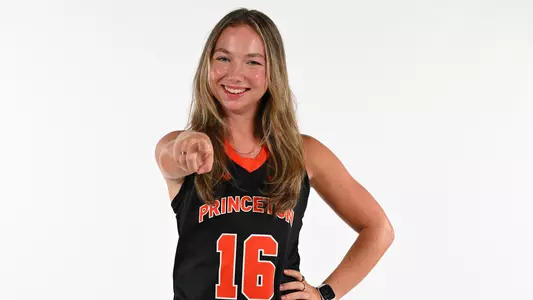
Ella Cashman Feature Story: How In The World Did She Do That?
September 10, 2026 | Field Hockey
Look at your pinky. Go ahead. Got it? Now imagine about three-quarters of its length and width, and what you’re left with is a pretty accurate approximation of a masterful, and infamous, internal body cabling.
When it works as designed, all your systems are go. Run. Jump. Plant. Hop. Do whatever you need to do. The strength of the cable far exceeds its size.
Ah, but there are limits, and when pushed to its breaking point, well, that’s another story. That’s when you hear the dreaded “POP,” a nasty sound that tells you your cable has snapped — and that at least nine months figure to pass before it’s fully back in working order.
This cable is, of course, the anterior cruciate ligament. Despite its small size, this fibrous tissue has the difficult job of connecting the two largest bones in the human body, the femur and the tibia. Those two meet at the knee, and it is the responsibility of the ACL to allow them to work together. It can usually survive immense strain, until it doesn’t. POP. For an athlete, that sound and the immediate realization of what it means — surgery, rehab, learning to trust that pesky cable all over again — often hurts more than the injury itself.

Karen Shelton Stadium, the home field for the University of North Carolina’s field hockey team, is an unlikely place for this Princeton story of toughness and determination. Princeton field hockey has never won here, with its most recent trip also its most frustrating, a 1-0 shootout loss this past Sunday after 75 minutes scoreless minutes. At one point in the second half, Princeton senior Ella Cashman got walloped in the face, drawing blood. She would return to the game in almost no time. When she arrived back on campus, she went straight to urgent care, where the wound would require nine stitches.
Pardon the syntax, but, as is said, when it comes to Ella Cashman, “that ain’t nothing.” A huge part of her story takes place on this field; almost none of it is about those nine stitches.
I will get back to Shelton Stadium in a second. First, the story takes us to the London suburb of Surbiton, Ella Cashman’s hometown. As quaint English villages go, Surbiton fits all the criteria: a high street called Victoria Road, a clocktower built in 1902 to commemorate the coronation of King Edward VII, a railroad station that can get you to Waterloo Station in London in less than 20 minutes. The town is part of the Royal Borough of Kingston upon Thames; if that doesn’t scream “England,” what does? Ella’s father Tony recently retired after 42 years as a London subway conductor, a “tube drive,” she calls him. Her mother Hayley has also spent her career working for the railroads.
“Surbiton is very quaint,” Ella says. “It’s very peaceful. Growing up there, we had so many nice people, lots of parks, the river, shops — and a super good hockey club. Sport was my thing. Not music or anything like that.”
Hayley had played field hockey when she was younger, and she encouraged Ella to try it when she was 10, after her introduction to athletics had come through another English staple, netball. Ella took to the sport quickly, as much for the love of the game as for her success as a player.
“I was never a standout,” she says. “I was never the best. I just enjoyed being part of a team, and I still do. I saw everyone join the English national system. I just played because I loved it, whatever level I was on. When I’m on the pitch, I don’t have to think about anything else. It’s a really cool experience.”
Her path to the English system was curtailed by the POP she heard when she was 16, on a non-contact injury to her left knee while playing field hockey. She didn’t think she’d done much damage, and the original assessment was to rest it for two weeks, but her coach wouldn’t let her come back without an MRI. Diagnosis? Torn ACL. Recovery time? Nearly nine months.
“The POP,” she says. “It’s not a good sound.”
Her fear was as much about her future as the present. Her goal was to be recruited to play college field hockey in the United States, something that she feared might be over before it began.
“I figured I’d have to take a gap year,” she says. “I hadn’t spoken to many schools at all. I spoke to Dina [associate head coach Dina Rizzo] and said I’d be happy to take a gap year. She said they had a need to fill the class and I was like “it’s Princeton. Who says no to Princeton?”
As it turned out, her first time in the United States was when she came to Princeton as a freshman, with no idea what to expect and no sense of where she’d fit in on, as she says, the pitch. It turns out she fit in just nicely. She started every game as a freshman, earning second-team All-Ivy honors. As a sophomore, she improved to first-team All-Ivy as Princeton won the league championship and reached the NCAA quarterfinals. She was a second-team All-American and first-team All-Ivy pick last year as the Tigers made it all the way to the second overtime of the NCAA championship game before falling 2-1 to Northwestern.
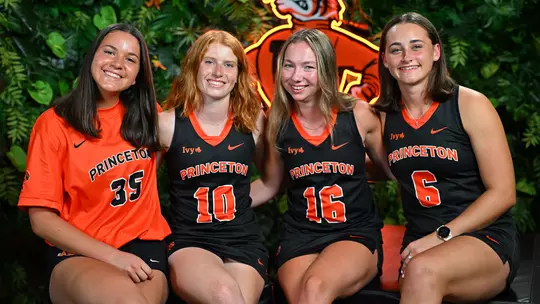
There are very few athletes whose on-field ferocity and off-field kindness are as far removed from each other as Cashman’s. She has a cherubic face, an easy smile and a calm voice that is even more so given her English accent. Away from the pitch, she is a bit of a Pied Piper to her teammates, something that makes sense given that this is her second season as a captain. If she’s fierce about anything away from the game, it’s the loyalty she has to the program and her teammates.
When she steps on the field, though, she toggles to her other side, the one that pushes back when pushed, the one that only has one gear, the one that has no quit in it. There is no questioning her toughness. And now our story can take us back to Karen Shelton Stadium.
Princeton practiced there on the day before its season opener, a 4-0 win over Old Dominion last Friday on the first day of the Conference Crossover. The Tigers had spent more than eight hours in Newark Airport waiting on a delayed flight and then took a bus directly to UNC.
As practice began, I was sitting pretty much alone on the bench on the far side of the field. Looking across the field I could see the Carolina blue stands and beyond that the baseball stadium. Looking to my left I see Ella Cashman. She is going through a usual practice, moving full speed at all times, encouraging, pushing, just being the one they call “Cash.” It took me back to the last time Princeton practiced there. It was a much different experience for her.
The NCAA Final Four last year was held at Duke, which is a short drive from Chapel Hill. Princeton had one practice on this field where Cashman was now moving without hesitation, her knees devoid of any sort of brace or wrap. That was hardly the case last time.
Cashman had started every game of her career through last year’s Ivy League tournament, which Princeton won by defeating its rival Harvard 2-1 in the final. Somewhere in the middle of the second half, guess what sound Cashman heard? POP. This time it was her right knee.
“Heard it again,” she says. “It was like the first time. I didn’t think I’d torn it this time either.”
The Surbiton in her comes out as she says that. She pronounces that last word “EYE-ther.”
“I mean, I guess part of me knew, but a bigger part of me hoped that I hadn’t.”
The first order of business was closing out the game, something she helped do after sitting out for maybe two or three minutes. There she was, back on the pitch, back where she didn’t have to think of anything else. It wasn’t until after the game that she had to face reality. She had an MRI the next day after returning to Princeton. Diagnosis? Another torn ACL, this time on her other knee. The Ivy League tournament final was played on a Sunday. The NCAA tournament began five days later, at home against Fairfield. That’s less than a week later. The Final Four would be the following weekend. From the time of the injury until the NCAA final, there were just 15 days.
“My first thought was that I still wanted to play,” she says, laughing and smiling. “Part of me thought that I’d just finished the game and felt fine. I thought there was nothing left to hurt. I knew I’d need surgery either way. This was the NCAA tournament. This was the Final Four and the championship. I got a lot of advice about if I could do it. I got a lot of mixed advice.”
Her doctors advised her not to try. Her parents were split. Her coach, Carla Tagliente, tried to be objective about it.
“Some people said I was stupid to try,” Cashman says. “There was the risk of doing additional damage to the knee that could have delayed my timeline back. It might have pushed me all the way out of this season if it took a year. That was the risk. Carla told me that if it had been her son or daughter, she’d tell them not to play. She also said even with that, she’d probably do it if she had been in the same situation.”
“Yeah, I did say that,” Tagliente says. “She saw her MRI result and you could see the drain and the sadness,” Tagliente says. “My reaction was that I was sick to my stomach. For me, my first thought was denial. It can’t be a torn ACL. She went back in the game and played eight more minutes. I’d never seen anyone come back into a game after tearing their ACL. You look for things that conform to what you want to believe.”
Cashman was immediately ruled out for the first weekend. Could she play if Princeton made it to the Final Four?
“I think she proved pretty quickly that she would do whatever it took to give her the best chance at playing in the Final Four,” says Jade Hennessy, who was the team’s athletic trainer a year ago but has since left Princeton. “So yes, I did think she had a chance.”
The Tigers rolled past Fairfield in the first round and got a late goal to beat Syracuse in the quarterfinals. Cashman watched both from the sideline, something that hurt as much as her knee.
“It was frustrating to watch first two rounds,” Cashman says. “I was so proud of everyone else though. We are one big team. Everyone is important. We all have a role to play on and off the field. My role changed but the team was so special and so awesome. I knew they could do it. I was just very proud of them.”
While the team prepared for Fairfield and Syracuse, Cashman and Hennessy worked overtime to give the player even a chance to play. One factor working in their favor was their familiarity with each other. Another was Hennessy herself. She is encouraging but honest, with no false promises but no negativity either. Even if the odds were long, she was willing to do whatever it would take to help Cashman get there.
“Jade was so supportive and willing to try with me,” Cashman says. “Obviously as an athletic trainer she knew the risks, but she’s such a calm person that she was able to talk me through everything. I spoke with her the most.
Hennessy and the medical team would be the ones to clear her. Tagliente would be the one to put her on the field.
“I never thought she could play,” Tagliente says. “She said she’d try, and I think I said that I didn’t think it was possible. She didn’t have seven or eight weeks to rehab. She had a few days. She got the idea in her head that she could do it though, and she wouldn’t drop it. The doctors said she couldn’t play that first weekend but that they’d revisit it if we won. And we won. And when we did, you could just see her brimming. There was something in her eyes. For me, though, I didn’t want to put her out there and have her blow everything out. I really didn’t want to see that.”
And so after barely more than a week of rehab, Princeton bused to North Carolina. Cashman’s status, on the other hand, was still up in the air.
“It was a huge opportunity, and we wanted her to have every chance at it, as long as she did it as safely as possible and passed all of the functional testing,” Hennessy says. “She knew she had to be at a certain level to be cleared to try, and she was able to get there through her hard work. She wasn’t going to miss out on this.”
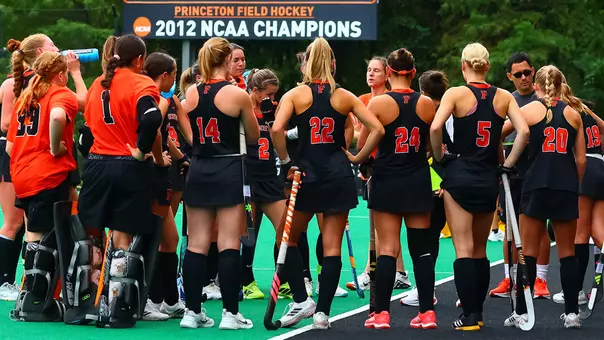
And so it was at that practice at Karen Shelton Stadium last November that Cashman, wearing a massive black brace on her injured knee, was off to the side with Hennessy while her teammates went through preparations to play, of all teams, Harvard in the semifinals. Eventually she was able to join in the team drills.
“That practice at UNC was the first time she was with the whole team,” Tagliente says. “I figured she was just going to blow it all out right there and then.”
She didn’t.
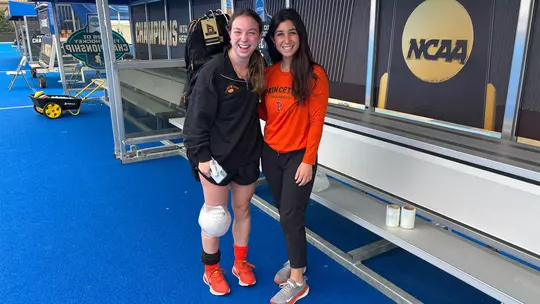
If you ever spend any time around the Princeton field hockey team, you’ll quickly realize that there’s one voice that rises above all others. You can be completely on the other side of the field, or you could be outside the team room when everyone else is inside. There is one voice you can’t miss. It is loud and it is usually a cross between upbeat banter and outright laughter. It belongs to senior goalie Olivia Caponiti, also one of the Tiger captains this season.
“Liv was born laughing,” Cashman says. “She’s spent her whole life laughing.”
Caponiti is part of the POP club, having torn her ACL during her sophomore lacrosse season in high school. The injury kept her out for all of her junior field hockey season.
“I would never have dreamed of playing two weeks after the injury,” she says.
I’m talking to Caponiti, something I’ve done dozens of times during her years at Princeton. It takes me a few seconds to figure out what is different during this conversation. Then it hits me. She’s not laughing. She’s deadly serious. I can’t remember seeing her like this before.
“When we first found out that she’d torn her ACL, of course everyone was upset and devastated for her,” Caponiti says. She isn’t smiling. She is giving deep thought to each answer. “She just set the goal that she wanted to play in the Final Four. That was a dream of hers. She worked so hard to get there. It’s pretty amazing considering the circumstances.”
Once she was cleared to play, there was the other matter of what to do with her. Tabby Vaughan, her replacement in the starting lineup, was playing well. This was the Final Four. If you put her in, could she possibly be the Cashman of usual? What percentage would she be?
“I think it was something I had to put to the side when I got back on the field,” she says. “I had to focus on the here and now. Whenever I play, that’s what I do. Where are my feet right now? Forget the last play. Forget what’s happened. Forget what’s coming later. Just focus on that play.”
It was nearly 11 minutes into the semifinal when she first went onto the field. Like everyone else, I wasn’t sure what to expect. Also like everyone else, I was amazed that she had gotten this far in the first place. This was 12 days after the ACL tear, and now she was out on the field? Playing with these stakes?
“I think everyone felt a sense that she was doing it for something bigger than just herself,” Caponiti says. “It was so inspirational for the team. She cares so much about us and supporting us, and she was willing to do something that was objectively scary and might have put her in more harm. She cared more about leading than about herself.”
She played a little less than half of both games. There was one thing she couldn’t do, and that was to play in the 7-v-7 overtimes in the final.
“What does this say about her?” Hennessy says. “It says she is incredibly hard working, passionate and brave. When she wants something, she’ll set her mind to it and she’ll meet every obstacle with determination and excitement rather than fear. It’s the first time I’ve ever seen anyone do that.”
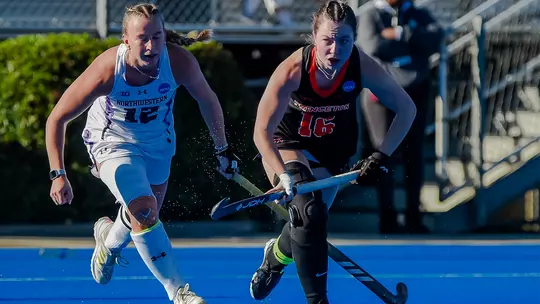
The championship game loss still stings, but getting there was an amazing accomplishment in its own right. And Cashman? She played, and made a serious contribution, in two games two weeks after an ACL tear.
Of course, that’s not the end of the story. There was a long way to go from the Final Four to the return to Karen Shelton Stadium. Cashman would have surgery on her knee on Dec. 4, exactly nine months to the day from the Princeton-ODU season opener. Caponiti is the one who drove her back to campus after the operation.
Not everyone makes it all the way back in nine months, and that doesn’t count what Cashman went through before the surgery. She was in the training room the day after the surgery. She flew home for Christmas two weeks later — “I had an aisle seat and it was awful.”
She began with very simple exercises in January, doing them three times a day and icing her knee as much as possible. She would first relearn to walk and then eventually run and jump. She first was able to put full pressure on the rebuilt ACL — the cable — in March. She did skip the spring scrimmages, though you’ll never convince me that she didn’t at least want to give them a try.
“Cash is the hardest working, dedicated and selfless person that I know,” Caponiti says. “She cares so much about every person on the team and puts 100 percent into everything she does, on and off the field. She’s also the kindest and most genuine person and an amazing leader by example.”
“She’s so resilient,” Tagliente says. “The sport means so much to her. You can see the pride she takes in the program and in her own growth. What she’s done is so special.”
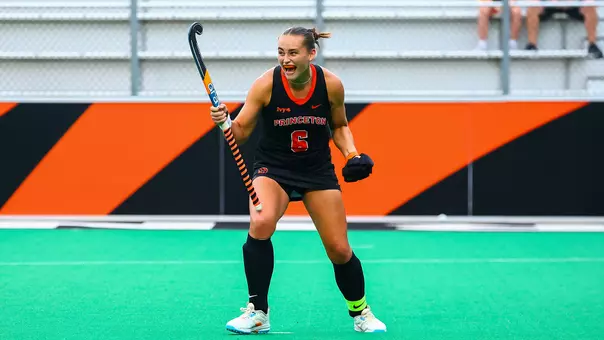
And there she was, back in the starting lineup against ODU and North Carolina. And she’ll be there Friday afternoon at 5 against Rutgers in the home opener on Bedford Field.
Maybe I was the only one who was struck by the juxtaposition of her two most recent visits to this field in Chapel Hill, but I found it fascinating. I remembered the bulky knee brace. I remembered the practice where maybe everyone was expecting the worst. I remembered watching her in the two Final Four games and marveling at what she accomplished.
Her story leaves me with one remaining question, one that none of the people I spoke with could really answer. If Ella Cashman could do this, why can almost nobody else?
“She’s one of the toughest people I know,” Hennessy says, echoing what Caponiti and Tagliente think. And what I think as well. There has to be more to it than that, though. I don’t have that answer.
I just know that as I watched her play last weekend, all I could think was this: How in the world did she do that?
— by Jerry Price