


.png&width=24&type=webp)


Princeton University Athletics
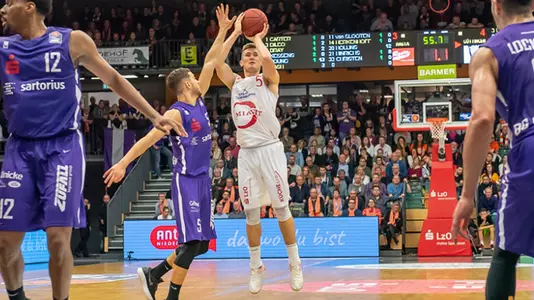
Photo by: Christian Becker / pfbecker.de
January 15, 2019 | Men's Basketball
T.J. Bray '14 is among Princeton's career 1,000-point scorers, graduated third in program history in career assists with 374, is the only player in program history with three 100-assist seasons, set the program record for assists in a game with 13, stands sixth in steals in program history at 150, and was a two-time All-Ivy League honoree. Here, he shares his thoughts on how Princeton has impacted his professional career. Thanks to Christian Becker Photography for the photos.
Since you've been playing professionally for several years now, what advice do you have for the recent and future Tigers to go pro about transitioning to life post-college?
There is so much more free time in your life when you're a professional. Basketball is definitely a 24/7 obligation, but that doesn't mean you're always at the gym. Most days you only have three or four hours total at the gym so it's up to you to figure out how you're going to use the rest of the day. I've found that Netflix and video games can only pique my interest for so long. Finding hobbies off the court is very important in staying busy and keeping the time moving. With all that free time though, things aren't the same as they are in college. When you're getting paid to be a professional, you have to be professional at all times. The whole city knows who you are so you can't be going out all the time or putting yourself in situations that will make the club look bad. You're on the clock as a representative of both the club and yourself at all times. This means you're held to a very high standard. It's even more true when things aren't going great on the court.

Having played in a few different countries, have you been able to pick up some of your home country's language?
I've put more effort into learning the language in some places compared to others. In Greece and Belgium, I didn't put a ton of effort in because most of both countries are very fluent in English. In Greece, tourism is such a big driver of the economy that everyone has to know English for most jobs. In Belgium, there are actually two languages within the country, French in the south and Dutch in the north. This leads to everyone learning English well and speaking that with people from the other side.
Being in Italy for two years, I picked up a decent amount of the language. While English is the language of European basketball, my first coach preferred to speak Italian so I picked up a lot from him. I was also in smaller towns in Italy so English wasn't as prevalent.
This year in Germany there's actually a clause in my contract that I have to take a weekly German class. The clause is in every player's contract in the league. I've tried to put some work in on my own time as well. Currently, I've got ordering at restaurants down pat and not much more. We'll see where I end up by the time the season ends.

What did you learn at Princeton that has helped you as a pro, both basketball-wise and not?
Princeton taught me a ton both on and off the court. I'm positive I would not still be playing basketball had I not played at Princeton. The coaching staff was so great for my development as a player and never tried to make me play a style that didn't fit me. The Princeton offense is a very valuable resource in European basketball. Being able to read situations and adjust on the fly is not something that every program teaches their players. That becomes second nature at Princeton. Working on all phases of skill development was also imperative for me to be the pro I am today. The coaching staff teaches every player every skill which gives us a ton of versatility as pros.
Off the court, Princeton taught me to learn and adapt as much as I can. Playing in four different countries, I've had to adapt to many different cultural norms and intricacies. Different little things surprised me my first few years as a pro. Now, I look to seek out cultural differences and learn about why things are the way they are. I've learned the most by finding the grocery stores closed on random days and having to google what national holiday is being celebrated.
Since you've been playing professionally for several years now, what advice do you have for the recent and future Tigers to go pro about transitioning to life post-college?
There is so much more free time in your life when you're a professional. Basketball is definitely a 24/7 obligation, but that doesn't mean you're always at the gym. Most days you only have three or four hours total at the gym so it's up to you to figure out how you're going to use the rest of the day. I've found that Netflix and video games can only pique my interest for so long. Finding hobbies off the court is very important in staying busy and keeping the time moving. With all that free time though, things aren't the same as they are in college. When you're getting paid to be a professional, you have to be professional at all times. The whole city knows who you are so you can't be going out all the time or putting yourself in situations that will make the club look bad. You're on the clock as a representative of both the club and yourself at all times. This means you're held to a very high standard. It's even more true when things aren't going great on the court.
Having played in a few different countries, have you been able to pick up some of your home country's language?
I've put more effort into learning the language in some places compared to others. In Greece and Belgium, I didn't put a ton of effort in because most of both countries are very fluent in English. In Greece, tourism is such a big driver of the economy that everyone has to know English for most jobs. In Belgium, there are actually two languages within the country, French in the south and Dutch in the north. This leads to everyone learning English well and speaking that with people from the other side.
Being in Italy for two years, I picked up a decent amount of the language. While English is the language of European basketball, my first coach preferred to speak Italian so I picked up a lot from him. I was also in smaller towns in Italy so English wasn't as prevalent.
This year in Germany there's actually a clause in my contract that I have to take a weekly German class. The clause is in every player's contract in the league. I've tried to put some work in on my own time as well. Currently, I've got ordering at restaurants down pat and not much more. We'll see where I end up by the time the season ends.
What did you learn at Princeton that has helped you as a pro, both basketball-wise and not?
Princeton taught me a ton both on and off the court. I'm positive I would not still be playing basketball had I not played at Princeton. The coaching staff was so great for my development as a player and never tried to make me play a style that didn't fit me. The Princeton offense is a very valuable resource in European basketball. Being able to read situations and adjust on the fly is not something that every program teaches their players. That becomes second nature at Princeton. Working on all phases of skill development was also imperative for me to be the pro I am today. The coaching staff teaches every player every skill which gives us a ton of versatility as pros.
Off the court, Princeton taught me to learn and adapt as much as I can. Playing in four different countries, I've had to adapt to many different cultural norms and intricacies. Different little things surprised me my first few years as a pro. Now, I look to seek out cultural differences and learn about why things are the way they are. I've learned the most by finding the grocery stores closed on random days and having to google what national holiday is being celebrated.


Friday, March 06
Friday, February 20
Wednesday, February 04
Tuesday, January 27