.png&width=24&type=webp)


Princeton University Athletics
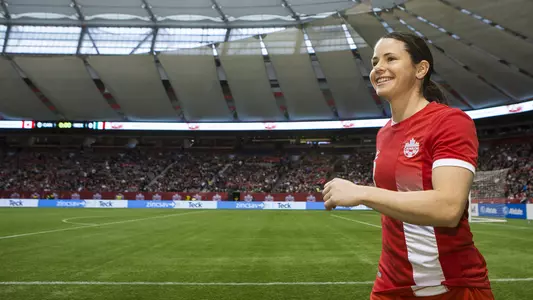
Book Excerpt - The First 50 Years Of Women's Athletics: Diana Matheson
July 21, 2021 | General, Women's Soccer
Diana Matheson says her shoes are a size 5.5. They were 4.5 when she was a Princeton student. Whatever the size, those small feet made one of the biggest plays, and probably the most-watched play, any Princeton women’s athlete has ever made, and did so on one of the biggest stages in the world.
It was in the 2012 Summer Olympic Games in London. Matheson and her Canadian teammates were a few days removed from having come excruciatingly close to knocking off the Americans to reach the gold medal game, only to fall 4-3 on a goal in the final seconds of the second overtime of stoppage time – after the Canadians had led not once, not twice, but three times. That game had been so dramatic, so compelling, so intense that one of the volunteers who was working at the postgame drug testing center, for which Matheson had been randomly selected, said that it was the best game he’d ever seen at Old Trafford, which just also happens to be the home stadium for Manchester United.
Now it was three days later, and the Canadians had gone from on the verge of playing for a gold medal to needing a win to leave London with a bronze. And that game, against France, was not going well. The Canadians clearly were physically and emotionally drained after the semifinal loss, and it was all they could do to hang with the French, who were clearly having the better of play, even though the game stayed scoreless.
Looming was the end of regulation, which would mean another thirty minutes of overtime. Up to that point, France had taken 28 shots. Canada had taken three. Nevertheless, the Canadians had defended their goal ferociously, and it was still 0-0. France had hit the crossbar and the goalpost. It had a shot get past the Canadian goalkeeper, only to have a sliding defender knock it away at the last minute. Overtime would clearly favor the French.
Diana Matheson is smiling. She is relaxed. It is nine years since her first Olympic appearance. It is seventeen years since she first arrived at Princeton as a member of the class of 2008, just in time to be the missing piece between a team that had not advanced in the NCAA tournament and a team that won four games in the postseason to reach the 2004 NCAA Final Four. She does not look one day older. When she talks about her path in soccer, she starts out with something rather obvious.
“I played a lot of hockey,” she says. “If I was small for soccer, I was really, really small for hockey.”
When you talk about Diana Matheson the athlete, there are three places to start. First, there is the obvious fact that she is short, perhaps the shortest woman ever to compete for Princeton. This is something she’s dealt with her entire athletic career, and it’s something she jokes about easily.
“There have been so many times where someone has said to me ‘oh, so-and-so is definitely shorter than you are,’” she says. “Then I meet so-and-so, and they’re not. One thing is that I have gotten comments from parents or kids. They say they admire how I play because they’re short, too.”
So that’s the first thing. The second is that, in addition to being among the shortest athletes Princeton has known, she’s also one of the fittest. She was known for her fitness back as a Princeton player, and her reputation for being fit extended into the international and professional ranks. She could simply run all day and all night and never look winded.
And third? Matheson has always possessed incredible, and innate, field vision. She sees everything, resulting in being incredibly valuable in countering or in feeding the ball into the box. No matter the situation, she would routinely play the ball to the right person in the right space at precisely the right moment.
Because of the second two, the first didn’t diminish her ability to be a major performer on the international stage.
Matheson grew up outside of Toronto, with a brother and sister who were also very athletic. She didn’t play on any of Canada’s youth national teams, a likely reason that US colleges didn’t pick her up on their radar. She did know the Willis twins, Janine and Rochelle, who were dominant Princeton defenders in the Class of 2005 and who had played in the same provincial program she had. She also knew Princeton had the academic challenge she was looking for, and so she applied, unrecruited, and was accepted. It was only afterwards that then-coach Julie Shackford saw her play for the first time, with Ottawa in the W-League, in a game against the New Jersey team that was played at Mercer County Community College.
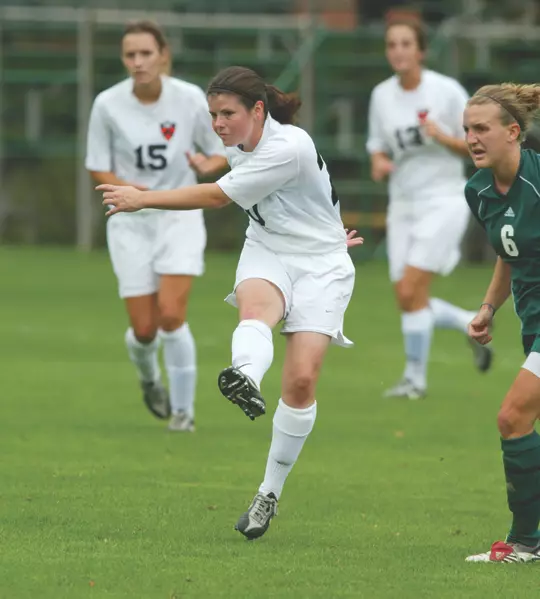
After Matheson went to the 13th grade that Canadian high schools had, she made the Canadian national team for the first time. She competed with Canada in the 2003 World Cup, which was held in the United States. Canada would finish second in its group and win two knockout stage games to reach the semifinals before losing 2-1 to Sweden and then 3-1 to the Americans in the third-place game. Following that World Cup she came to Princeton, in time for the 2004 season, which started with a Matheson goal five minutes into the season-opening win over fifth-ranked Texas A&M and ended in the Final Four.
“I don’t think I knew what to expect going into university.” she says. “The stars aligned that freshman year. We had a senior class that was incredible. They were great leaders. Every class was great. We meshed so well. We had all the right people at Princeton at the right time. I remember that preseason. I was getting to explore this beautiful campus. I loved the time with the team before classes started. That whole season was so much fun. The momentum just continued to grow. We had great crowds that year. The campus was buzzing as we went into the tournament. It was a ton of fun to play soccer. We had so many great moments. We had that crazy Harvard game where we tied it at the end and then won it in overtime. I was moving some stuff around the other day and I found a picture of the pileup after the game. That year was honestly right up there with anything I’ve ever experienced. We could have beaten anyone that year. The teams we faced in the Final Four had more experience on a big stage than our team did. We didn’t play as well that game. If we played them again or played them at home? We were as good as any team that year.”
She’d end up being a first-team All-American in 2004. She also would be a four-time first-team All-Ivy League selection and the 2007 Ivy League Player of the Year, after being the Rookie of the Year her freshman year. She would play professionally in Europe and in the NWSL, and she would return to the World Cup with Canada in 2007, 2011, and 2015.
The US-Canada semifinal game at the 2012 Olympics was played on Sunday, August 6th. Canada went up 1-0 on a goal by Christine Sinclair in the 20th minute, and it was still a 1-0 game at the half. The Americans tied it fourteen minutes into the second half, but Sinclair put Canada back on top fourteen minutes later, 2-1. That lead lasted all of two minutes before it was tied again, 2-2.
Once again Sinclair put Canada ahead, again two minutes later, making it 3-2. And, again, the US tied it, this time on a penalty kick in the 80th minute. That led to the overtimes, where Abby Wambach hit the crossbar in the 119th minute before Alex Morgan scored the game-winner in the 122nd minute, on a header after a cross into the box from Heather O’Reilly. Final score: US 4 Canada 3.
“That loss still stings Canadian soccer fans,” Matheson says. “I got drug tested after the game, and I happened to be sitting with Alex Morgan, to make it worse. For me, though, I’m grateful to have been part of a game like that. It was just a great game. It’s hard to tell when you’re in it, and it’s even harder when you lose it like that, but looking back on it, that was probably the best game I was ever a part of.”
Turning the page on that was not going to be easy. The bronze medal game was August 9th, which meant a quick turnaround and not a lot of time to recover from the physical and emotional toll the semifinal game had inflicted on the Canadians.
“We were wiped out in every way,” Matheson says. “We had two days off, and now this was going to be our seventh game. We played great against France for the first twenty minutes. Then the wheels came off. After that, we were just trying to hang on for the next seventy minutes. We really got every break you can imagine. The post. The crossbar. The defenders’ knocking everything off the line. If it had gone to overtime, we definitely would have lost. We had nothing left.”
Matheson did. She had two things left, actually. Fitness. Field vision.
The game was in stoppage time when the ball made a rare trip across midfield, onto the Canadians’ attacking side. Then it found its way to the left side, as Matheson came down the middle. The ball squirted between a Canadian foot and a French foot and found Matheson, who trapped it and found Sophie Schmidt open in front of the goal.
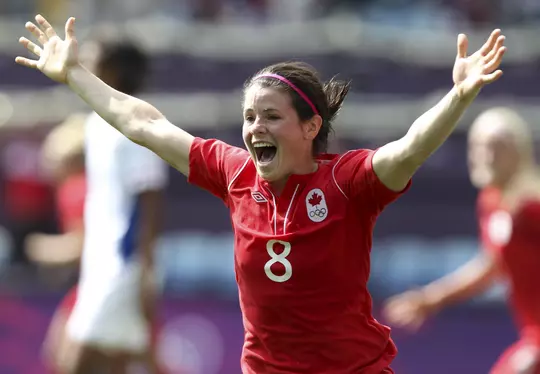
Schmidt took a shot, and the French goalkeeper dove to stop it. Instead, it hit off a French defender and rolled to Matheson, who had followed the play into the box. With an open goal to shoot into, Matheson didn’t miss, volleying it into the net and giving Canada a 1-0 win and the bronze medal.
She might have been spent, but she had enough energy left to sprint to the corner, where she was tackled by one teammate. To give a sense of just how exhausted they were, no other Canadian player was able to get to her to celebrate by that point.
“That goal was just the right place at the right time,” she says humbly. “If you look at that goal, and I’ve seen it quite a few times, we had seven players around the perimeter. Someone would have gotten it.”
Maybe. But only one player did.
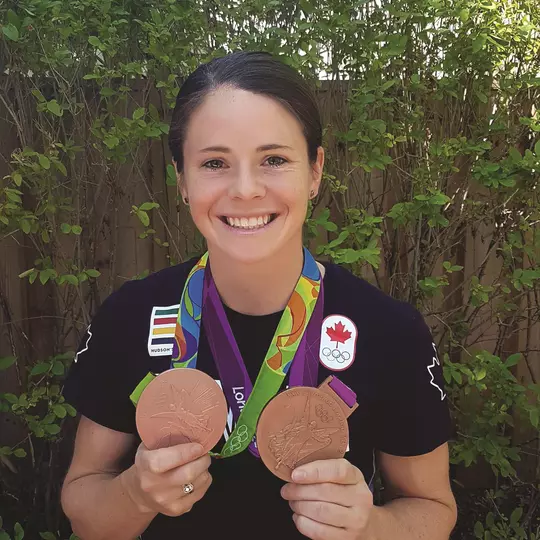
“I remember feeling incredible joy and relief that we didn’t have to play another thirty minutes,” says Matheson, who won a second bronze four years later in Rio, where Canada lost to Germany 2-0 in the semifinals, but then defeated Brazil 2-1 in the third-place game after scoring the first two and then withstanding a late Brazilian goal. But that was relatively tame compared to what happened in the London win.
“I mean, it was pure joy after that goal,” Matheson says. “I was interviewed on the field right after the game and asked about the goal, and honestly I had no idea. All I knew was that we were just so thrilled to have won. It took everything we had to make it happen, and when we did it, we were just so overcome with happiness.”
The Canadian players received their medals – the first Olympic women’s soccer medals Canada had ever won – after the game. Three days later, they received the cases to hold the medals. In between, Matheson never took hers off.
“Not even when I was sleeping,” she says.