

.png&width=24&type=webp)


Princeton University Athletics
So Far, So Good
December 16, 2002 | Men's Basketball
Dec. 16, 2002
Game Recap
Forget the shot itself for a second. There was some serious alignment of the stars for the potential of the shot to even happen.
OK, we'll back up even further for those of you who might not know which shot we're talking about. Princeton at Monmouth, Dec. 3, 2002. Score tied at 57-57, 00:00.7 remaining on the clock. Princeton ball, under its own basket. Sophomore Will Venable inbounds to junior Ed Persia, some 85 feet away from the basket.
Pivot. Fire. Bedlam. Victory.
But again, forget the shot for a second. Here's what had to happen for Persia to even have a chance to headline SportsCenter's "Plays Of The Day" (which he did).
First of all, a gutsy Princeton team, far from playing its best basketball, had to rally from double digits down at Monmouth. Accurate shooting and timely defense helped the Tigers crawl out of a hole they spent an icy stretch early in the second half digging for themselves. Down two points with less than a minute remaining, Persia took a convential three-point shot that rimmed out. In the middle of much taller traffic, 6-4 senior guard and captain Kyle Wente came flying down the lane to tip in the shot and even the score. The lane had to be there for Wente. The tip had to be perfect. The captain had to finish.
Check. Check. Check.
Monmouth could hold for a final shot, and it certainly looked like it was going to. Kevin Owens, a tough center that had given Princeton trouble throughout the game, took a shot with mere seconds remaining. It rimmed out, and Spencer Gloger tied up the rebound with a Monmouth player. If only one gets the rebound, the clock runs out. If the possession arrow is in Monmouth's favor, the Hawks get the ball back. If the clock operator allows .4 of a second to tick off the clock - less than half of a second - following the play, rules would have prohibited Princeton from scoring on anything but a tip.
Once again, check. Check. Check.
With all that out of the way, all that was left was the shot. Ho-hum.
Remember Christian Laettner's buzzer beater against Kentucky in the 1992 NCAA tournament? Plenty of the talk surrounding the play centered around two aspects: the pass and Kentucky coach Rick Pitino's decision not to guard the inbounder. Grant Hill rocketed a pass to Laettner, who was standing at the top of the key and hit the now-famous turnaround jumper.
This play was significantly different. First of all, Duke was trailing Kentucky, so overtime wasn't an option. Princeton didn't call timeout, didn't draw up a set play. It could have tried a deep pass, but there was an inherent risk to that; if the pass traveled out of bounds over the other baseline without touching anybody, Monmouth would have gotten possession under its own basket with enough time to get off a reasonable shot.
And on this night, a reasonable shot wasn't even a necessity. Any shot would do.
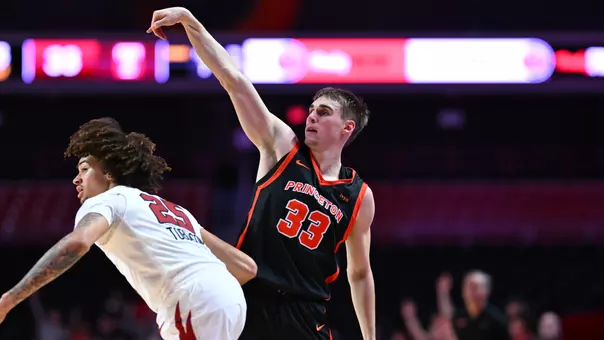
Without wanting to risk a turnover, Venable sent a simple pass to Persia, a former all-state quarterback at Beaumont High School in Texas. Persia, who might as well have been in Persia at the time, turned and fired a one-armed shot that seemed more appropriate for a third-down conversion than a three-point conversion.
Princeton head coach John Thompson was already on the court at this point, ready to rally his troops for overtime. Wente was walking off the court, but decided to take one final look.
Persia never took his eyes off the shot. When it comes from your hands, sometimes you just have that feeling.
"I knew it had a chance," he says. "You don't think a shot like that will go in, but I knew the whole time that it wasn't offline."
The ball hit the backboard, directly in the square your seventh-grade gym teacher told you to hit when you tried to make a layup. It bounced - with significant force - directly into the basket, never touching an ounce of the rim but only ripping into the nylon.
Thompson immediately started pointing towards the ground, a motion officials use to signify a basket count. His players didn't bother waiting for the referee's indication, instead storming Persia to celebrate the surreal moment.
"I couldn't believe it went in," junior teammate Spencer Gloger said. "I don't think anybody could. It was so far."
So far, so good.
* * *
The six people at the Persia household were thrilled at the prospect of going to overtime. It had been such an exciting comeback to begin with, they were ready to listen to the next five minutes of overtime on their home computer.
They wouldn't get the chance.
"I started crying," Christie Persia said after listening to Tom McCarthy's dramatic call of her son's game winner. "We all started hugging, and then the phone started ringing." The first phone call came from his brothers, who listened to the shot on their computer at the University of Mississippi. Then some of the team parents called. Eventually, the hero himself called.
Both mother and son agreed who was more excited. "She was just going nuts," Ed said.
"It took us about three days to come down from that one," she admitted.
And they thought overtime would be exciting.
* * *
Adjectives get thrown around. Most are applicable in this situation.
Unbelievable. Sure. Let's face it, if somebody told you that Princeton, the kings of the pass and cut, won on something Hollywood-esque like that, you'd probably need some evidence.
Incredible. Easy. The shot was taken from 85 feet away with .7 of a second remaining. If that isn't incredible, what is?
Unforgettable. Just ask anybody who was there. They'll never forget the night, from the moment the shot went in through the explosion of sound in Boylan Gym to the scene of the celebration.
Impossible. Wrong. It can't be impossible. These shots get made once or twice a year during promotions at NBA games. Granted, it's not a game situation, there's no defense, and they usually take three or four steps before the shot, so that's travelling. Well, it is the NBA, so maybe it wouldn't be travelling, but you get the picture.
The fact is, the shot was dramatically improbable, but not impossible. The fact is, there's quite a bit of athleticism needed to get the ball there and allow a little luck to take over. Persia had made throws like that before.
"In football, you throw it to a basic area," he says. "When I turned and saw the basket, it was just like seeing a receiver."
Touchdown.
* * *
Ever feel really prepared for class? The first 15-20 minutes of one of his precepts the next day were spent by the professor talking all about the shot. If Persia ever wanted points for class participation, this was his chance.
Then there was the library, where he heard a couple of kids next to him talking about it. They had no idea who he was. You get the feeling that didn't happen to Laettner anytime after his shot against Kentucky. Assuming he was ever in the library, of course.
Then came the emails and messages. Persia estimated hearing from about 50 people that he hadn't talked to in quite some time. SportsCenter has a way of reacquainting people.
Of course, the media wasn't finished with him. During a 20-minute span in the early evening, he spoke with reporters from both the New York Times and ESPN. Later that night, he was interviewed on the nationally syndicated "Bob Valvano Radio Show."
A couple days later, he took an elbow above the eye in practice and needed stitches.
Back to reality. Back to work.
People will still ask about it, and maybe the shot will someday be from even further back.
But maybe not.
Sometimes reality is simply more amazing than fiction.