

.png&width=24&type=webp)


Princeton University Athletics
What's In A Number?
February 04, 2002 | Men's Basketball
Feb. 4, 2002
It's possible that Bill Carmody never realized that his players actually had names. In his four seasons as Princeton's head basketball coach, Carmody almost never referred to his guys by name.
On some occasions, it was by position, as in "my center played well."
Most times, though, it was simply by a number.
"Hey, Forty-Five," he would call out in practice, "I thought Ten was tremendous," he would tell the media after the game.
Carmody wasn't the only Princeton coach like that. John Thompson has continued the trend, though not quite to Carmody's extent.
Of course, both of them learned it at the hands of Pete Carril, the master himself. Carril had it perfected, substituting not only Position and Number for name but also throwing in a nickname as well. Carril even went so far as to have multiple players on the same team with the same nickname, as in 1992, when both Sean Jackson and Steve Eidle were nicknamed "Pee-Wee." Given the tendancy of these three head coaches, who between them have been in charge of Tiger basketball for the last 35 years, it's no surprise that numbers can tell you a great deal about the history of Princeton basketball.
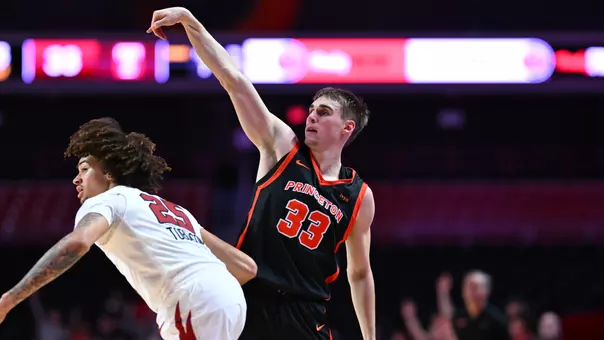
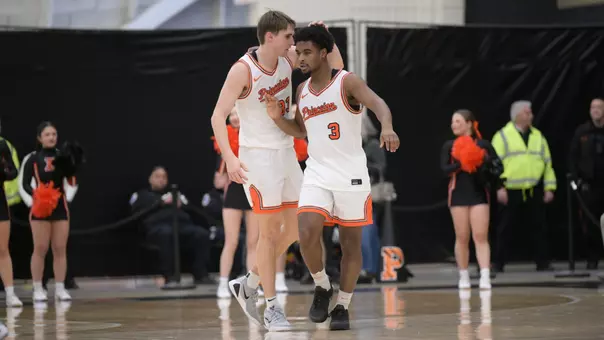
No Tiger team has ever had its names on the back of its warm-ups or uniforms. It's always number only, and some of the numbers themselves have developed their own geneologies, passed from generation to generation to generation of Princeton basketball player.
"We've stayed within certain numbers for the most part," says Hank Towns, Princeton's head equipment manager who has been giving out uniforms for 30 years now. "Certainly when Pete was here, we didn't order uniforms too often. We had the same numbers year after year because they were the same uniforms year after year."
There's been very little rhyme or reason to the distribution of uniform numbers at Princeton. Most of the time it's a matter of finding a shirt that fits. Some players are interested in a specific number and change once the upperclassmen in front of them graduates.
"Some guys try to take numbers that just don't fit them," Towns says. "Then I tell them no. You can't be a big guy and be No. 3."
Princeton, like almost all Division I colleges, uses a computerized program for in-game stats called the Automated Scorebook for Basketball, or StatCrew. This program doesn't even bother with names. Once the roster is entered, everything is done by numbers and play codes.
Pretend for a minute that it's the Princeton-Kansas game. Suppose Mike Bechtold's jump shot is blocked by Nick Collison, but Bechtold gets the rebound and passes to Kyle Wente for a layup. The program reads that: "J23, K04, R23, L03, A23."
Luckily for Princeton stat keepers in the early days, there were no computers. Princeton basketball dates to 1901, but uniform numbers didn't appear until the 1933-34 season. There were seven players on the team that season, and they wore numbers 1, 3, 4, 6, 9, 16 and 17.
Princeton's first 1,000-point scorer was Bud Haabestad, who scored 1,292 points from 1952-55. He wore No. 11.
Haabestad was the first of 24 1,000-point scorers in Princeton history, and they have worn 18 different uniform numbers.
One number, No. 10, has had three 1,000-point scorers-Brian Earl '99, Art Hyland '63, Jim Brangan '60-while four others had two each. Craig Robinson '83 and Geoff Petrie '70, who rank No. 4 and No. 7 all-time in scoring at Princeton, make No. 45 the only number with two in the Top 10. Had Mason Rocca not been injured his whole career, he would have had a good shot at being another No. 45 who cracked the 1,000-point plateau.
The other two-time 1,000-point scoring numbers? Give up?
Barnes Hauptfuhrer '76 and Bob Roma '79 both wore No. 40, Armond Hill '85 and John Hummer '70 both wore No. 24, Ted Manakas '73 and Carl Belz '59 both wore No. 22. Princeton has had nine different players win the Ivy League Player of the Year award, and they wore nine different uniform numbers. Let the record show: Armond Hill (24), Frank Sowinski (25), Craig Robinson (45), Bob Scrabis (34), Kit Mueller (00), Sean Jackson (11), Sydney Johnson (5), Steve Goodrich (30), Brian Earl (10).
Princeton has also had five Ivy Rookies of the Year, none of whom won Player of the Year, by the way and no two of whom wore the same number: Taylor (14), Roma (40), Rick Hielscher (33), Chris Young (55) and Konrad Wysocki (34).
Thirty-three different Princeton players wearing 20 different numbers have been named first-team All-Ivy League. Three of those numbers have had three different players be first-team All-Ivy: Nos. 10 (Earl, Hyland, Brangan), 21 (Chris Mooney, Kevin Mullin, Randy Melville) and 22 (Belz, Manakas, Bill Ryan).
Certain numbers are associated completely with one player. This is truest in the case of Bill Bradley, whose number hasn't been worn by any other Tiger since he finished his career with 58 points against Wichita State in the NCAA Final Four consolation game in 1965. Bradley wore 24 as a professional with the Knicks, but he wore 42 as a Tiger.
Steve Goodrich is the dominant 30 in Princeton history, Frank Sowinski, with apologies to Chris Doyal, is the main No. 25. The same is true of No. 5 and Sydney Johnson, with apologies to Isaac Carter.
Perhaps the second most identifiable number in Princeton history is 00, worn by three-time first-team All-Ivy League selection and two-time Ivy League Player of the Year Kit Mueller '91. Mueller led Princeton to three Ivy League titles and finished his career second in scoring and assists all time at Princeton. He was a near-unanimous choice of a panel of sportswriters as Princeton's Player of the Decade for the 1990s. Yet what most people don't realize about Mueller is that he wore No. 55 as a freshman. In fact, many of Mueller's 1,546 career points were scored off a low-post play called "Fifty-five" - originally named for No. 55 Howard Levy - long after he had taken 00 as his number.
There are other numbers whose tradition is overwhelming. Take No. 22. Belz wore it in the 50s as a 1,000-point man and as the No. 3 rebounder in school history. Ted Manakas wore it in the early '70s as part of Carril's early years. In the early '80s it was worn by Bill Ryan, Princeton's career leader in assists. Thompson took it from Ryan and become No. 3 in assists and later obviously the head coach. George Leftwich, the point guard on the great Princeton teams of the early '90s, took it from Thompson and gave it to his brother Brian in his two years up from the jayvee. From there, it went to C.J. Chapman, one of the top three-point shooters in Princeton history and now finds itself with freshman Will Venable. Other numbers have similar runs, though not quite as defined as No. 22. No. 23, for instance, traces its lineage from Chris Thomforde to Billy Omeltchenko to Mike Brennan to Mike Bechtold. No. 21 in the last 20 years has gone from Randy Melville to Kevin (Moon) Mullin to Dave Orlandini to Chris Mooney to Mitch Henderson.
If you're looking for the person on the current team most likely to become a coach, you might try either Tom McLaughlin, Venable or Bechtold. Numbers in the low 20s seem to lend themselves to coaching: Gary Walters (20), Northwestern's Mitch Henderson (21), Thompson (22), Air Force's Chris Mooney (21), Brennan (23) and Columbia's Hill (24). "I personally notice the line of numbers," Towns says. "I see certain guys wearing numbers and it brings back memories of guys from the past. I see 22 and think of all those guys. Twenty-three. I think 24 is one of my favorite numbers. That was Armond's number. I liked No. 14. It's a way of seeing the history of the program all at once." That it is. Princeton's always been known for its team game, its system, its emphasis away from the individual.
On a certain level, that's shown best by tracing the history of the numbers. Hey, Twenty-two. Hey, Fourteen. Now that's a sign of respect.