

.png&width=24&type=webp)


Princeton University Athletics

Men's Basketball's Scott Greenman's Notes from Israel
July 16, 2009 | Men's Basketball
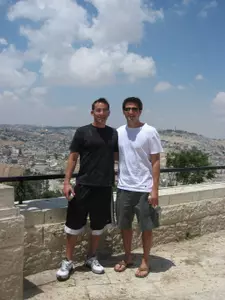
PRINCETON -- Men's basketball assistant coach Scott Greenman is coaching the U.S. youth basketball entry in the Maccabiah Games in Israel in July. His team has won its first four games over Germany, Canada, Israel and Australia by an average of 48 points and has two games left in the round-robin. The U.S., the only undefeated team in the seven-team standings, will play Argentina (2-2) Sunday and Azerbaijan (1-2) Monday. Tuesday will feature the final placement games, including the gold-medal game.
Here are Greenman's thoughts on his experiences in Israel so far:
The Maccabiah Games are known as “The Jewish Olympics”
and occur every four years in Israel. It is the third-largest
gathering of international athletes in the world (only surpassed in
numbers by the Olympics and World Games) and the largest gathering of
Jews each year in the world. I participated in the 2005 Maccabiah Games
as a player and now have the privilege of coaching the 17-18 year old
youth men's division. I couldn't be more excited for the opportunity.
Our team, selected during three separate regional tryouts last summer,
in Princeton, Chicago, and Los Angeles, has been in Israel since June
29. From June 29 – July 3, we conducted a training camp to prepare for
the upcoming games. From July 4 – July 9, we practiced early in the
mornings and then took a number of day trips to different regions of
the country, including Jerusalem, Masada, The Dead Sea, Golan Heights,
Tel Aviv, and a Druze village. Competition will begin on July 11 and
most gold medal games are played on July 22.
During the traveling portion of our trip (July 4-9), our activities and
tour guides were phenomenal. We did everything from cave diving
(“spelunking” – it was very interesting watching 6'7” basketball
players try to fit through spaces I barely made it through) to water
rides and walking through underground water tunnels for a half-mile. The
Holocaust Museum was especially moving, as one cannot help to be
touched by the graphic photos and innumerable stories of suffering. For many athletes and coaches with grandparents in the Holocaust,
it resonates especially deeply.
While many day trips were focused on a historical significance, we
did get to enjoy some of the more relaxing elements of Israel. Perhaps
the most unique physically (and spiritually) cleansing aspect of our
travel was the day we visited the Dead Sea. It is the lowest point on
earth (over 1300 feet below sea level--Death Valley, the lowest point
in the Western Hemisphere, is 282 feet below sea level) and the water
consists of 27.5% minerals and salt. Because of this, people simply
float on top of the water rather than sinking to the sea's bottom. The
salt and minerals from the Dead Sea are believed to heal many skin
problems and are also known for relieving stress and cleansing the
body.
If there is one thing that is true about Israel, it is that many
aspects of modern-day Israel go unnoticed by Americans. What we see on
the news is very misleading, and as Americans, we tend to associate
Israel with daily strife and war. For 99.9% of Israeli citizens, this
couldn't be further from the truth. In actuality, their daily routines
are essentially the same as ours (the major difference exists in the
fact that most Israelis believe they are driving bumper cars and not
actual automobiles!). In particular, the Tel-Aviv region has an
incredibly vibrant lifestyle. Beautiful beaches, great restaurants, and
incredible shopping are the norm and the population's willingness to
enjoy such luxuries enables foreign travelers to feel welcome. As
someone familiar with Israel [Greenman played one season for B'nei
Ha'sharon in Israel's top division basketball league], I felt that I
would be doing my Maccabiah team a disservice by not showing them
around Tel Aviv. As much as the historical significance of Israel has
been stressed by the delegation, the players have been learning about
the day-to-day aspects of Israeli life and present day culture.
The basketball experience thus far has certainly rivaled the cultural
and social facets of this trip. The guys on the team have been working
very hard in practice and have shown a willingness to implement our
team strategy. With only ten days of practice, our coaching staff
(consisting of myself and Jordan Marks - Director of Basketball
Operations at Robert Morris University) has tried to find the happy
medium between teaching certain aspects of what we are trying to do
while making sure we don't get caught up in too many details. During a
collegiate basketball season, plays, concepts, and details can be
meticulously explained and illustrated throughout the year; the format
of the Maccabiah Games and our limited practice time makes detailed
instruction much more difficult. In those 10 days, our team needs to
feel comfortable and understand our man-to-man offenses, man-to-man
defensive principles, zone offenses, zone defenses, presses, press
breaks, out of bounds plays, sideline out plays, etc. Additionally, the
FIBA rules impact the way the game is actually played. With the
24-second shot clock, the pace of play is quickened considerably. Most
players on our team do not have a shot clock in high school (and for
those that do, it is 35 seconds). It will be very interesting to see
how we react to a new type of game, in a new environment, with players
who have only been playing together for a week and a half. Our team
is very excited to start the games and I believe we have prepared
ourselves to be successful. We are especially anxious because we have
no idea what to expect, as nobody has seen any other teams play.